
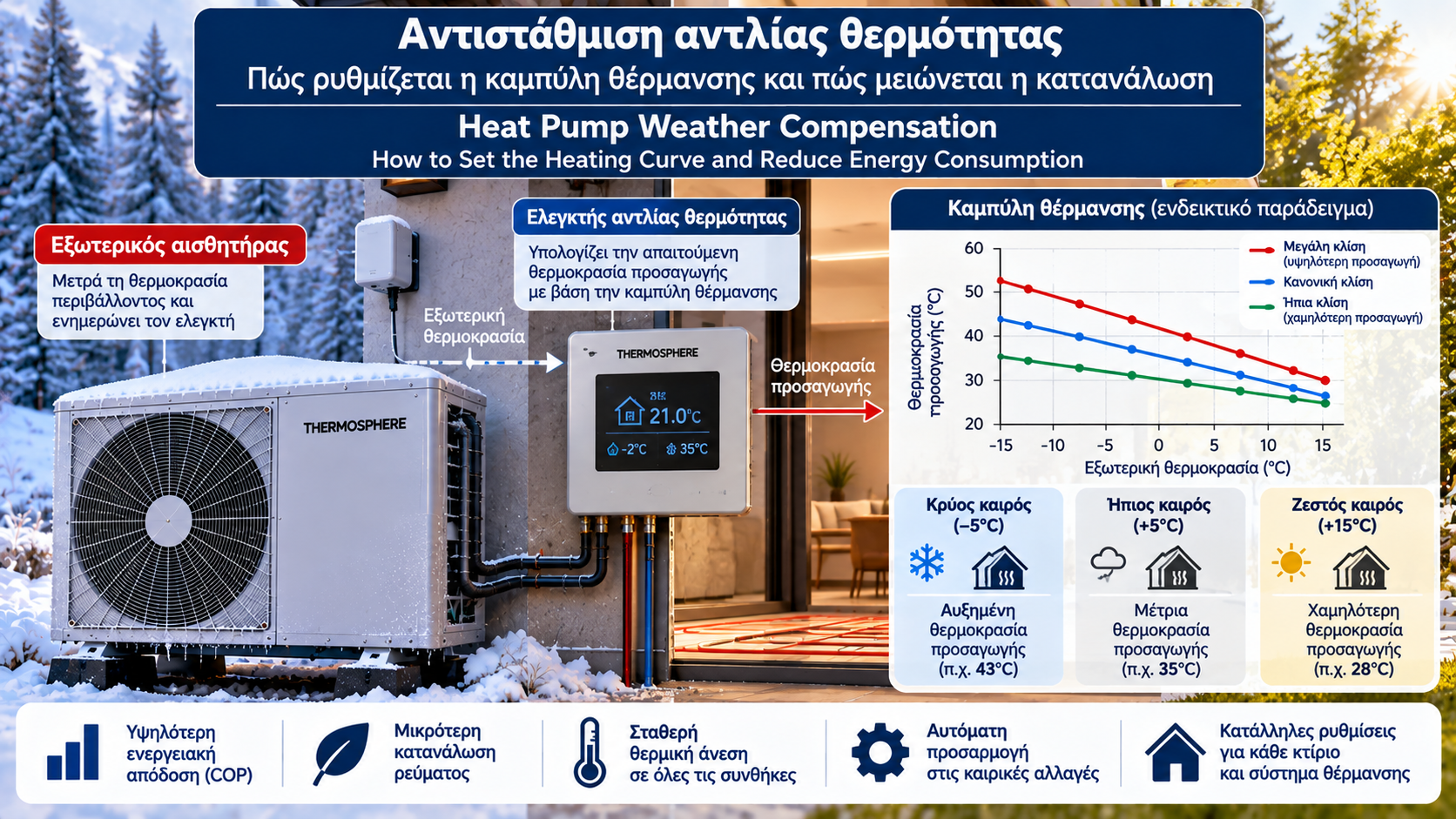
Heat Pump Weather Compensation: How to Set the Heating Curve and Reduce Energy Consumption
Correct heat pump settings can significantly influence energy efficiency, electricity consumption and indoor comfort.
One of the most important control functions is weather compensation, also known as outdoor temperature compensation.
This function allows the heat pump to automatically adjust heating-water temperature according to outdoor weather conditions.
Instead of operating continuously at one fixed, high flow temperature, the system aims to produce water that is only as hot as necessary to meet the building’s heating demand.
Weather compensation is not simply a comfort feature. When correctly configured, it can improve the coefficient of performance (COP) and reduce unnecessary energy consumption.
This guide explains how weather compensation works, which sensors it uses, how heating curves are adjusted and which common mistakes should be avoided.
1. What Is Weather Compensation?
Weather compensation is a control strategy that calculates the required heating-water flow temperature based on outdoor temperature.
The principle is straightforward:
As outdoor temperatures decrease, buildings generally require more heating.
When outdoor temperatures rise, heat losses decrease.
The heat pump can therefore operate with lower water temperatures during mild weather and higher temperatures when more heating is required.
For example, one installation may require 32°C flow water when outdoor temperature is 12°C and 43°C water when it falls to −5°C.
These figures are illustrative and are not universal recommended settings.
2. Why Is Weather Compensation Important for Heat Pumps?
Heat pump efficiency depends strongly on the temperature difference between the heat source and the required heating-water temperature.
Higher water temperatures generally require a greater temperature lift in the refrigeration cycle.
This can increase compressor electricity consumption.
For example, under comparable conditions, operating with 35°C flow water is generally more efficient than operating with 55°C water.
Weather compensation helps prevent unnecessarily high flow temperatures.
The objective is not to use the coldest possible water, but the lowest flow temperature that can reliably maintain indoor comfort.
3. How Does the Control System Work?
A typical weather compensation system operates as follows:
The outdoor sensor measures ambient temperature.
The controller receives the measurement.
The heating curve determines the target flow temperature.
The heat pump adjusts operation within its permitted limits.
The flow temperature sensor measures the actual water temperature.
The controller continuously adjusts operation as conditions change.
More advanced systems may also use indoor temperature, schedules or heating demand from different zones.
4. What Is a Heating Curve?
A heating curve describes the relationship between outdoor temperature and target heating-water flow temperature.
Typically, the required flow temperature increases as outdoor temperature decreases.
Consider a hypothetical installation:
Outdoor temperature | Target flow temperature |
+15°C | 28°C |
+10°C | 31°C |
+5°C | 35°C |
0°C | 39°C |
−5°C | 43°C |
−10°C | 47°C |
This table shows an illustrative heating curve.
The correct curve depends on heat losses, radiators, insulation and the building’s thermal response.
Settings should not simply be copied from another installation.
5. What Is Heating Curve Slope?
The slope determines how quickly target flow temperature increases as outdoor temperature decreases.
A steeper slope generally produces a larger increase in flow temperature during cold weather.
A flatter slope produces a more gradual change.
For example:
A well-insulated building with underfloor heating may require a relatively gentle curve.
A building with greater heat losses and radiators requiring hotter water may need a steeper curve.
The correct slope depends on the building and the heat emitters.
6. What Is Heating Curve Offset?
Many controllers allow the heating curve to be shifted upward or downward.
An upward offset increases target flow temperature across much of the outdoor temperature range.
A downward offset reduces it.
For example, if rooms are consistently slightly too cold during both mild and cold weather, an upward offset may be appropriate.
If rooms consistently overheat, a downward offset may be considered.
Offset and slope are different settings and should not be confused.
7. Should You Adjust the Slope or the Offset?
A practical approach is to observe indoor temperatures under different outdoor conditions.
Observed behaviour | Possible adjustment to investigate |
Rooms are too cold in both mild and cold weather | Increase curve offset |
Rooms are consistently too warm | Decrease curve offset |
Rooms are comfortable in mild weather but cold during freezing weather | Increase curve slope |
Rooms are comfortable in mild weather but too warm during freezing weather | Decrease curve slope |
This is an initial diagnostic guide rather than a guaranteed solution.
Poor hydraulic balancing, insufficient heating capacity, restricted water flow or faulty sensors can produce similar symptoms.
8. Weather Compensation for Underfloor Heating and Radiators
Underfloor heating has a large heat transfer surface and usually operates at relatively low water temperatures.
This often allows a flatter heating curve.
Radiators have different characteristics.
Properly sized radiators can also operate efficiently with lower water temperatures.
Older installations may require higher flow temperatures during freezing weather.
The heating curve should therefore be based on actual emitter output and building heat demand, not merely the type of heating system.
9. Where Should the Outdoor Temperature Sensor Be Located?
Outdoor sensor placement is important.
Direct sunlight may cause the sensor to report temperatures higher than the representative outdoor temperature.
The controller may then request water temperatures that are too low.
Positioning near ventilation outlets, warm surfaces or other heat sources can also distort measurements.
The sensor should be installed according to manufacturer instructions in a location representative of actual outdoor conditions.
Some heat pumps use sensors integrated into the outdoor unit.
10. What Is the Role of an Indoor Temperature Sensor?
Some systems calculate flow temperature using outdoor temperature alone.
Others combine weather compensation with indoor temperature feedback.
Indoor sensors can help account for:
Solar heat gains.
Heat produced by occupants and appliances.
Differences between expected and actual room temperature.
Changes in building use.
The influence of indoor feedback depends on the heat pump’s control strategy.
Excessively aggressive room temperature correction can cause frequent operating changes in some systems.
11. Weather Compensation vs ON/OFF Thermostats
A simple ON/OFF thermostat generally starts or stops a heating demand based on room temperature.
Weather compensation operates differently.
It adjusts the required heating-water temperature according to outdoor conditions.
The two functions can work together.
However, a thermostat that repeatedly interrupts heating demand may limit the benefits of smooth inverter operation.
The appropriate control strategy depends on the controller, hydraulic system and building behaviour.
12. How Does Weather Compensation Work With an Inverter Compressor?
An inverter compressor can adjust its operating speed within defined limits.
Weather compensation sets an appropriate target water temperature for current outdoor conditions.
Together, these functions may provide:
Smoother operation.
Better matching of heating output to demand.
Fewer unnecessary high-temperature operating periods.
Reduced cycling where system conditions permit.
Actual performance depends on minimum heat pump output, water volume, circulation flow and control strategy.
13. How Does Weather Compensation Affect COP?
COP is the ratio of useful heating output to electrical input.
COP = Heating output / Electrical input
Assume a heat pump delivers 8 kWh of useful heat.
At COP 3:
8 / 3 = 2.67 kWh of electricity.
At COP 4:
8 / 4 = 2 kWh of electricity.
The difference is approximately 0.67 kWh for the same heating output.
Weather compensation can improve COP when it allows the heat pump to operate with lower flow temperatures.
However, no fixed percentage of energy savings can be guaranteed for every installation.
14. Can Incorrect Weather Compensation Increase Electricity Consumption?
Yes.
If the heating curve is too high, the heat pump may produce water hotter than necessary.
This can reduce COP and increase electricity consumption.
If the curve is too low, rooms may not reach the desired temperature.
Repeated thermostat changes or other manual interventions may then create unstable operation.
Correct adjustment balances efficiency and comfort.
15. How to Adjust a Heating Curve Gradually
Start with an appropriate initial curve selected by the installer.
Then:
Maintain a consistent indoor temperature target.
Observe the building over a suitable period.
Record outdoor and indoor temperatures.
Identify whether problems occur only in cold weather or across all conditions.
Make small changes using manufacturer-approved settings.
Allow the system time to respond.
Compare results before making further changes.
Underfloor heating systems may take many hours or longer to show the full effect of adjustments.
Safety parameters and temperature limits must not be modified arbitrarily.
16. Why Avoid Constant Thermostat Changes?
Large, frequent changes to the desired room temperature can make stable operation more difficult.
Buildings with high thermal inertia may respond slowly to sudden thermostat increases.
Depending on the control strategy, the system may temporarily increase flow temperature or activate supplementary heating.
This does not mean that every nighttime temperature setback is inefficient.
The best approach depends on the building, occupancy schedule, weather and heating controls.
17. What Is Adaptive or Smart Weather Compensation?
Advanced controllers may use more information than a basic outdoor temperature measurement.
Depending on the system, inputs may include:
Indoor temperature.
Historical building response.
Occupancy schedules.
Time programs.
Weather forecasts.
Energy management information.
Not all smart controllers use artificial intelligence.
Many rely on conventional automation and adaptive control algorithms.
Actual functionality should be verified in the manufacturer’s technical documentation.
18. What Happens When a Building Has Two Heating Zones?
A home may use different heat emitters in separate areas.
For example:
Underfloor heating downstairs.
Radiators upstairs.
These zones may require different flow temperatures.
Such installations may need appropriate hydraulic separation, mixing valves and independent control strategies.
A heat pump cannot necessarily supply two independent water temperatures directly without additional equipment.
The design must also maintain adequate water flow and correct circulation pump operation.
19. How Does Weather Compensation Interact With Defrost?
During heating operation, frost may accumulate on the outdoor heat exchanger.
Weather compensation determines the target heating-water temperature based on building demand.
Defrost is a separate function controlled by parameters related to the refrigeration circuit and outdoor heat exchanger.
Both functions operate through the overall control system, but they serve different purposes.
An incorrect heating curve should not automatically be assumed to cause frequent defrost cycles.
20. How Can You Tell Whether Weather Compensation Is Working Correctly?
A well-adjusted system will often show:
Stable indoor temperatures.
Flow temperature responding to outdoor conditions.
No unnecessarily high water temperatures.
Smooth compressor operation where possible.
Limited need for manual intervention.
Electricity consumption consistent with heating demand and weather.
Performance should be assessed over time.
One day of increased electricity consumption does not prove incorrect settings.
21. Common Weather Compensation Mistakes
Heating Curve Too High
The heat pump produces hotter water than necessary.
Heating Curve Too Low
The system cannot meet the building’s heating demand.
Incorrect Outdoor Sensor Placement
Temperature readings do not represent actual outdoor conditions.
Constant Setting Changes
Insufficient time is allowed to evaluate results.
Poor Thermostat Coordination
The thermostat frequently interrupts heating demand.
Ignoring Hydraulic Problems
Low flow or poor balancing is incorrectly blamed on the heating curve.
Copying Settings From Another Building
Different buildings have different heating requirements.
22. Practical Monitoring Checklist
Homeowners can monitor basic information without changing advanced settings.
Useful measurements include:
Outdoor temperature.
Indoor temperature.
Desired room temperature.
Target flow temperature.
Actual flow temperature.
Electricity consumption.
Compressor start frequency, if available.
Electric backup heater operation, if recorded.
These observations can help technicians evaluate system performance.
23. Frequently Asked Questions
What Is Weather Compensation in a Heat Pump?
It is the automatic adjustment of heating-water temperature based on outdoor temperature.
Does Weather Compensation Reduce Electricity Consumption?
It can reduce consumption by avoiding unnecessarily high flow temperatures. Actual savings depend on the installation.
What Is the Best Heating Curve?
There is no universal heating curve. The correct setting depends on building heat losses and heat emitter performance.
Is an Outdoor Sensor Required?
Reliable outdoor temperature information is needed. Depending on the model, it may come from an integrated or separate sensor.
Can I Adjust the Heating Curve Myself?
Some basic adjustments may be user-accessible. Advanced parameters and safety limits should be handled by a qualified technician.
Is Weather Compensation Better Than a Simple Thermostat?
They serve different purposes and can work together. Weather compensation adjusts water temperature, while a thermostat controls heating demand.
Should the Heat Pump Run Continuously?
Not necessarily. Extended smooth operation can be normal for inverter systems, but behaviour depends on heating demand and system design.
What If My Home Does Not Get Warm Enough During Freezing Weather?
The heating curve, available heat pump capacity, water flow and heat emitters should be checked. Operating limits should not be increased arbitrarily.
Conclusion
Weather compensation is one of the most important control functions in a modern heat pump.
A correctly configured heating curve allows the system to adjust heating-water temperature to the building’s actual needs.
This can reduce unnecessary high-temperature operation and improve energy efficiency.
Successful adjustment depends on building heat losses, heat emitters, sensors and correct hydraulic design.
Effective weather compensation does not simply mean lower water temperatures. It means delivering the appropriate water temperature at the right time for the building’s actual heating needs.
Thermosphere.gr — Technical knowledge for heating and building systems.