
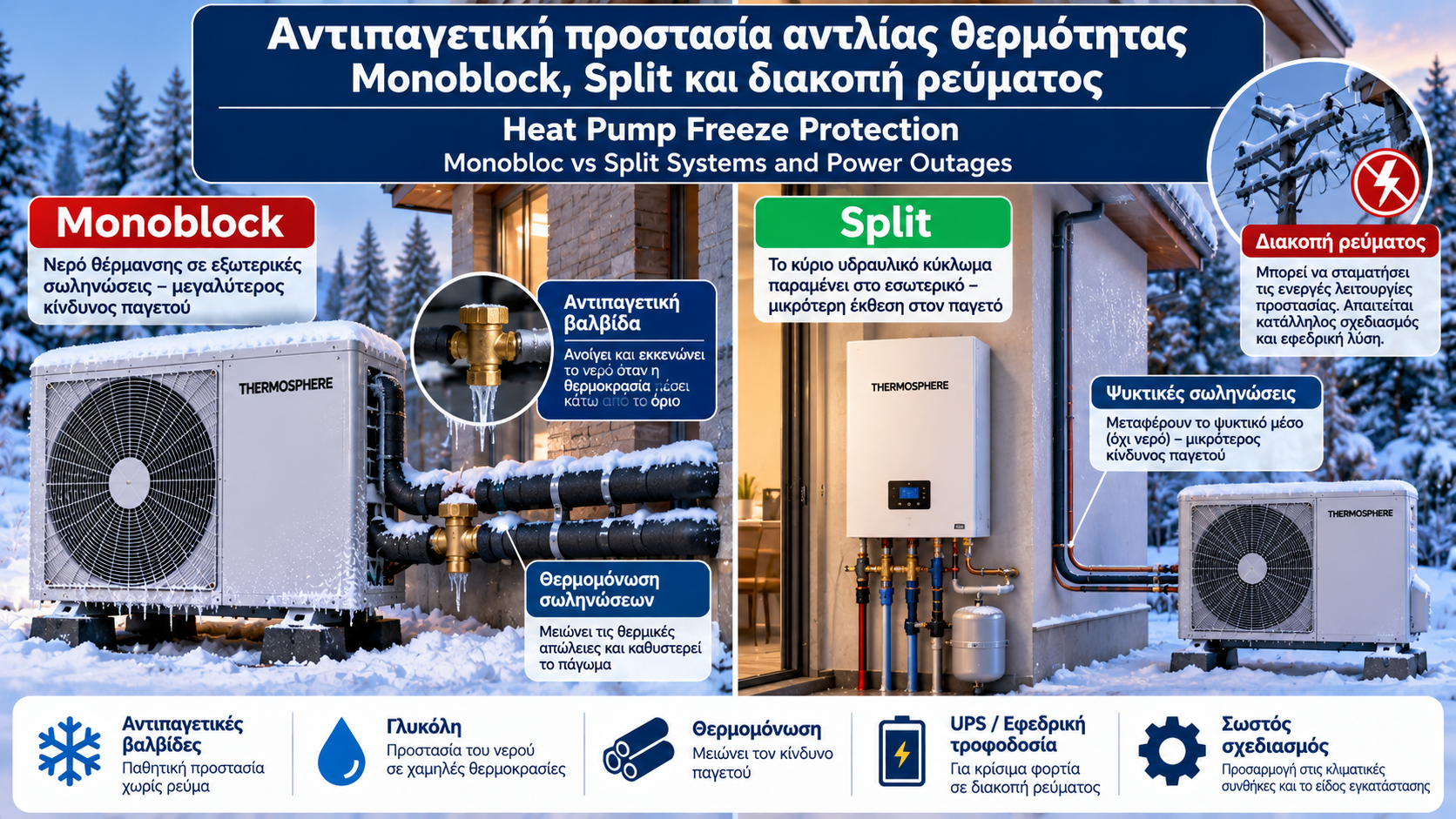
Heat Pump Freeze Protection: Monobloc vs Split Systems and Power Outages
Freeze protection is one of the most important considerations when designing and operating a heat pump installation, particularly in regions where outdoor temperatures regularly fall below freezing.
A heating system may operate normally during cold weather but become vulnerable if electricity is interrupted or water circulation stops.
Under these conditions, water inside exposed pipes and components can freeze, expand and cause serious mechanical damage.
The risk is especially relevant to monobloc air-to-water heat pumps, where part of the water circuit is located outdoors.
This guide examines the differences between monobloc and split systems, frost protection valves, glycol solutions, pipe insulation and the precautions needed during winter power outages.
1. Why Is Freeze Protection Necessary?
Water expands when it freezes.
If this occurs inside a closed pipe or hydraulic component, significant mechanical stress can develop.
Possible consequences include:
Burst pipes.
Damaged plate heat exchangers.
Failure of hydraulic components.
Water leaks.
Damage to circulation pumps or valves.
Heating system shutdown.
Expensive repairs.
Freeze protection is not simply about maintaining indoor comfort. Its primary purpose is to prevent damage to the installation.
2. What Is the Difference Between Monobloc and Split Heat Pumps?
Air-to-water heat pumps are available in different configurations.
Monobloc Heat Pumps
In a typical monobloc system, the refrigerant circuit is contained within the outdoor unit.
Heating water circulates between the outdoor unit and the building.
This means some hydraulic components are exposed to outdoor temperatures.
If circulation stops and water remains exposed to freezing conditions, ice formation may occur.
Split Heat Pumps
In a typical split system, the outdoor and indoor units are connected by refrigerant pipes.
The heat exchanger that heats the water is usually located indoors.
Therefore, the main water circuit can remain within the protected building envelope.
However, not every split installation is automatically protected against freezing.
Actual protection depends on the equipment configuration and location of hydraulic components.
3. Why Do Monobloc Systems Require Special Attention?
In monobloc systems, water may circulate through an outdoor heat exchanger, connecting pipes and other hydraulic components.
While electricity is available, built-in controls may activate freeze protection functions, depending on the model.
These may include starting the circulation pump or an appropriate heating source.
During a power outage, these active protection functions may stop.
Water can then remain stationary inside outdoor components.
Pipe insulation slows heat loss, but it does not guarantee protection during prolonged freezing conditions.
4. How Does Built-In Freeze Protection Work?
Many heat pumps include software-controlled frost protection.
Depending on the model, the controller may monitor:
Outdoor temperature.
Water temperature.
Heat exchanger temperature.
Circulation pump status.
Other safety parameters.
When certain conditions are met, the controller may activate water circulation or heating.
Activation temperatures and control sequences vary by manufacturer.
Built-in active protection should not automatically be considered sufficient during every power outage scenario.
5. What Happens During a Winter Power Outage?
A power outage may stop:
The compressor.
The circulation pump.
Electronic controls.
Electric backup heating.
Active freeze protection functions.
If outdoor temperatures remain sufficiently low for long enough, water inside exposed components may freeze.
The time required depends on:
Outdoor temperature.
Wind conditions.
Insulation.
Water volume.
Thermal mass.
Pipe exposure.
There is no universal safe power outage duration for every installation.
6. What Is a Frost Protection Valve?
A frost protection valve is a specialised hydraulic component used in certain installations to reduce freezing risk.
Some designs operate mechanically without electrical power.
When the water temperature at the valve falls toward a predefined threshold, the valve opens and allows water to discharge.
This is intended to remove water from vulnerable outdoor sections before damaging freezing occurs.
The exact activation temperature depends on the product.
Valve operation must be considered as part of the overall hydraulic design.
7. Where Are Frost Protection Valves Installed?
Installation positions must follow the valve manufacturer’s instructions and the heat pump manufacturer’s requirements.
Some systems may require valves on both flow and return lines.
Important considerations include:
Suitable outdoor positioning.
Effective drainage of vulnerable sections.
Avoidance of trapped water.
Appropriate pipe gradients where required.
Safe disposal of discharged water.
Prevention of unintended discharge.
Incorrect positioning can leave water trapped in components that remain vulnerable to freezing.
Installation should be carried out by a suitably qualified professional.
8. Advantages and Limitations of Frost Protection Valves
Advantages
Certain designs work without electricity.
They can provide passive protection in suitable systems.
They may avoid the need for antifreeze fluid.
They can be incorporated into monobloc protection strategies.
Limitations
Correct installation position is essential.
Complete drainage of every component is not guaranteed.
Water discharge can reduce system pressure.
Refilling and venting may be necessary.
Not every valve is suitable for every hydraulic system.
Compatibility must be confirmed before installation.
9. What Is Glycol and How Does It Prevent Freezing?
Glycol is used in some hydraulic systems as a component of antifreeze solutions.
When mixed with water at a suitable concentration, it changes the freezing characteristics of the fluid.
Heating installations often use specially formulated propylene glycol products containing appropriate corrosion inhibitors.
The selected product must comply with the heat pump manufacturer’s specifications.
Automotive or other unsuitable antifreeze products must not be used without explicit confirmation of compatibility.
10. What Glycol Concentration Is Required?
The appropriate concentration depends on:
Minimum design temperature.
Required protection level.
Type of glycol.
Product formulation.
Heat pump manufacturer requirements.
Two different concepts must be distinguished.
Freeze protection: The temperature at which ice crystals begin to form.
Burst protection: The temperature down to which a suitable solution can protect components from destructive expansion, according to the product’s specifications.
These are not the same.
Concentration must be determined using the specific product’s technical data and the system design.
11. How Does Glycol Affect Heat Pump Performance?
Glycol solutions have advantages but also affect hydraulic and thermal performance.
Compared with pure water, they may have:
Higher viscosity.
Different specific heat capacity.
Greater hydraulic resistance.
Different heat transfer characteristics.
Depending on concentration and temperature, circulation pump requirements may increase.
Glycol must therefore be considered in hydraulic calculations.
Using a higher concentration than necessary does not automatically improve overall system performance.
12. Can Glycol and Frost Protection Valves Be Combined?
The combination is not automatically suitable.
Some thermostatic frost protection valves are designed specifically for water-only systems and are not compatible with glycol solutions.
Using an incompatible valve may lead to incorrect operation or unwanted fluid discharge.
Compatibility must be verified against the technical documentation for all components.
The final protection strategy should form part of the system design.
13. How Important Is Pipe Insulation?
Proper insulation reduces heat loss from water pipes.
Outdoor insulation materials should be suitable for:
External installation.
Moisture exposure.
Ultraviolet radiation.
Mechanical stress.
Expected temperature ranges.
Special attention should be given to fittings, valves and other locations where thermal bridges may occur.
Insulation slows cooling but cannot prevent stationary water from freezing indefinitely.
14. Are Electric Heat Tracing Cables Necessary?
Some installations use electric heating cables to protect pipes or drainage components.
Their use must be compatible with the equipment and materials.
Important requirements include:
Appropriate electrical protection.
Temperature control.
Correct installation.
Moisture protection.
Maintenance accessibility.
Heat tracing requires electricity.
It cannot provide active protection during a power outage unless a suitable backup supply is available.
15. Can a UPS Protect a Heat Pump?
A UPS may provide temporary electricity to selected loads in some applications.
However, a standard computer UPS should not be assumed capable of powering an entire heat pump.
Power requirements depend on:
Circulation pumps.
Controls.
Compressor.
Electric resistance heaters.
Required backup duration.
Backup power systems must be designed by a qualified electrical professional and comply with equipment requirements.
Even if the circulation pump remains operational, circulating water alone does not guarantee unlimited freeze protection without an available heat source.
16. What About Holiday Homes Left Empty in Winter?
Homes that remain unoccupied for extended periods may face increased freezing risk.
Without heating, indoor temperatures may gradually fall.
Possible precautions include:
Maintaining suitable frost protection operation.
Ensuring reliable electrical supply.
Protecting outdoor pipes.
Assessing the need for an appropriate antifreeze solution.
Considering controlled drainage.
Using remote fault monitoring.
Switching off the main electrical supply may disable active protection functions.
The installer should provide a suitable procedure before extended winter absences.
17. How Does Installation Location Affect Freezing Risk?
Wind exposure, pipe positioning and distance from the building can affect heat losses.
Important factors include:
Length of outdoor pipework.
Insulation quality.
Exposed hydraulic components.
Valve positioning.
Drainage arrangements.
Mechanical protection.
The outdoor unit must maintain the clearances required for airflow and maintenance.
Improvised enclosed covers that restrict airflow must be avoided.
18. What Should You Do After a Prolonged Power Outage?
If freezing inside pipes or components is suspected, the system should not simply be restarted without inspection.
Possible warning signs include:
Visible leaks.
Abnormally low pressure.
Deformed components.
Inability to circulate water.
Fault codes.
A qualified technician should inspect the hydraulic system before normal operation resumes.
Open flames or improvised methods must not be used to thaw frozen components.
19. Comparison of Freeze Protection Methods
Method | Main advantage | Main limitation |
Built-in controls | Automatic operation | Requires electricity |
Frost protection valves | Potential passive protection | Correct hydraulic design required |
Suitable glycol solution | Low-temperature fluid protection | Changes hydraulic and thermal properties |
Pipe insulation | Reduces heat loss | Cannot provide indefinite protection |
Electric heat tracing | Localised protection | Requires electricity |
Backup power | Temporary operation of selected loads | Limited autonomy and design requirements |
No single method is ideal for every installation.
20. Winter Preparation Checklist
Before freezing weather arrives, ask your installer to confirm:
Which freeze protection method is installed.
Whether protection remains effective during a power outage.
Whether outdoor pipes are adequately insulated.
Whether frost protection valves are correctly positioned.
Whether glycol concentration is suitable, if used.
Whether circulation pumps operate correctly.
Whether electrical protection devices are in good condition.
Whether previous low-temperature faults have occurred.
Whether special procedures are required during extended absences.
How to restart the system safely after suspected freezing.
21. Frequently Asked Questions
Can a Monobloc Heat Pump Freeze During a Power Outage?
Yes. Water inside exposed outdoor components may freeze if adequate protection is not provided.
Is a Split Heat Pump Safer in Freezing Conditions?
A typical split system may have less outdoor water exposure because the main hydraulic circuit is located indoors. Actual protection depends on system design.
Does Every Monobloc Need Glycol?
Not necessarily. The correct solution depends on manufacturer instructions and the overall freeze protection design.
Is Pipe Insulation Enough?
Not in every situation. Insulation slows heat loss but does not guarantee protection during prolonged freezing weather.
Do Frost Protection Valves Need Electricity?
Some mechanical designs operate without electrical power. Product specifications must be checked.
Can I Use Automotive Antifreeze?
Not without explicit approval. The fluid must be compatible with the materials and requirements of the heating system.
What Should I Do If I Suspect Frozen Water?
Avoid restarting the system or using improvised heating methods. Arrange a professional inspection.
Conclusion
Freeze protection is an essential part of heat pump system design, not an optional accessory.
Monobloc installations require particular attention because water may be present in outdoor components, especially in regions with frequent freezing weather or unreliable electricity supply.
Frost protection valves, suitable glycol solutions, insulation and active protection functions can reduce risk when correctly selected and installed.
The final solution must follow manufacturer requirements, local climate conditions and a proper technical design.
Effective freeze protection should not rely entirely on the assumption that electricity will always be available.
Thermosphere.gr — Technical knowledge for heating and building systems.