
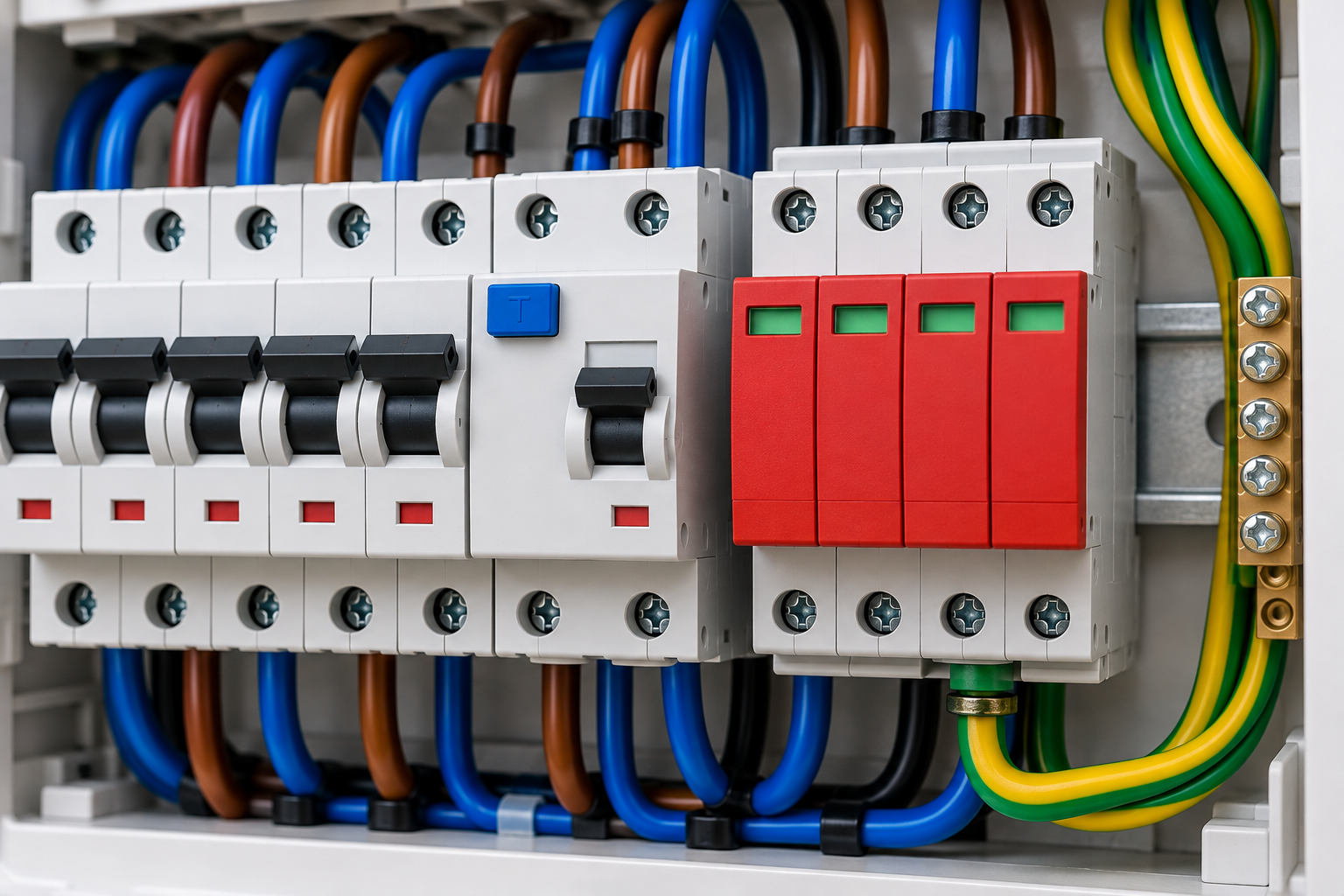
Surge Protection Devices (SPD): What Are They and When Do You Need One?
Electrical installations and electronic equipment can be damaged by transient overvoltages. These sudden voltage surges may result from lightning activity, electrical network switching, or the operation of certain electrical equipment.
One important way to reduce these risks is by installing surge protective devices, commonly known as SPDs.
But what exactly does an SPD do? What is the difference between Type 1, Type 2 and Type 3 surge protection? And when does an electrical installation require this type of protection?
This guide explains the key principles, typical applications, and important selection considerations.
What Is a Surge Protection Device (SPD)?
A surge protective device is designed to limit transient overvoltages and divert associated surge currents through the intended paths of an electrical installation.
Under normal operating conditions, an SPD has little effect on the circuit.
When a transient overvoltage occurs, the device responds by limiting the voltage appearing across its terminals.
This helps reduce the electrical stress imposed on connected equipment.
However, no SPD can guarantee complete protection against every lightning event or electrical disturbance.
Its effectiveness depends on correct selection, installation, earthing arrangements, and coordination with other protective measures.
What Causes Electrical Surges?
Transient overvoltages can arise from several sources.
1. Lightning Activity
Lightning can generate powerful electrical transients.
A direct strike to a structure or nearby electrical infrastructure may introduce significant surge currents into connected systems.
Even when lightning does not strike the building directly, electromagnetic effects and surges travelling through power or communication networks can affect electrical equipment.
2. Electrical Network Switching
Switching operations within the electrical distribution network may produce temporary voltage disturbances.
These can occur when electrical equipment or sections of the network are connected or disconnected.
3. Operation of Electrical Equipment
Certain inductive loads and other electrical equipment can generate switching transients during operation.
The magnitude and effects of these disturbances depend on the electrical system and its characteristics.
Type 1 SPD: Protection Against High-Energy Surge Currents
Type 1 surge protective devices are designed for applications where the installation may need to handle a portion of lightning current.
They are commonly considered in installations with an external lightning protection system or other conditions requiring this level of protection.
Type 1 SPDs are tested using a characteristic 10/350 μs impulse current waveform.
This test represents a demanding surge-current condition associated with lightning protection applications.
However, Type 1 protection is not automatically required in every building.
The appropriate selection depends on the installation design, lightning risk assessment, applicable standards, and the manufacturer’s specifications.
Type 2 SPD: Protection Against Transient Overvoltages
Type 2 SPDs are widely used in electrical distribution boards to limit transient overvoltages.
They are suitable for many installations where the protection requirements do not involve the same lightning-current handling duty as a Type 1 SPD.
Type 2 devices are tested using surge currents with a characteristic 8/20 μs waveform.
They are commonly installed in main distribution boards or sub-distribution boards as part of a coordinated surge protection system.
In residential buildings, Type 2 SPDs can play an important role in protecting electrical and electronic equipment.
Their necessity and installation position must be determined according to the applicable requirements.
Type 3 SPD: Additional Protection Near Sensitive Equipment
Type 3 SPDs provide supplementary surge protection, often close to sensitive electronic equipment.
They may be used to further limit the transient voltage reaching a particular device.
Examples of equipment that may benefit from appropriately coordinated protection include:
Computers and networking equipment.
Electronic control systems.
Smart home devices.
Sensitive measuring instruments.
Other electronic appliances.
Type 3 SPDs are generally intended to operate in coordination with suitable upstream protection.
They should not automatically be considered a replacement for the surge protection required at the main distribution board.
Type 1 vs Type 2 vs Type 3 SPD: Key Differences
SPD Type | Main Function | Typical Application |
Type 1 | Handles high-energy impulse currents, including a portion of lightning current | Installation entry points where lightning-current protection is required |
Type 2 | Limits transient overvoltages | Main distribution boards and sub-distribution boards |
Type 3 | Provides supplementary protection for sensitive equipment | Near final electrical or electronic devices |
Combined devices, such as Type 1+2 SPDs, are also available.
The correct device must be selected based on its electrical characteristics and the requirements of the installation, not simply its type designation.
Does Every Home Need Surge Protection?
Whether surge protection is required depends on the applicable electrical installation standards and national regulations.
In Europe, the IEC 60364 framework and its national implementations provide requirements concerning protection against transient overvoltages.
Important considerations may include:
The building’s function and occupancy.
The consequences of equipment failure or interruption of service.
The characteristics of the electrical supply.
Exposure to lightning activity.
The presence of an external lightning protection system.
The sensitivity and importance of connected equipment.
Not every home requires the same SPD configuration.
A qualified electrician should assess the installation and determine the appropriate protective arrangement.
Is an SPD the Same as a Lightning Rod?
No.
An external lightning protection system is designed to manage direct lightning strikes through components such as air terminals, down conductors, and an earthing system.
An SPD is designed to limit transient overvoltages within electrical circuits.
These systems have different but complementary functions.
An SPD alone does not provide complete protection against all the effects of a direct lightning strike.
A comprehensive protection strategy may require both external lightning protection and coordinated internal surge protection.
SPD vs RCD: What Is the Difference?
Surge protective devices and residual current devices perform different functions.
An SPD limits transient overvoltages.
An RCD detects residual current and disconnects the supply when its operating conditions are met.
An RCD does not replace an SPD, and an SPD does not replace an RCD.
Their correct arrangement depends on the earthing system, the type of protective devices, and the electrical installation design.
Important SPD Specifications
Selecting an SPD involves more than choosing between Type 1, Type 2, and Type 3.
Several technical characteristics must be considered.
Maximum Continuous Operating Voltage (Uc)
Uc indicates the maximum voltage that may be continuously applied to the SPD under specified operating conditions.
The selected value must be compatible with the electrical system.
Voltage Protection Level (Up)
Up is a characteristic associated with the voltage limitation provided by the SPD.
It is an important parameter when assessing the protection requirements of connected equipment.
Nominal Discharge Current (In)
In is a standardised discharge-current characteristic used to evaluate certain SPDs under specified test conditions.
Impulse Current (Iimp)
Iimp is particularly important for Type 1 SPDs.
It characterises their ability to handle specified high-energy impulse currents.
Short-Circuit Current Capability
The SPD and its associated protective arrangements must be compatible with the prospective short-circuit current and the manufacturer’s requirements.
The installation may also require suitable backup overcurrent protection.
All these factors should be assessed by a qualified electrical professional.
How Do You Know If an SPD Needs Replacing?
Many surge protective devices include a visual status indicator.
Depending on the manufacturer and model, this indicator may show whether the device is operational or whether its protective module requires replacement.
Some SPDs also provide remote signalling contacts for maintenance monitoring.
However, the meaning of an indicator colour must be checked against the specific manufacturer’s documentation.
A damaged or end-of-life SPD should be assessed and replaced by a qualified electrician.
Can a Surge-Protected Power Strip Replace an SPD in the Electrical Panel?
Not necessarily.
A properly rated surge-protected power strip may provide supplementary protection for connected devices.
However, it does not automatically replace the surge protection required at the electrical installation’s distribution board.
Effective protection may require coordinated SPD stages at different locations.
The performance of a plug-in device also depends on the wider installation and earthing arrangements.
Surge Protection for Heat Pumps and Electronic Equipment
Modern heat pumps often contain electronic control boards, sensors, communication interfaces, and inverter-driven components.
These systems may be vulnerable to certain transient overvoltages.
Appropriate surge protection can help reduce the risk of damage, but the required arrangement depends on the equipment and installation.
The manufacturer’s instructions and applicable electrical standards should be followed.
Where external communication or control cables are present, additional protection considerations may also apply.
When Should You Contact an Electrician?
Professional assessment is recommended when:
Installing a new SPD.
Upgrading an electrical distribution board.
Adding sensitive or expensive electrical equipment.
A building has an external lightning protection system.
Electrical equipment has suffered repeated surge-related damage.
An existing SPD indicates failure.
The installation has been modified or extended.
SPD installation and replacement involve electrical work that must be carried out by a suitably qualified professional.
Frequently Asked Questions
Does an SPD protect against a direct lightning strike?
An SPD can form part of a coordinated lightning protection system, but it does not guarantee complete protection against a direct lightning strike.
What is the main difference between Type 1 and Type 2 SPD?
Type 1 devices are designed to handle high-energy impulse currents, including a portion of lightning current.
Type 2 devices are primarily used to limit transient overvoltages in electrical distribution systems.
Do I need an SPD if I already have an RCD?
An RCD and an SPD perform different functions. Whether surge protection is required must be assessed independently of the presence of an RCD.
How long does an SPD last?
There is no universal service life for all SPDs.
Their condition depends on the technology, operating environment, surge exposure, and manufacturer specifications.
Can I install an SPD myself?
SPD installation requires appropriate electrical knowledge, equipment selection, and testing.
Work inside electrical distribution boards should be carried out by a qualified electrician.
Can an SPD protect a heat pump?
Appropriately selected and installed surge protection can help reduce the risk of damage to a heat pump’s electrical and electronic components.
However, no SPD guarantees complete protection against all electrical disturbances.
Conclusion
Surge protective devices are an important part of protecting electrical installations against transient overvoltages.
Type 1, Type 2, and Type 3 SPDs serve different purposes and may work together in a coordinated protection strategy.
The appropriate configuration depends on the building, electrical supply, lightning exposure, equipment characteristics, and applicable standards.
Correct selection and professional installation are essential for effective surge protection.
thermosphere.gr — Practical technical knowledge for safer electrical installations.
Disclaimer: This article is intended for general information only. It does not replace professional electrical design, inspection, or installation.
Technical References
IEC 61643-11 — Low-voltage surge protective devices.
IEC 60364-4-44 — Protection against voltage disturbances and electromagnetic disturbances.
IEC 60364-5-53 — Selection and erection of electrical equipment: Devices for protection, isolation, switching, control and monitoring.
IEC 62305 — Protection against lightning.
ELOT 60364 — Requirements for electrical installations in Greece.