
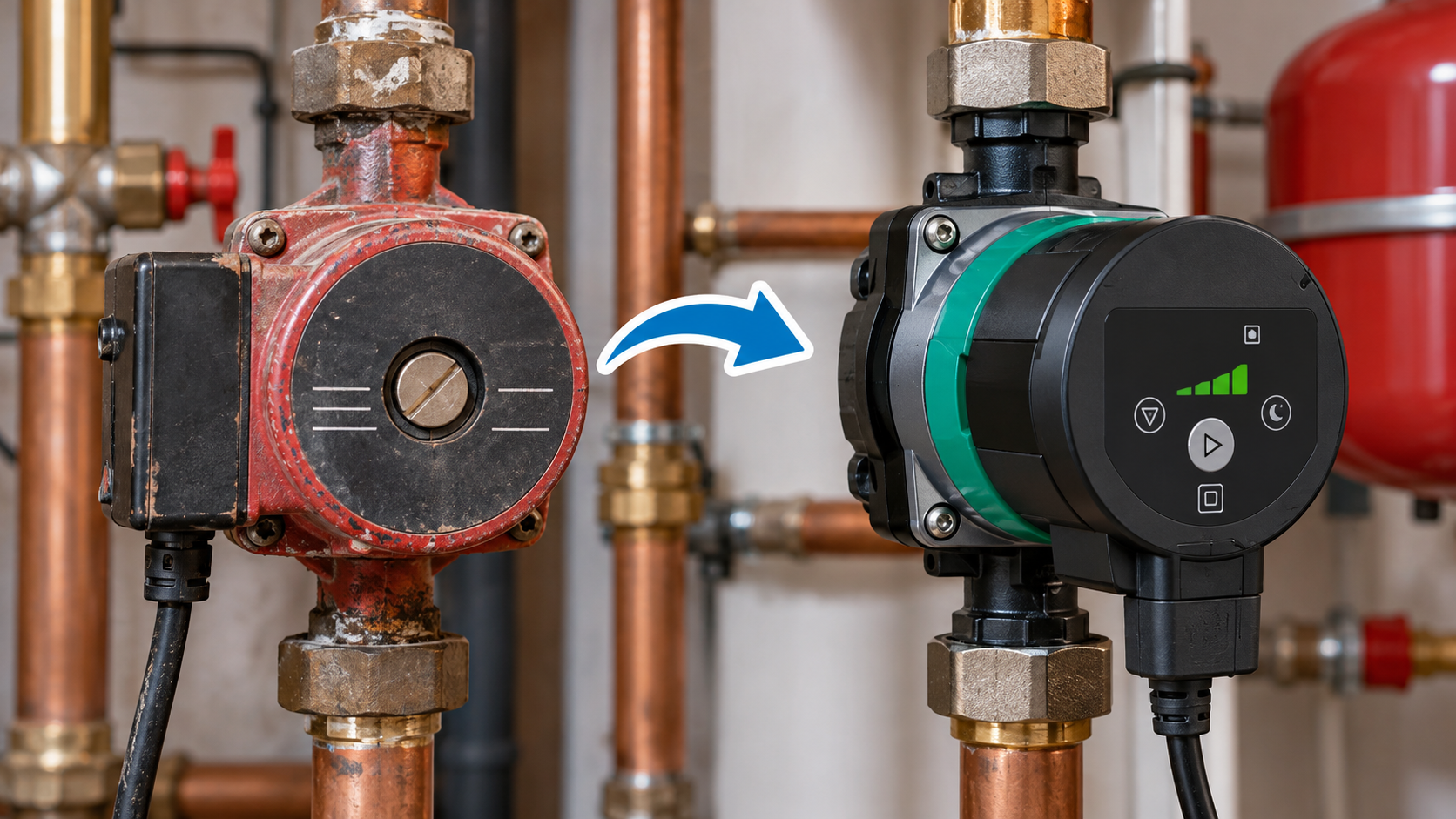
Heating Circulation Pump Replacement: When to Replace It and How to Choose a New One
A heating circulation pump is one of the most important components of a hydronic heating system. It moves water from the heat source through radiators, underfloor heating circuits and other heating equipment.
When the pump develops problems, heating performance may deteriorate, unusual noises may occur or water circulation may stop.
However, not every problem requires replacement. In many cases, the actual cause is related to incorrect settings, trapped air, valves or other system components.
When should a heating circulation pump be replaced, and what should you consider when choosing a new one?
1. When Does a Circulation Pump Need Replacing?
Replacement may be necessary when the pump has developed a fault that cannot be safely repaired or when repair is not economically reasonable.
Examples include:
Severe mechanical wear.
Motor failure.
Non-repairable electronic faults.
Repeated failure to start.
Leakage from a component that cannot be repaired.
Unavailability of replacement parts.
Insufficient performance for system requirements.
The final decision should be based on a technical diagnosis rather than pump age alone.
2. What Are the Signs of a Failing Circulator?
A faulty circulation pump may show several symptoms.
Pump does not start: Possible electrical, electronic or mechanical fault.
Pump hums but water does not circulate: Possible blockage, trapped air or insufficient flow.
Loud metallic noise: Possible mechanical wear.
Repeated shutdowns: Possible protection activation or operating fault.
Water leakage: Possible sealing or housing problem.
Radiators remain cold: Possible inadequate circulation, although the cause may be elsewhere in the heating system.
These symptoms do not automatically mean that the pump must be replaced.
3. When Is Replacement Unnecessary?
Replacing a circulation pump without identifying the actual problem can lead to unnecessary expense.
For example, poor heating performance may result from:
Trapped air.
Closed or faulty valves.
Blocked strainers.
Incorrect pump settings.
Low system filling pressure.
Hydraulic imbalance.
Problems with the boiler or heat pump.
Replacing a properly functioning circulator will not necessarily solve these problems.
4. How Long Does a Heating Circulation Pump Last?
There is no single service-life figure that applies to every circulation pump.
Service life depends on:
Equipment quality and design.
Operating hours.
Water temperature.
Water quality.
Pressure conditions.
Correct installation.
Presence of air and contaminants.
Some pumps operate reliably for many years, while others experience premature wear due to unfavourable conditions.
Age is one factor to consider, but it is not sufficient on its own to justify replacement.
5. How Do You Choose the Correct Replacement Pump?
Selection should be based on the hydraulic requirements of the heating system.
The two primary parameters are:
Flow rate (Q): The required volume of circulating water, commonly expressed in m³/h.
Pump head (H): The differential pressure expressed as an equivalent water column height, commonly in metres.
The replacement pump must be capable of meeting the required operating point, combining flow rate and pump head.
Choosing a pump with a higher maximum rating is not necessarily better.
An oversized circulator may create excessive differential pressure, noise and electricity consumption if not properly controlled.
6. What Do 25-40 and 25-60 Mean?
Circulation pumps are often identified by designations such as 25-40 and 25-60.
In the common naming conventions used by several manufacturers:
25: Generally refers to a nominal connection or hydraulic size.
40: Commonly corresponds to a pump head class of approximately 4 metres.
60: Commonly corresponds to a pump head class of approximately 6 metres.
The exact meaning depends on the manufacturer and product range.
Importantly, a pump designated 25-60 does not necessarily provide 6 metres of head at every flow rate.
Actual performance must be determined from the manufacturer’s pump curve.
A 25-60 should therefore not automatically replace a 25-40 without hydraulic verification.
7. Must the Replacement Have the Same Dimensions?
Mechanical dimensions and connections must be checked before replacement.
Important factors include:
Installation length between connections.
Connection size and type.
Pipework arrangement.
Available installation space.
Permitted mounting orientation.
Maintenance accessibility.
Installation lengths of 130 mm and 180 mm are common in many residential applications.
However, other dimensions also exist.
The replacement must be compatible with the existing connections, or suitable modifications must be planned by the installer.
8. Can an Old Circulator Be Replaced With an Electronic Model?
In many cases, yes, provided the new electronic circulator is suitable for the installation.
Modern electronic circulators may offer:
Lower electricity consumption.
Variable-speed operation.
Differential pressure control.
Better adaptation to changing demand.
Additional diagnostic functions, depending on the model.
However, hydraulic performance, mechanical connections, electrical supply and control compatibility must all be verified.
Special care is required when the circulator is directly controlled by a boiler or heat pump.
9. Repair or Replace?
The decision depends on the fault and the cost of restoring reliable operation.
Minor settings issue: Inspect and adjust → Replacement may be unnecessary.
Trapped air: Check venting → Does not automatically indicate pump failure.
Blocked strainer: Maintain the system → Pump replacement may be unnecessary.
Electronic control fault: Assess repair options → Replacement may be required.
Severe mechanical wear: Evaluate parts and repair cost → Replacement is often considered.
High electricity consumption: Assess operating costs → An efficiency upgrade may be worthwhile.
A proper cost comparison should include labour, replacement parts and new equipment.
10. How Much Does Circulation Pump Replacement Cost?
Total replacement cost depends on:
Pump type.
Required flow rate and head.
Installation dimensions and connections.
Installation complexity.
Additional components.
Labour costs.
Filling, venting and commissioning.
There is no universal replacement price.
Choosing a pump solely because it has the lowest purchase price may result in unsuitable equipment or higher operating costs.
11. What Should Be Checked During Replacement?
The technician should evaluate:
The actual cause of the fault.
Required flow rate.
Required pump head.
Replacement pump performance curves.
Installation length and connections.
Correct flow direction.
Permitted motor orientation.
Electrical compatibility.
Water quality and filter condition.
Heating control system requirements.
After installation, the system must be properly filled and vented, checked for leaks and tested for correct operation.
12. Common Replacement Mistakes
Selecting by the old model code alone: Possible incompatibility → Verify actual specifications.
Choosing a larger pump without assessment: Excessive differential pressure → Correct hydraulic sizing.
Incorrect installation length: Connection mismatch → Check dimensions.
Wrong flow direction: Improper circulation → Check the housing arrow.
Incorrect orientation: Possible premature wear → Follow manufacturer instructions.
Inadequate venting: Noise and operating problems → Proper commissioning.
Incorrect settings: Poor performance or noise → Check the selected operating curve.
13. Can Homeowners Replace a Circulation Pump Themselves?
Replacing a circulator involves work on electrical and hydraulic equipment.
The procedure may require:
Safe electrical isolation.
Hydraulic circuit isolation.
Depressurisation.
Handling hot water.
Removing and sealing connections.
Electrical reconnection.
Refilling and venting.
Operating checks.
For safety, replacement should be performed by a suitably qualified professional.
Homeowners can collect the existing pump’s identification details, record symptoms and request a technical assessment.
14. Frequently Asked Questions
When Should I Replace My Heating Circulation Pump?
When a serious fault has been confirmed, repair is uneconomical or the existing pump cannot meet system requirements.
Can I Replace a 25-40 With a 25-60?
Not automatically. Pump curves, required flow, head and operating conditions must be checked.
Can I Replace an Old Pump With an Electronic Circulator?
Often yes, provided hydraulic, mechanical and electrical compatibility are confirmed.
How Long Does a Circulation Pump Last?
Service life depends on equipment quality, operating hours, water quality, maintenance and installation conditions.
Does a Humming Pump Need Replacing?
Not necessarily. Humming may result from trapped air, vibration, incorrect settings or mechanical problems.
Is Replacement Worth It for Electricity Savings?
It can be, especially when an older pump operates for many hours at high electrical input power. Actual savings and replacement costs should be calculated.
Conclusion
Heating circulation pump replacement should be based on a confirmed technical need or a clear operational and economic benefit.
A new circulator should not be selected solely by the old model designation or maximum pump head.
Flow rate, pump head, installation dimensions, connections and compatibility with the heating system must all be considered.
Correct selection and professional installation help ensure reliable circulation, appropriate performance and opportunities to reduce electricity consumption.
Technical References
Grundfos — Technical manuals, pump curves and replacement information: https://www.grundfos.com
Wilo — Circulator specifications and installation documentation: https://wilo.com
Caleffi — Hydronic system and circulator technical publications: https://www.caleffi.com
European Commission — Regulation (EC) No 641/2009 on ecodesign requirements for circulators and its amendments: https://eur-lex.europa.eu/eli/reg/2009/641/oj
For a specific pump replacement, use the official manufacturer’s performance curves, technical specifications and installation instructions.