
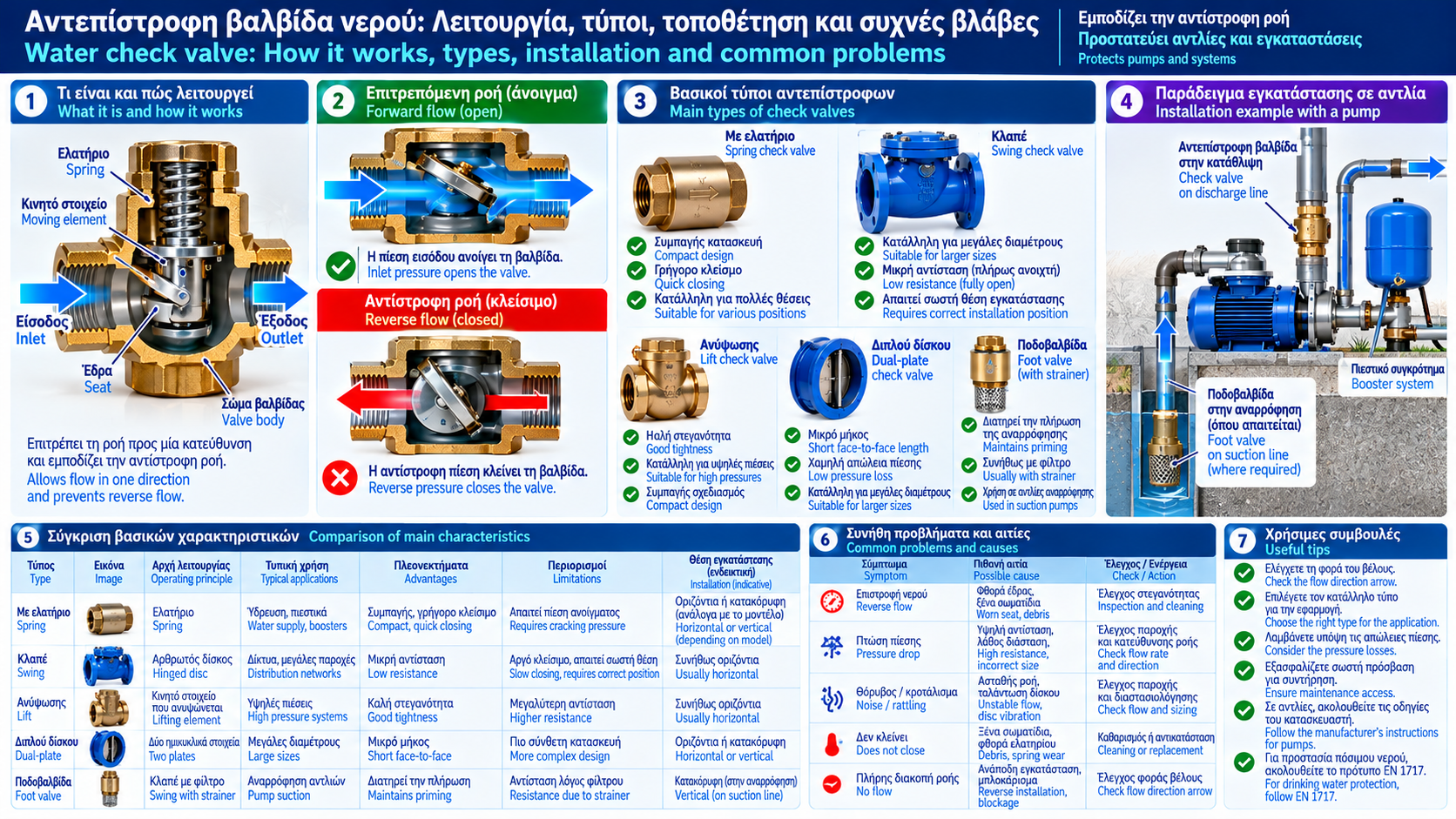
Water Check Valve: How It Works, Installation, Types and Common Problems
A water check valve is an important flow-control component in plumbing and pumping systems.
Its primary function is to allow water to flow in one direction while preventing unwanted reverse flow.
Check valves are used in water pumps, booster systems, distribution networks, heating installations and various industrial applications.
An incorrectly selected or faulty check valve may cause pressure loss, reverse flow, frequent pump starts, noise or water hammer.
This Thermosphere.gr technical guide explains check valve operation, major designs, correct installation and common problems.
1. What Is a Water Check Valve?
A check valve is generally an automatically operated valve that does not require manual actuation.
Common terms include:
Check valve.
Non-return valve.
One-way valve.
When upstream pressure is sufficiently greater than downstream pressure, the valve opens.
When the pressure differential reverses, the mechanism closes to restrict or prevent reverse flow.
Actual shut-off tightness depends on valve design, seat condition and manufacturer specifications.
2. How Does a Check Valve Work?
Check valve operation depends on the pressure difference between its inlet and outlet.
In a typical spring-loaded design:
Water enters from the intended direction.
Pressure applies force to the moving element.
When the force overcomes spring resistance and other forces, the valve opens.
Water passes towards the outlet.
When flow decreases or the pressure differential reverses, the spring assists closure.
Other designs may use gravity, flow forces or a combination of mechanisms.
Not all check valves contain springs.
3. Why Is a Check Valve Needed?
Check valves prevent unwanted reverse flow.
Depending on the application, they may help:
Maintain priming in a suction line.
Limit reverse flow through a pump.
Separate hydraulic flow paths.
Prevent unwanted reverse circulation.
Protect equipment from certain effects of reverse flow.
However, an ordinary check valve should not be treated as a universal solution for every backflow or drinking-water contamination risk.
4. Main Types of Check Valves
Common categories include:
Spring-Loaded Check Valves
Use a movable closure element and return spring.
Swing Check Valves
Use a hinged disc that opens with forward flow.
Lift Check Valves
Use a closure element that lifts from its seat under differential pressure.
Dual-Plate Check Valves
Use two hinged plates, commonly assisted by springs.
Foot Valves
Installed at the inlet of a suction line, often with a strainer.
Selection depends on flow, pressure, pipe diameter and installation orientation.
5. Spring-Loaded Check Valves
Spring-loaded check valves are common in small and medium-sized systems.
Advantages
Automatic return.
Potential suitability for different orientations when permitted.
Compact construction.
Common use in booster installations.
Limitations
Require a certain pressure differential to begin opening.
The spring adds flow resistance.
Deposits and wear may affect closure.
Horizontal and vertical installation suitability must be confirmed for the specific model.
6. Swing Check Valves
Swing check valves use a hinged disc that moves with the water flow.
Forward flow opens the disc.
When flow stops or reverses, the disc returns towards its seat.
Advantages
Suitable for many water distribution applications.
Available in large diameters.
Can have relatively low resistance when fully open.
Limitations
Installation orientation is important.
Slow closure may allow temporary reverse flow.
Some systems may experience severe closing impacts.
Suitability depends on design and operating conditions.
7. What Is a Pump Foot Valve?
A foot valve is a check valve installed near the lower end of a suction pipe.
It commonly includes an inlet strainer.
Its purpose is to limit water returning to a tank or well when the pump stops.
This can help maintain suction-line priming in properly designed systems.
Foot valves are mainly used where a pump is positioned above the water level and suction priming must be retained.
They do not replace proper suction design or cavitation assessment.
8. Where Is a Check Valve Installed on a Water Pump?
Correct placement depends on pump type and system design.
Surface Pumps with Suction Lift
Some installations use a foot valve at the suction-line inlet.
Submersible Pumps
A check valve may be integrated into the pump or installed in the discharge line, according to manufacturer instructions.
Booster Systems
Placement should follow the hydraulic diagram and pump-control requirements.
Adding multiple check valves without engineering assessment is not always beneficial.
It can increase pressure losses or cause undesirable dynamic behaviour.
9. Correct Flow Direction
Most check valves have an arrow marked on their body.
The arrow indicates the permitted direction of flow.
Installing the valve backwards may block normal water delivery.
Before installation, verify:
Flow direction.
Mounting orientation.
Material compatibility.
Operating pressure.
Temperature.
Maintenance access.
Not all check valves are suitable for vertical piping.
10. Can a Check Valve Be Installed Vertically?
It depends on the valve type.
Some spring-loaded designs can operate in different orientations.
Certain swing check valves require specific mounting positions to close correctly.
Flow direction also matters in vertical installations.
The technical datasheet must confirm suitability.
The generic description “check valve” is insufficient.
11. What Is Cracking Pressure?
Cracking pressure is the differential pressure at which the valve begins to open under specified test conditions.
A valve may require a small pressure difference to initiate opening.
The actual value depends on its design and spring characteristics, where applicable.
Cracking pressure is not the same as pressure drop during normal operation.
A valve may have a low cracking pressure but still produce significant resistance at high flow rates.
12. How Does a Check Valve Affect Water Pressure?
Every check valve introduces some hydraulic resistance.
Pressure drop depends on:
Valve design.
Diameter.
Flow rate.
Closure-element geometry.
Opening position.
Fluid density.
For water, when an appropriate Kv coefficient is available for the operating condition, the approximate relationship is:
Δp = (Q / Kv)²
Where:
Δp is pressure drop in bar.
Q is flow rate in m³/h.
Kv is the flow coefficient in m³/h at a 1 bar pressure drop.
This expression assumes water with a relative density close to 1 and does not replace manufacturer performance curves.
13. Pressure Drop Calculation Example
Assume:
Water flow: 3 m³/h.
Suitable valve Kv under the evaluated conditions: 6.
Then:
Δp = (3 / 6)²
Δp = 0.25 bar.
The estimated pressure drop is 0.25 bar.
This corresponds to approximately 2.55 metres of water head.
In pumping systems, this resistance should be included in total dynamic head calculations.
The example is hypothetical. Actual selection must use the specific valve’s performance data.
14. Why Does a Check Valve Make Noise?
Noise may result from:
Unstable flow.
Excessively low flow.
High water velocity.
Incorrect sizing.
Closure-element oscillation.
Sudden closure.
Mechanical wear.
Repeated tapping or rattling may occur.
This can indicate valve chatter, where the closure element oscillates.
Actual flow and valve operating conditions should be checked.
15. Check Valves and Water Hammer
Water hammer is a transient pressure change caused by rapid changes in water velocity.
In pumping systems, stopping a pump may cause flow deceleration or reversal.
If a check valve closes abruptly after substantial reverse velocity develops, a severe pressure transient may occur.
Potential mitigation measures include:
Appropriate check valve design.
Correct installation location.
Suitable closing characteristics.
Transient hydraulic analysis.
Dedicated protection equipment where required.
Installing any check valve does not automatically prevent water hammer.
16. Why Does Pump Pressure Drop After Shutdown?
One possible cause is internal leakage through the check valve.
If water flows backwards towards the pump or source, system pressure may decrease.
Other causes include:
Pipe leakage.
Leaking connections.
Pressure vessel problems.
Failure of another component.
Incorrect control-system operation.
Diagnosis requires pressure measurement and appropriate isolation of system sections.
17. Why Does a Check Valve Fail to Close?
Common causes include:
Foreign Particles
Sand, rust or deposits may become trapped between the closure element and seat.
Seat Wear
The sealing surface may become damaged.
Spring Failure
In spring-loaded designs, spring damage may affect closure.
Incorrect Installation
Unsuitable orientation may prevent proper operation.
Incorrect Selection
A valve operating outside its suitable flow range may become unstable.
18. Common Troubleshooting Table
Symptom | Possible cause | Check |
Reverse flow | Worn or contaminated seat | Inspect shut-off tightness |
Pressure loss after pump shutdown | Internal leakage or other loss | Isolate and monitor pressure |
Low flow | Excessive resistance or obstruction | Check direction and pressure drop |
Rattling | Unstable opening | Check flow and sizing |
Severe closing impact | Hydraulic transient | Investigate water hammer |
No flow | Reverse installation or blockage | Check arrow and mechanism |
19. Check Valves and Drinking Water Protection
Preventing backflow is especially important in potable-water systems.
However, a distinction must be made between:
Ordinary check valve: Used to control flow direction within a system.
Backflow protection device: Selected to protect drinking water against potential contamination according to the relevant hazard category and regulatory requirements.
EN 1717 establishes principles for protecting drinking water from pollution and defines fluid categories and suitable backflow protection device families.
Certain applications require specialised protection devices rather than an ordinary check valve.
Selection must follow applicable legislation, standards and water utility requirements.
20. Common Installation Mistakes
Reversed Installation
The arrow must align with normal flow.
Incorrect Orientation
Not every design is suitable for horizontal and vertical installation.
Choosing Only by Diameter
Flow rate and pressure drop must also be assessed.
Ignoring Water Hammer
Dynamic performance is particularly important in pumping stations.
Poor Maintenance Access
The valve should remain accessible for inspection or replacement.
Using an Ordinary Check Valve as Universal Potable-Water Protection
Protection against contamination requires hazard assessment and an appropriate approved device.
21. Frequently Asked Questions
How Do I Know If My Check Valve Is Faulty?
Possible signs include reverse flow, pressure loss, frequent pump starts or noise. Testing is needed for confirmation.
Where Should a Check Valve Be Installed on a Pump?
Placement depends on pump type, suction or discharge arrangement, and manufacturer instructions.
Should the Check Valve Be Before or After the Pump?
There is no universal rule. Position depends on system design.
Can a Check Valve Be Installed Vertically?
Yes, if the specific model is approved for the orientation and flow direction.
Why Does a Check Valve Make Noise?
Possible causes include closure-element oscillation, unstable flow or abrupt closure.
Does Every Booster Pump Need an Additional Check Valve?
Requirements depend on the booster design and existing components. Additional valves should not be installed without reviewing the hydraulic arrangement.
Is a Check Valve the Same as a Safety Valve?
No. A check valve limits reverse flow. A safety relief valve protects against overpressure by releasing fluid.
Conclusion
A water check valve is a fundamental component for controlling flow direction.
Correct selection requires considering valve type, flow rate, cracking pressure, hydraulic losses and installation orientation.
In pumps and booster systems, it can help maintain pressure and limit unwanted reverse flow.
However, poor selection may cause noise, unstable operation or water hammer.
Special attention is required when the objective is protecting drinking water from contamination, because an ordinary check valve may not provide sufficient protection.
The correct check valve is selected not only by pipe diameter, but by the hydraulic behaviour and protection requirements of the entire installation.
Technical References and Further Reading
EN 1717: Protection against pollution of potable water in water installations and general requirements of devices to prevent pollution by backflow.
EN 13959: Anti-pollution check valves — DN 6 to DN 250, family E, type A, B, C and D.
EN 1074: Valves for water supply — Fitness for purpose requirements and appropriate verification tests.
EN 806: Specifications for installations inside buildings conveying water for human consumption.
CEN-CENELEC: https://www.cencenelec.eu/
Caleffi: https://www.caleffi.com/ — technical documentation on valves and hydraulic components.
Grundfos: https://www.grundfos.com/ — pump and installation technical documentation.
Applicability of each standard depends on product type, application and current edition.
Safety note: Before dismantling a check valve, safely isolate and depressurise the system and allow it to cool where necessary. In pumping systems, accidental pump startup must also be prevented.
Thermosphere.gr — Technical knowledge for water supply and heating systems.Water Check Valve: How It Works, Installation, Types and Common Problems
A water check valve is an important flow-control component in plumbing and pumping systems.
Its primary function is to allow water to flow in one direction while preventing unwanted reverse flow.
Check valves are used in water pumps, booster systems, distribution networks, heating installations and various industrial applications.
An incorrectly selected or faulty check valve may cause pressure loss, reverse flow, frequent pump starts, noise or water hammer.
This Thermosphere.gr technical guide explains check valve operation, major designs, correct installation and common problems.
1. What Is a Water Check Valve?
A check valve is generally an automatically operated valve that does not require manual actuation.
Common terms include:
Check valve.
Non-return valve.
One-way valve.
When upstream pressure is sufficiently greater than downstream pressure, the valve opens.
When the pressure differential reverses, the mechanism closes to restrict or prevent reverse flow.
Actual shut-off tightness depends on valve design, seat condition and manufacturer specifications.
2. How Does a Check Valve Work?
Check valve operation depends on the pressure difference between its inlet and outlet.
In a typical spring-loaded design:
Water enters from the intended direction.
Pressure applies force to the moving element.
When the force overcomes spring resistance and other forces, the valve opens.
Water passes towards the outlet.
When flow decreases or the pressure differential reverses, the spring assists closure.
Other designs may use gravity, flow forces or a combination of mechanisms.
Not all check valves contain springs.
3. Why Is a Check Valve Needed?
Check valves prevent unwanted reverse flow.
Depending on the application, they may help:
Maintain priming in a suction line.
Limit reverse flow through a pump.
Separate hydraulic flow paths.
Prevent unwanted reverse circulation.
Protect equipment from certain effects of reverse flow.
However, an ordinary check valve should not be treated as a universal solution for every backflow or drinking-water contamination risk.
4. Main Types of Check Valves
Common categories include:
Spring-Loaded Check Valves
Use a movable closure element and return spring.
Swing Check Valves
Use a hinged disc that opens with forward flow.
Lift Check Valves
Use a closure element that lifts from its seat under differential pressure.
Dual-Plate Check Valves
Use two hinged plates, commonly assisted by springs.
Foot Valves
Installed at the inlet of a suction line, often with a strainer.
Selection depends on flow, pressure, pipe diameter and installation orientation.
5. Spring-Loaded Check Valves
Spring-loaded check valves are common in small and medium-sized systems.
Advantages
Automatic return.
Potential suitability for different orientations when permitted.
Compact construction.
Common use in booster installations.
Limitations
Require a certain pressure differential to begin opening.
The spring adds flow resistance.
Deposits and wear may affect closure.
Horizontal and vertical installation suitability must be confirmed for the specific model.
6. Swing Check Valves
Swing check valves use a hinged disc that moves with the water flow.
Forward flow opens the disc.
When flow stops or reverses, the disc returns towards its seat.
Advantages
Suitable for many water distribution applications.
Available in large diameters.
Can have relatively low resistance when fully open.
Limitations
Installation orientation is important.
Slow closure may allow temporary reverse flow.
Some systems may experience severe closing impacts.
Suitability depends on design and operating conditions.
7. What Is a Pump Foot Valve?
A foot valve is a check valve installed near the lower end of a suction pipe.
It commonly includes an inlet strainer.
Its purpose is to limit water returning to a tank or well when the pump stops.
This can help maintain suction-line priming in properly designed systems.
Foot valves are mainly used where a pump is positioned above the water level and suction priming must be retained.
They do not replace proper suction design or cavitation assessment.
8. Where Is a Check Valve Installed on a Water Pump?
Correct placement depends on pump type and system design.
Surface Pumps with Suction Lift
Some installations use a foot valve at the suction-line inlet.
Submersible Pumps
A check valve may be integrated into the pump or installed in the discharge line, according to manufacturer instructions.
Booster Systems
Placement should follow the hydraulic diagram and pump-control requirements.
Adding multiple check valves without engineering assessment is not always beneficial.
It can increase pressure losses or cause undesirable dynamic behaviour.
9. Correct Flow Direction
Most check valves have an arrow marked on their body.
The arrow indicates the permitted direction of flow.
Installing the valve backwards may block normal water delivery.
Before installation, verify:
Flow direction.
Mounting orientation.
Material compatibility.
Operating pressure.
Temperature.
Maintenance access.
Not all check valves are suitable for vertical piping.
10. Can a Check Valve Be Installed Vertically?
It depends on the valve type.
Some spring-loaded designs can operate in different orientations.
Certain swing check valves require specific mounting positions to close correctly.
Flow direction also matters in vertical installations.
The technical datasheet must confirm suitability.
The generic description “check valve” is insufficient.
11. What Is Cracking Pressure?
Cracking pressure is the differential pressure at which the valve begins to open under specified test conditions.
A valve may require a small pressure difference to initiate opening.
The actual value depends on its design and spring characteristics, where applicable.
Cracking pressure is not the same as pressure drop during normal operation.
A valve may have a low cracking pressure but still produce significant resistance at high flow rates.
12. How Does a Check Valve Affect Water Pressure?
Every check valve introduces some hydraulic resistance.
Pressure drop depends on:
Valve design.
Diameter.
Flow rate.
Closure-element geometry.
Opening position.
Fluid density.
For water, when an appropriate Kv coefficient is available for the operating condition, the approximate relationship is:
Δp = (Q / Kv)²
Where:
Δp is pressure drop in bar.
Q is flow rate in m³/h.
Kv is the flow coefficient in m³/h at a 1 bar pressure drop.
This expression assumes water with a relative density close to 1 and does not replace manufacturer performance curves.
13. Pressure Drop Calculation Example
Assume:
Water flow: 3 m³/h.
Suitable valve Kv under the evaluated conditions: 6.
Then:
Δp = (3 / 6)²
Δp = 0.25 bar.
The estimated pressure drop is 0.25 bar.
This corresponds to approximately 2.55 metres of water head.
In pumping systems, this resistance should be included in total dynamic head calculations.
The example is hypothetical. Actual selection must use the specific valve’s performance data.
14. Why Does a Check Valve Make Noise?
Noise may result from:
Unstable flow.
Excessively low flow.
High water velocity.
Incorrect sizing.
Closure-element oscillation.
Sudden closure.
Mechanical wear.
Repeated tapping or rattling may occur.
This can indicate valve chatter, where the closure element oscillates.
Actual flow and valve operating conditions should be checked.
15. Check Valves and Water Hammer
Water hammer is a transient pressure change caused by rapid changes in water velocity.
In pumping systems, stopping a pump may cause flow deceleration or reversal.
If a check valve closes abruptly after substantial reverse velocity develops, a severe pressure transient may occur.
Potential mitigation measures include:
Appropriate check valve design.
Correct installation location.
Suitable closing characteristics.
Transient hydraulic analysis.
Dedicated protection equipment where required.
Installing any check valve does not automatically prevent water hammer.
16. Why Does Pump Pressure Drop After Shutdown?
One possible cause is internal leakage through the check valve.
If water flows backwards towards the pump or source, system pressure may decrease.
Other causes include:
Pipe leakage.
Leaking connections.
Pressure vessel problems.
Failure of another component.
Incorrect control-system operation.
Diagnosis requires pressure measurement and appropriate isolation of system sections.
17. Why Does a Check Valve Fail to Close?
Common causes include:
Foreign Particles
Sand, rust or deposits may become trapped between the closure element and seat.
Seat Wear
The sealing surface may become damaged.
Spring Failure
In spring-loaded designs, spring damage may affect closure.
Incorrect Installation
Unsuitable orientation may prevent proper operation.
Incorrect Selection
A valve operating outside its suitable flow range may become unstable.
18. Common Troubleshooting Table
Symptom | Possible cause | Check |
Reverse flow | Worn or contaminated seat | Inspect shut-off tightness |
Pressure loss after pump shutdown | Internal leakage or other loss | Isolate and monitor pressure |
Low flow | Excessive resistance or obstruction | Check direction and pressure drop |
Rattling | Unstable opening | Check flow and sizing |
Severe closing impact | Hydraulic transient | Investigate water hammer |
No flow | Reverse installation or blockage | Check arrow and mechanism |
19. Check Valves and Drinking Water Protection
Preventing backflow is especially important in potable-water systems.
However, a distinction must be made between:
Ordinary check valve: Used to control flow direction within a system.
Backflow protection device: Selected to protect drinking water against potential contamination according to the relevant hazard category and regulatory requirements.
EN 1717 establishes principles for protecting drinking water from pollution and defines fluid categories and suitable backflow protection device families.
Certain applications require specialised protection devices rather than an ordinary check valve.
Selection must follow applicable legislation, standards and water utility requirements.
20. Common Installation Mistakes
Reversed Installation
The arrow must align with normal flow.
Incorrect Orientation
Not every design is suitable for horizontal and vertical installation.
Choosing Only by Diameter
Flow rate and pressure drop must also be assessed.
Ignoring Water Hammer
Dynamic performance is particularly important in pumping stations.
Poor Maintenance Access
The valve should remain accessible for inspection or replacement.
Using an Ordinary Check Valve as Universal Potable-Water Protection
Protection against contamination requires hazard assessment and an appropriate approved device.
21. Frequently Asked Questions
How Do I Know If My Check Valve Is Faulty?
Possible signs include reverse flow, pressure loss, frequent pump starts or noise. Testing is needed for confirmation.
Where Should a Check Valve Be Installed on a Pump?
Placement depends on pump type, suction or discharge arrangement, and manufacturer instructions.
Should the Check Valve Be Before or After the Pump?
There is no universal rule. Position depends on system design.
Can a Check Valve Be Installed Vertically?
Yes, if the specific model is approved for the orientation and flow direction.
Why Does a Check Valve Make Noise?
Possible causes include closure-element oscillation, unstable flow or abrupt closure.
Does Every Booster Pump Need an Additional Check Valve?
Requirements depend on the booster design and existing components. Additional valves should not be installed without reviewing the hydraulic arrangement.
Is a Check Valve the Same as a Safety Valve?
No. A check valve limits reverse flow. A safety relief valve protects against overpressure by releasing fluid.
Conclusion
A water check valve is a fundamental component for controlling flow direction.
Correct selection requires considering valve type, flow rate, cracking pressure, hydraulic losses and installation orientation.
In pumps and booster systems, it can help maintain pressure and limit unwanted reverse flow.
However, poor selection may cause noise, unstable operation or water hammer.
Special attention is required when the objective is protecting drinking water from contamination, because an ordinary check valve may not provide sufficient protection.
The correct check valve is selected not only by pipe diameter, but by the hydraulic behaviour and protection requirements of the entire installation.
Technical References and Further Reading
EN 1717: Protection against pollution of potable water in water installations and general requirements of devices to prevent pollution by backflow.
EN 13959: Anti-pollution check valves — DN 6 to DN 250, family E, type A, B, C and D.
EN 1074: Valves for water supply — Fitness for purpose requirements and appropriate verification tests.
EN 806: Specifications for installations inside buildings conveying water for human consumption.
CEN-CENELEC: https://www.cencenelec.eu/
Caleffi: https://www.caleffi.com/ — technical documentation on valves and hydraulic components.
Grundfos: https://www.grundfos.com/ — pump and installation technical documentation.
Applicability of each standard depends on product type, application and current edition.
Safety note: Before dismantling a check valve, safely isolate and depressurise the system and allow it to cool where necessary. In pumping systems, accidental pump startup must also be prevented.
Thermosphere.gr — Technical knowledge for water supply and heating systems.