
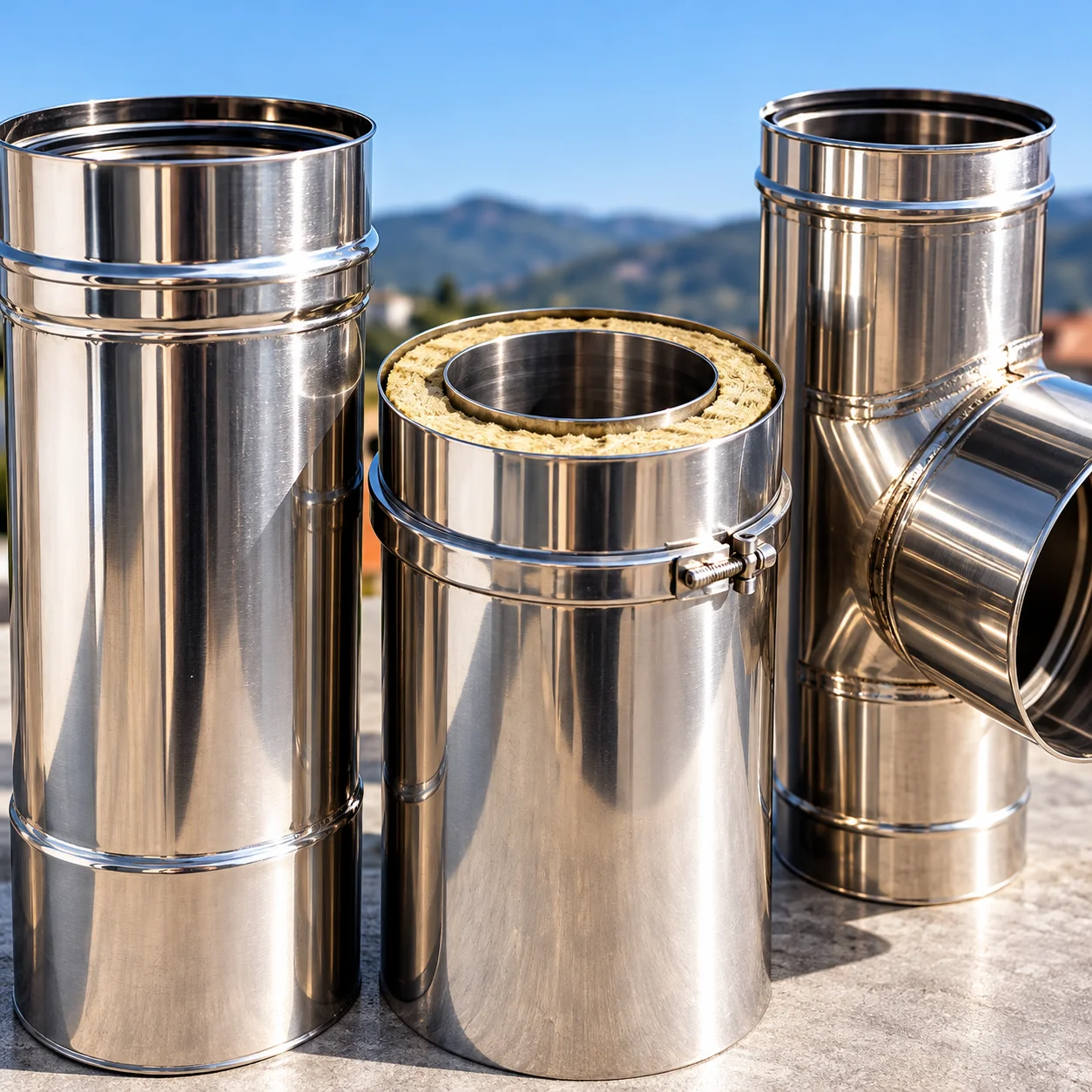
Stainless Steel Chimneys: AISI 304, 316L and 444 Grades Explained
Stainless steel chimneys are widely used to discharge combustion gases from boilers, stoves, fireplaces and other heating appliances.
Metal chimney systems offer several practical advantages, including relatively low weight, installation flexibility and compatibility with a variety of building configurations.
However, not all stainless steel chimneys offer the same corrosion resistance or are suitable for the same operating conditions.
Different stainless steel grades, including AISI 304, 316L and 444, have different chemical compositions and performance characteristics.
Understanding these differences is useful when selecting a chimney, but one principle is particularly important:
The stainless steel grade alone does not establish whether a chimney is suitable for a particular heating appliance.
Correct selection requires examination of the complete chimney system, its declared performance classification and the manufacturer's instructions.
What Is Stainless Steel?
Stainless steel is an iron-based alloy containing at least approximately 10.5% chromium.
Chromium helps form a thin, protective oxide layer on the metal surface.
Under suitable conditions, this passive layer provides resistance to corrosion.
However, the term stainless does not mean that the material is completely immune to corrosion.
Its performance depends on several factors:
Chemical composition of the alloy.
Operating temperature.
Chemical composition of condensate.
Exposure to chlorides and other aggressive substances.
Moisture and environmental conditions.
Manufacturing and welding quality.
Maintenance and operating conditions.
Different stainless steel grades therefore behave differently in specific environments.
AISI 304 Stainless Steel
AISI 304 is an austenitic stainless steel widely used in industrial, commercial and construction applications.
It contains chromium and nickel, which contribute to its corrosion resistance and mechanical properties.
Advantages of AISI 304
Good general corrosion resistance in suitable environments.
Good formability and weldability.
Wide commercial availability.
Suitability for many industrial applications.
Limitations of AISI 304
AISI 304 is not automatically suitable for every chimney application.
In environments containing aggressive condensates or elevated chloride concentrations, its corrosion resistance may be insufficient.
Its use in a flue system must therefore be supported by the documented suitability of the specific chimney product.
AISI 316L Stainless Steel
AISI 316L is another austenitic stainless steel grade.
Compared with AISI 304, it contains molybdenum, which improves resistance to certain forms of localised corrosion, particularly in chloride-containing environments.
The letter L indicates a low-carbon grade.
The reduced carbon content helps limit sensitisation and associated corrosion problems that may otherwise occur in certain welded components.
Advantages of AISI 316L
Improved resistance to certain corrosive environments compared with AISI 304.
Good weldability.
Widespread use where enhanced corrosion resistance is required.
Availability in various industrial and flue system components.
Limitations of AISI 316L
AISI 316L is not immune to corrosion.
Aggressive condensates, elevated temperatures and unsuitable operating conditions can still cause material degradation.
Furthermore, using AISI 316L does not automatically mean that a chimney is suitable for:
Wet operation.
Positive-pressure operation.
A particular temperature class.
Soot-fire exposure.
These properties must be confirmed by the chimney system's declared performance classification.
AISI 444 Stainless Steel
AISI 444 is a ferritic stainless steel grade.
It contains chromium and molybdenum, while its metallurgical structure differs from that of the austenitic grades 304 and 316L.
AISI 444 can provide good corrosion resistance in certain environments and is used in selected technical applications.
Advantages of AISI 444
Good corrosion resistance under suitable operating conditions.
A metallurgical structure different from austenitic stainless steels.
Potential suitability for specifically designed and assessed flue systems.
Limitations of AISI 444
The suitability of AISI 444 depends on the application, manufacturing quality and actual exposure conditions.
It is not technically correct to assume that AISI 444 is always better or worse than AISI 316L.
A meaningful comparison must consider the specific corrosion environment, relevant material data and the declared performance of the finished chimney product.
Comparison: AISI 304 vs 316L vs 444
Property | AISI 304 | AISI 316L | AISI 444 |
|---|---|---|---|
Stainless steel family | Austenitic | Austenitic | Ferritic |
Molybdenum content | Normally absent | Present | Present |
Significant nickel content | Yes | Yes | Generally no |
General corrosion behaviour | Good in suitable environments | Improved in certain environments | Good in selected applications |
Chimney suitability | Based on product documentation | Based on product documentation | Based on product documentation |
Important: This comparison describes general material characteristics. It is not a chimney selection chart for particular fuels or heating appliances.
What Causes Corrosion in Stainless Steel Chimneys?
Corrosion can occur when the operating environment exceeds the resistance of the selected material.
In chimney systems, condensate is an important consideration.
When combustion gases cool sufficiently, some of their components may condense on the internal chimney walls.
The chemical composition of this condensate depends on:
Fuel type.
Composition of combustion products.
Flue gas temperature.
Combustion conditions.
Contaminants and impurities.
Condensate may contain acidic compounds capable of attacking unsuitable materials.
The fact that a chimney is manufactured from stainless steel does not eliminate this risk.
Dry and Wet Chimney Operation
Chimney performance classifications distinguish between systems intended for dry and wet operating conditions.
Dry Operation — D
The designation D indicates a chimney classified for dry operating conditions.
Wet Operation — W
The designation W indicates a chimney classified for wet operating conditions.
This distinction is particularly important in installations where condensate formation is expected during normal operation.
A chimney classified for dry operation should not automatically be considered suitable for wet operation.
What Does EN 1856-1 Specify?
The European standard EN 1856-1 covers requirements for metal system chimney products.
The product designation provides information about the chimney's declared performance characteristics.
Depending on the system and applicable classification requirements, these may include:
Temperature class.
Pressure class.
Wet or dry operating conditions.
Corrosion resistance.
Material specification and thickness, where applicable.
Soot-fire resistance.
Distance to combustible materials.
Correct chimney selection requires consideration of the complete designation and the manufacturer's documentation.
A label stating only AISI 316L or stainless steel chimney is insufficient.
What Is Soot-Fire Resistance?
Chimneys connected to solid-fuel appliances may accumulate combustible soot and creosote deposits.
If these deposits ignite, very high temperatures can develop inside the chimney.
Chimney performance classifications distinguish between:
G: A chimney classified as soot-fire resistant.
O: A chimney not classified as soot-fire resistant.
The relevant designation also includes requirements concerning the distance from combustible materials.
The selected chimney must meet the requirements of the connected appliance and the installation.
Which Stainless Steel Chimney Is Suitable for an Oil Boiler?
The correct chimney depends on whether the oil-fired boiler is conventional or condensing, as well as its actual operating conditions.
Important parameters include:
Flue gas temperature.
Operating pressure.
Potential for condensate formation.
Required corrosion resistance.
Documented suitability of the chimney system.
The selection should not be based solely on the stainless steel grade.
Which Chimney Is Suitable for a Natural Gas Boiler?
Modern gas condensing boilers frequently use fan-assisted flue systems operating under positive pressure and wet conditions.
These installations require an approved system with suitable gas-tightness, condensate resistance and compatibility with the appliance.
Depending on the manufacturer's approved configurations, suitable plastic, metal or concentric air/flue systems may be used.
A stainless steel chimney is not mandatory for every gas boiler installation if another suitable system is approved by the appliance manufacturer.
Which Stainless Steel Chimney Is Suitable for Solid Fuels?
For wood-fired boilers, stoves and fireplaces, the following characteristics are particularly important:
Expected flue gas temperature.
Potential for soot deposits.
Required soot-fire resistance.
Clearance from combustible materials.
Accessibility for cleaning.
Pressure and condensation conditions.
Not every stainless steel chimney is suitable for wood combustion.
The product's complete classification and the appliance manufacturer's requirements must be checked.
Does Stainless Steel Thickness Matter?
The thickness of the metal wall is an important construction characteristic.
It affects mechanical behaviour and, depending on the exposure conditions, may influence component durability.
However, greater thickness does not automatically demonstrate better corrosion resistance or suitability for higher temperatures.
Performance depends on the combination of:
Stainless steel grade.
Wall thickness.
Manufacturing and welding quality.
Thermal insulation, where applicable.
Declared product performance.
Chimney selection should therefore not be based solely on comparing wall thicknesses.
Common Mistakes When Choosing a Stainless Steel Chimney
Selecting a Chimney Only Because It Uses AISI 316L
AISI 316L has useful corrosion resistance properties, but the suitability of the complete system must still be verified.
Assuming All Stainless Steel Chimneys Resist Condensate
Suitability for wet operation must be supported by the product's performance classification.
Ignoring Operating Pressure
A chimney intended for natural-draft operation is not automatically suitable for positive-pressure applications.
Overlooking Soot-Fire Resistance
Where soot-fire resistance is required, an appropriately classified chimney system must be selected.
Combining Incompatible Components
Mixing components from different chimney systems may compromise joint integrity, gas-tightness and declared performance.
Ignoring Installation Instructions
Correct support, safety clearances, routing and maintenance are essential parts of a safe installation.
How to Choose the Correct Stainless Steel Chimney
A technically justified selection process should include the following steps:
Identify the appliance: Determine its type, fuel and operating characteristics.
Check temperature and pressure: Use the appliance manufacturer's technical data.
Assess condensation conditions: Determine whether wet or dry operation is expected.
Verify corrosion resistance: Consider fuel type and operating conditions.
Check soot-fire requirements: Where applicable.
Review the complete chimney classification: Do not rely solely on the steel grade.
Confirm correct sizing: Use manufacturer requirements and appropriate calculation methods.
Verify installation conditions: Follow manufacturer instructions and applicable regulations.
Conclusion
AISI 304, 316L and 444 stainless steels have different chemical compositions, metallurgical structures and corrosion resistance characteristics.
AISI 316L provides improved resistance to certain corrosive environments compared with AISI 304, while AISI 444 offers different properties that may be suitable for specific applications.
However, no single stainless steel grade is automatically the correct choice for every chimney installation.
Safe and technically appropriate chimney selection must be based on the complete product performance classification, appliance requirements and actual operating conditions.
Chimney design and installation should be carried out by suitably qualified professionals in accordance with applicable standards, national regulations and manufacturer instructions.
Technical References
EN 1856-1 — Chimneys: Requirements for metal chimneys — Part 1: System chimney products.
EN 1856-2 — Chimneys: Requirements for metal chimneys — Part 2: Metal flue liners and connecting flue pipes.
EN 1443 — Chimneys: General requirements.
EN 13384-1 — Chimneys: Thermal and fluid dynamic calculation methods — Part 1: Chimneys serving one combustion appliance.
EN 10088 — Stainless steels.
The applicable editions of these standards, the product's Declaration of Performance and the manufacturer's instructions should be verified for the specific chimney system and installation.