
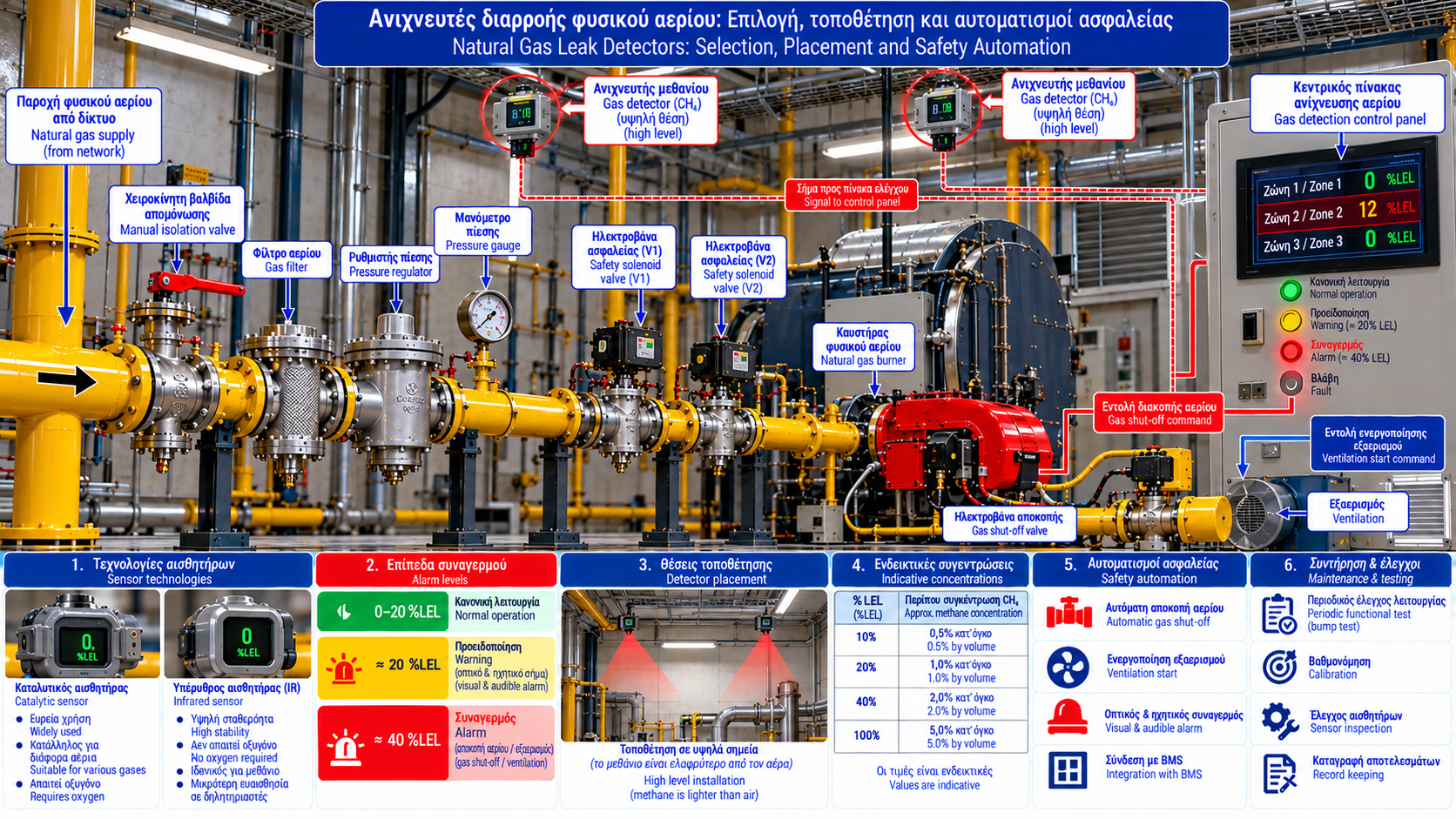
Natural Gas Leak Detectors: Selection, Placement and Safety Automation
Natural gas detectors are an important part of protection systems in boiler rooms, industrial combustion installations and other areas where methane leakage may occur.
Their main function is to detect combustible gas and initiate the specified warning or safety response.
System effectiveness depends not only on sensor quality but also on the selected technology, detector placement, alarm settings, safety interfaces and maintenance.
1. What Is a Natural Gas Detector?
A natural gas detector monitors the presence of a specified gas in ambient air.
For most natural gas installations, methane (CH₄) is the primary gas of interest.
Depending on its design, a detector may provide continuous concentration readings, alarm signals, fault indications and interfaces with safety systems.
The detector does not prevent leakage itself. It supports detection and the planned response.
2. Why Is Methane Detection Important?
Methane is flammable and can form ignitable mixtures with air.
Its lower flammability limit is approximately 5% by volume in air, depending on conditions.
Early detection may allow warnings or protective actions before dangerous concentrations develop.
However, a gas detection system cannot guarantee that every leak will be detected in time.
3. Understanding %LEL
LEL means Lower Explosive Limit.
Combustible gas detectors commonly express concentration as a percentage of the LEL.
For methane with an illustrative LEL of 5% by volume:
Detector Reading | Approximate Methane Concentration |
10% LEL | 0.5% by volume |
20% LEL | 1.0% by volume |
40% LEL | 2.0% by volume |
100% LEL | 5.0% by volume |
These values are approximate and depend on the instrument’s reference and calibration.
A reading of 20% LEL does not mean that the atmosphere contains 20% methane.
4. Main Detection Technologies
Different sensor technologies are used for combustible gas detection.
Two important categories for methane are catalytic sensors and infrared (IR) sensors.
Selection depends on the gas, operating environment and performance requirements.
5. Catalytic Sensors
Catalytic sensors detect combustible gas through heat generated by catalytic oxidation.
Advantages may include suitability for various combustible gases and established industrial use.
Limitations include the need for sufficient oxygen, possible sensor poisoning by certain substances and periodic performance verification.
Actual behavior depends on sensor design and operating conditions.
6. Infrared Sensors
Infrared gas sensors measure absorption of infrared radiation by gas molecules.
For methane detection, IR technology may offer important advantages in suitable applications.
Its measurement principle does not depend on catalytic combustion or require oxygen.
It is not affected by catalytic poisons through the same mechanism as catalytic sensors.
However, IR detectors cannot detect every combustible gas, and performance may be affected by optical contamination or other environmental factors.
7. Catalytic Versus Infrared Sensors
Feature | Catalytic | Infrared (IR) |
Measurement principle | Catalytic oxidation | Infrared absorption |
Oxygen required | Yes, for measurement | No, for measurement principle |
Catalytic poisoning | Possible | Not through the same mechanism |
Methane detection | Yes, with suitable sensor | Yes, with suitable sensor |
Maintenance | Scheduled checks required | Scheduled checks required |
Suitability | Application-dependent | Application-dependent |
Neither technology is universally ideal for every installation.
8. Where Should Methane Detectors Be Installed?
Methane is generally lighter than air.
Therefore, high-level detector placement is often considered in enclosed installations.
However, detector position should not be determined solely by a fixed distance from the ceiling.
Relevant factors include potential leak sources, airflow patterns, room geometry, obstacles, temperature, equipment locations, maintenance access and manufacturer instructions.
Placement should be determined by engineering assessment and risk analysis.
9. Detection in Industrial Boiler Rooms
Potential areas of interest include gas trains, pressure regulators, piping connections, flanges and areas where leaked gas could accumulate.
Detectors should be positioned to provide effective coverage while avoiding unsuitable environmental conditions.
10. How Many Detectors Are Required?
Detector quantity cannot be determined solely from floor area.
It depends on room layout, possible leak sources, airflow, obstructions, ceiling height, response requirements and the risk assessment.
A single detector may be insufficient for a large or complex boiler room.
11. Central Gas Detection Control Panel
A control panel receives detector signals and manages specified outputs.
Depending on the design, it may provide concentration displays, multiple alarm levels, audible and visual warnings, automation signals, gas isolation commands and fault indications.
System reliability also depends on how equipment faults are managed.
12. First and Second Alarm Levels
Some systems use two or more alarm levels.
An initial level may provide early warning.
A higher level may initiate additional protective actions.
Alarm thresholds and actions must not be copied arbitrarily from another installation.
They must follow the risk assessment, applicable requirements and approved safety logic.
13. Integration with Automatic Gas Shut-Off Valves
A gas detection system may interface with a suitable automatic gas isolation valve.
When the specified safety condition occurs, the system may command fuel supply isolation.
Valve location, actuation, power-loss behavior and reset requirements must be defined by the safety design.
The valve must be suitable for the intended service.
14. Integration with Ventilation
Gas detection systems may interface with mechanical ventilation in certain installations.
However, the use or activation of electrical equipment in a potentially explosive atmosphere must be assessed against the hazardous area classification and explosion protection requirements.
A conventional fan must not automatically be assumed safe to operate following a gas alarm.
15. Gas Detectors and ATEX Areas
Installations with a potential explosive atmosphere require appropriate hazardous area assessment.
Equipment installed in a classified zone must be suitable for that zone and its conditions of use.
The presence of gas detection does not automatically remove ATEX requirements.
Electrical equipment and connections must meet the applicable standards.
16. Fail-Safe Design
Safety system design must consider faults such as power failure, sensor signal loss, communication failure, control panel malfunction and output failure.
The required response depends on the risk assessment and safety architecture.
Correct behavior during gas detection alone is not sufficient.
17. Functional Testing and Calibration
Detectors require periodic verification according to manufacturer instructions and installation requirements.
Bump test: Confirms that the sensor and specified functions respond to suitable test gas.
Calibration: Checks and, where appropriate, adjusts the instrument’s measurement response against a known reference concentration.
A bump test is not equivalent to calibration.
Intervals depend on the manufacturer, operating conditions and risk assessment.
18. Common Gas Detection System Faults
Symptom | Possible Cause | Investigation |
No display | Power or device fault | Qualified technical inspection |
Persistent fault indication | Sensor or communication issue | Review diagnostics |
Unexpected alarms | Environmental influence or malfunction | Assess conditions |
Abnormal sensor response | Contamination or aging | Approved function test |
No isolation command | Interface fault | Verify safety chain |
Unstable readings | Environmental or electrical issue | Inspect installation |
These are possible diagnostic directions, not instructions for bypassing protective functions.
19. Common Installation Mistakes
Typical mistakes include selecting an unsuitable sensor, placing detectors without evaluating gas dispersion, installing behind obstructions, ignoring ventilation, omitting maintenance, using undocumented alarm settings and failing to verify safety interfaces.
Correct installation is as important as the sensor specifications.
20. Technical Standards
Relevant references include:
EN 60079-29-1: Performance requirements for flammable gas detectors.
EN 60079-29-2: Guidance for selection, installation, use and maintenance.
EN 60079-10-1: Classification of areas where explosive gas atmospheres may occur.
EN IEC 60079-14: Electrical installation design, selection and erection in explosive atmospheres.
EN 50271: Requirements for gas detection equipment using software or digital technologies.
Applicability depends on the equipment and installation.
Conclusion
Natural gas detection is an integrated monitoring and response system, not simply a sensor installed on a wall.
Its effectiveness depends on suitable measurement technology, appropriate detector placement, documented alarm thresholds, safety system interfaces and periodic maintenance.
In industrial boiler rooms and combustion installations, selection and installation should follow an engineering study and risk assessment by competent professionals.