
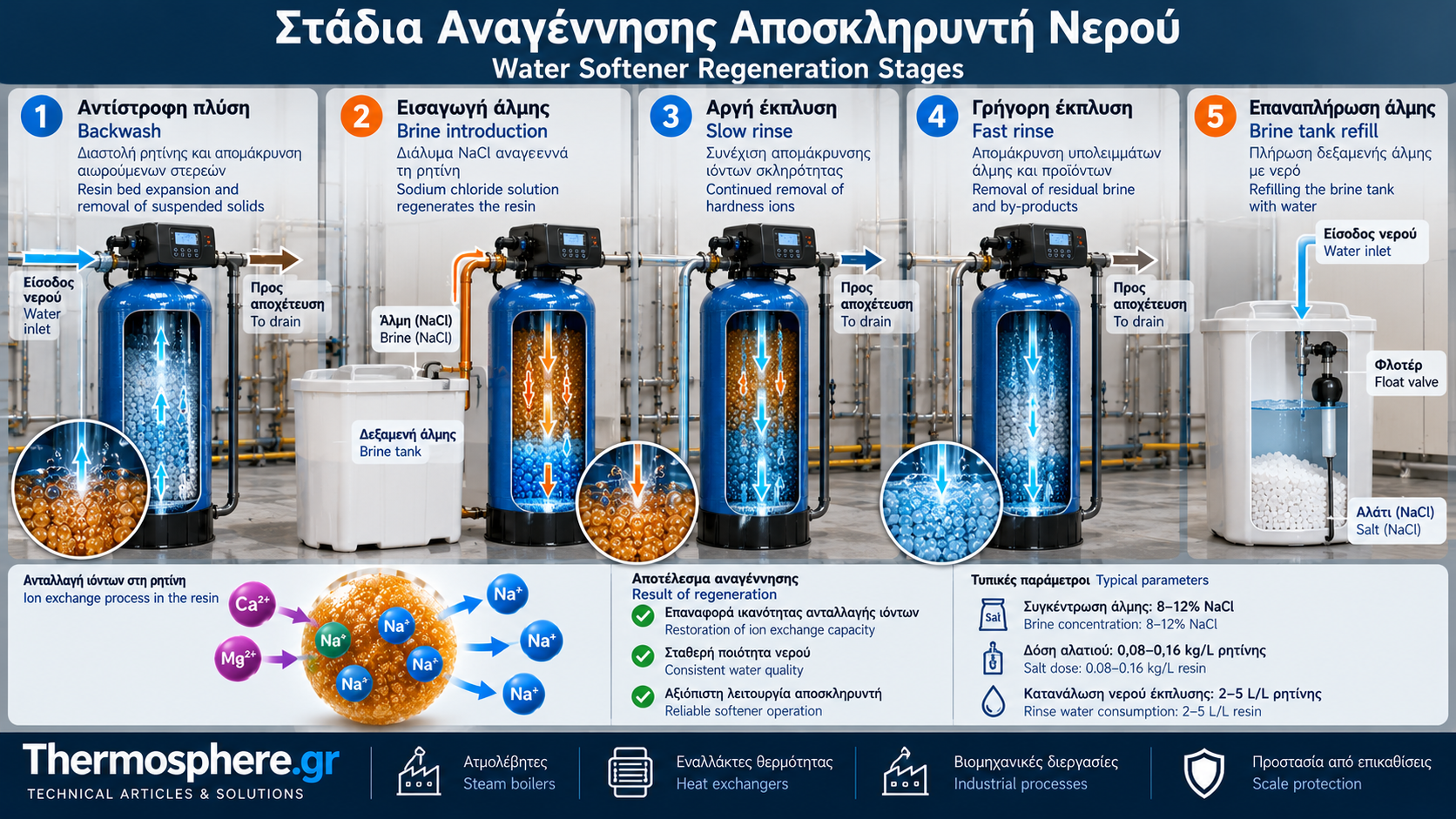
# Water Softener Regeneration: Stages, Brine and Salt Consumption
## Introduction
Regeneration is essential for maintaining the performance of a water softener using ion exchange resin.
During normal operation, the resin removes calcium (Ca²⁺) and magnesium (Mg²⁺) ions responsible for water hardness while releasing sodium (Na⁺) ions.
Over time, the available exchange capacity decreases. Regeneration with sodium chloride (NaCl) brine is required to restore a substantial portion of the resin's operating capacity.
Proper regeneration supports consistent treated water quality and reliable industrial water softener operation.
## 1. Why Does Ion Exchange Resin Require Regeneration?
Most conventional water softeners use strong acid cation exchange resin in sodium form.
During service, the following simplified reactions occur:
2 R–Na + Ca²⁺ → R₂–Ca + 2 Na⁺
2 R–Na + Mg²⁺ → R₂–Mg + 2 Na⁺
R represents an active resin exchange site.
As calcium and magnesium occupy the exchange sites, the resin's remaining softening capacity decreases.
If operation continues beyond the available capacity, hardness appears in the treated water. This is known as hardness breakthrough.
Regeneration restores the resin primarily to sodium form.
## 2. How Does Brine Regeneration Work?
Regeneration involves contacting exhausted resin with a concentrated sodium chloride solution.
The high sodium concentration shifts the ion exchange equilibrium and allows calcium and magnesium to be released from the resin.
A simplified reaction is:
R₂–Ca + 2 Na⁺ ⇌ 2 R–Na + Ca²⁺
Released hardness ions leave the vessel with spent regenerant and rinse wastewater.
Regeneration does not necessarily restore 100% of the resin's theoretical exchange capacity.
Actual recovery depends on salt dosage, brine concentration, contact time and system configuration.
## 3. When Does Regeneration Start?
Regeneration can be initiated using different control strategies.
### Time-based regeneration
Regeneration takes place at scheduled intervals.
This approach is simple but may not reflect actual water consumption.
### Volume-based regeneration
A flowmeter tracks the volume of water processed.
Regeneration is initiated when the programmed operating capacity is nearly exhausted, taking into account the required reserve.
### Water-quality-based regeneration
Some systems use outlet hardness measurements to support regeneration control.
The control strategy must prevent off-specification water from entering critical processes.
## 4. Stage 1: Backwashing
Backwashing uses water flowing in the reverse direction to normal service flow, where required by the equipment design.
Its main purposes are:
- Loosening and expanding the resin bed.
- Removing accumulated suspended solids.
- Reducing channeling problems.
- Preparing the bed for regeneration.
Required backwash flow depends on vessel diameter, resin properties and water temperature.
Excessive flow can cause resin loss through the drain.
Special regeneration configurations may use different sequences and do not necessarily include the same backwash step in every cycle.
## 5. Stage 2: Brine Introduction
Sodium chloride solution is introduced into the resin vessel.
The brine provides sodium ions required to regenerate exchange sites.
Brine delivery may use:
- Venturi injectors.
- Brine suction arrangements.
- Suitable dosing or transfer pumps.
Brine concentration, flow rate and contact time must follow resin and equipment manufacturer recommendations.
Insufficient brine or uneven distribution reduces regeneration effectiveness.
## 6. Stage 3: Slow Rinse
Slow rinsing generally follows brine introduction.
Water gradually displaces the brine through the resin bed while allowing continued contact.
This stage supports regeneration and removes displaced hardness ions.
Flow rate and duration depend on equipment specifications.
## 7. Stage 4: Fast Rinse
Fast rinsing removes residual brine and regeneration by-products.
Its purpose is to restore acceptable treated water quality before the softener returns to service.
For critical industrial applications, outlet water quality should be verified before reconnecting the system to the process.
## 8. Stage 5: Brine Tank Refill
The brine tank contains salt and the water required to prepare regeneration solution.
Refilling may occur before or after other regeneration stages, depending on the control configuration.
Important checks include:
- Adequate quantity of suitable salt.
- Correct water level.
- Tank cleanliness.
- Proper float or level control operation.
- Absence of salt bridging.
- Good brine suction line condition.
The presence of salt in the tank does not guarantee proper brine preparation or delivery.
## 9. Salt Consumption Calculation
Salt consumption depends on resin volume and the selected regeneration dose.
The basic relationship is:
mNaCl = Vresin × Dsalt
Where:
mNaCl = salt mass per regeneration (kg).
Vresin = resin volume (L).
Dsalt = salt dose (kg/L of resin).
Example:
Resin volume: 100 L.
Illustrative regeneration dose: 0.12 kg NaCl/L resin.
Therefore:
mNaCl = 100 × 0.12
mNaCl = 12 kg NaCl per regeneration.
This is an illustrative calculation, not a universal dosing recommendation.
Actual salt dose should be selected using manufacturer regeneration and operating capacity data.
## 10. Salt Consumption and Regeneration Efficiency
Increasing salt dose does not produce a proportional increase in operating capacity.
Higher doses may improve capacity recovery but often reduce salt-use efficiency.
Optimization must balance:
- Required outlet water quality.
- Operating exchange capacity.
- Regeneration frequency.
- Sodium chloride consumption.
- Rinse water consumption.
- Wastewater generation.
## 11. How Does Feedwater Hardness Affect Regeneration Frequency?
Higher inlet hardness increases the calcium and magnesium loading on the resin per unit volume of treated water.
For a fixed operating capacity, increasing hardness reduces the volume that can be treated between regenerations.
For example, if inlet hardness doubles while all other conditions remain unchanged, theoretical treated water volume between regenerations is approximately halved.
Actual calculations must account for usable resin capacity, reserve requirements and outlet quality specifications.
## 12. Common Regeneration Problems
### Insufficient brine suction
Possible causes include:
- Blocked injector.
- Low supply pressure.
- Air leakage in the suction line.
- Blocked brine tubing or filter.
- Control valve malfunction.
### High hardness after regeneration
Possible causes include:
- Insufficient salt dose.
- Incorrect brine concentration.
- Inadequate contact time.
- Resin fouling or degradation.
- Hydraulic bypass.
- Excessive service flow.
### Excessive salt consumption
Possible causes include:
- Excessive regeneration dose.
- Regeneration too frequently.
- Incorrect capacity settings.
- Faulty flow measurement.
- Leaks or control errors.
### Salty treated water
Possible causes include:
- Insufficient final rinsing.
- Premature return to service.
- Control valve malfunction.
- Incorrect cycle settings.
## 13. Preventive Maintenance
A maintenance program should include:
- Outlet hardness testing.
- Verification of regeneration sequences.
- Salt level and quality checks.
- Brine tank inspection.
- Injector and brine line inspection.
- Control valve and automation checks.
- Salt consumption records.
- Pressure drop monitoring.
- Resin condition assessment.
Maintenance must follow manufacturer instructions and applicable safety procedures.
## 14. Environmental Management of Regeneration Wastewater
Regeneration generates wastewater containing elevated salt concentrations and calcium and magnesium ions.
Disposal must comply with applicable environmental requirements and site discharge conditions.
Optimizing salt dosing and rinse volumes can reduce resource consumption and wastewater loading.
## Conclusion
Ion exchange resin regeneration is essential for reliable water softener performance.
The correct sequence of backwashing, brine introduction and rinsing helps restore operating capacity.
Salt consumption must be determined from actual technical data rather than arbitrary settings.
With systematic monitoring, proper maintenance and responsible wastewater management, industrial water softeners can deliver consistent water quality with controlled operating costs.
Thermosphere.gr – Technical Knowledge for Professionals.