
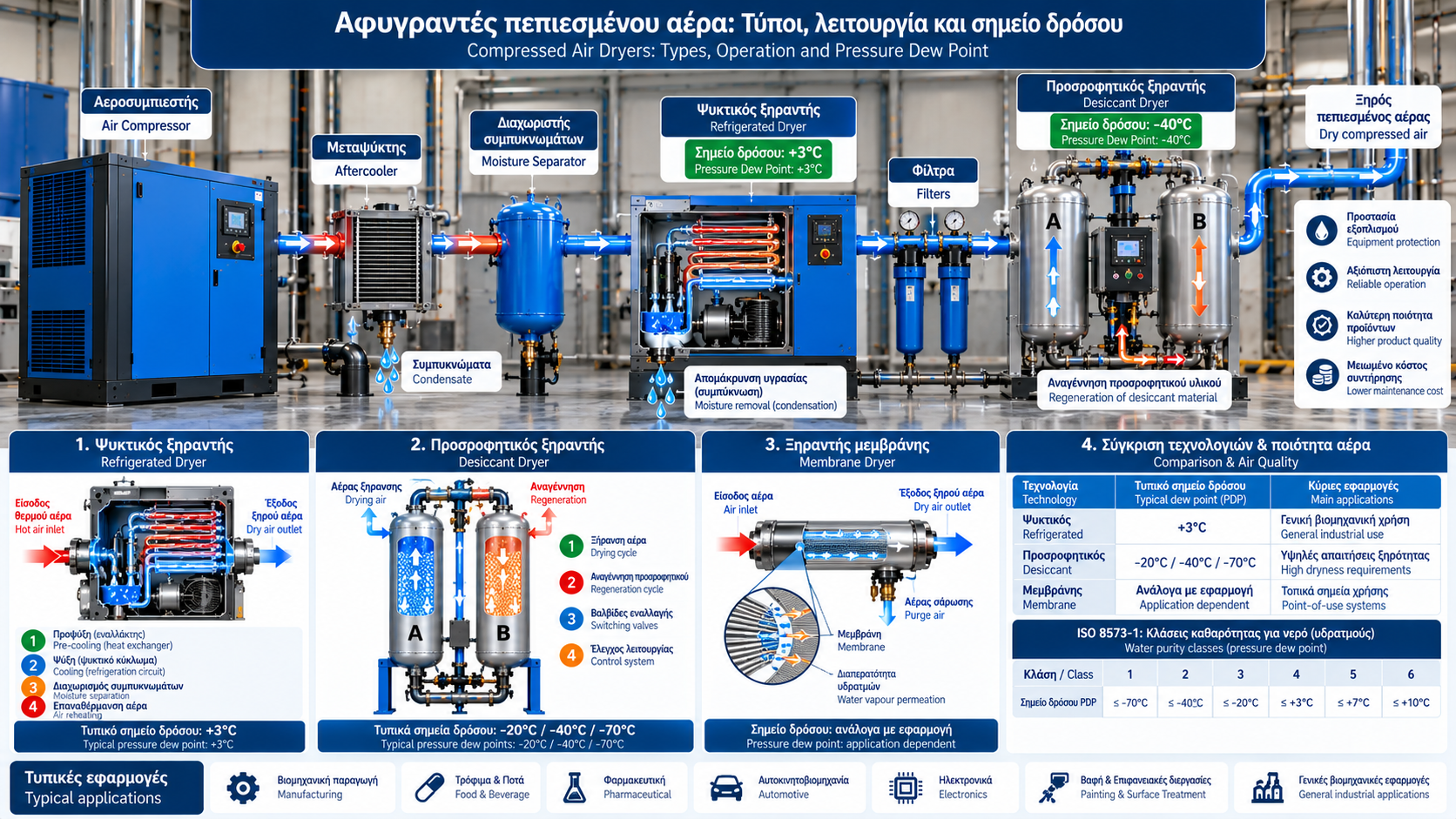
Compressed Air Dryers: Types, Operation and Pressure Dew Point
Moisture is one of the most important factors affecting the reliability and quality of industrial compressed air systems.
Atmospheric air contains water vapour. When this air is compressed and subsequently cooled, liquid water may form inside the compressed air system.
Moisture can cause pipe corrosion, pneumatic equipment malfunctions, product contamination and interruptions to industrial processes.
Compressed air dryers reduce the water vapour content of compressed air to achieve a specified pressure dew point.
Why Moisture Forms in Compressed Air Systems
The amount of water vapour in atmospheric air depends on temperature and relative humidity.
Compression increases the partial pressure of water vapour. As compressed air cools in an aftercooler or distribution system, some of the vapour may condense.
Moisture separators and automatic drains remove liquid condensate but cannot independently guarantee a low water vapour content.
Dedicated air dryers are therefore required when a specified dryness level must be maintained.
Understanding Pressure Dew Point
Dew point is the temperature at which air reaches saturation and water vapour begins to condense, assuming constant pressure and moisture content.
In compressed air systems, the relevant parameter is pressure dew point (PDP).
A lower PDP indicates a lower water vapour content at the same pressure.
For example, a PDP of +3°C means that condensation may begin if the compressed air is cooled to approximately +3°C at the specified pressure.
A PDP of -40°C indicates substantially drier air and is used in applications with stricter moisture requirements.
Pressure dew point must not be confused with atmospheric dew point.
Refrigerated Compressed Air Dryers
Refrigerated dryers cool compressed air to condense part of its water vapour.
A typical arrangement includes an air-to-air heat exchanger, refrigeration heat exchanger, moisture separator, condensate drain and air reheating stage.
Reheating the outgoing compressed air helps reduce external condensation on downstream piping.
Refrigerated dryers commonly provide a nominal PDP of approximately +3°C and are widely used in general industrial applications.
They are generally unsuitable when a substantially sub-zero pressure dew point is required.
Desiccant Compressed Air Dryers
Desiccant dryers use adsorbent materials, such as activated alumina or molecular sieves, to capture water vapour on their surfaces.
Many designs incorporate two vessels. One vessel dries the compressed air while the other undergoes regeneration.
Regeneration may use a portion of dry compressed air, external heating or other technologies.
Depending on equipment design and operating conditions, desiccant dryers can achieve PDP values of -20°C, -40°C or -70°C.
The energy required for regeneration and the compressed air consumed during purge cycles must be included in lifecycle cost calculations.
Membrane Air Dryers
Membrane dryers use selectively permeable materials that allow water vapour to migrate through the membrane.
A portion of the dry air is commonly used as sweep air.
These dryers are suitable for selected low-flow and point-of-use applications, particularly where electrical power is unavailable or undesirable.
Performance depends on operating pressure, inlet temperature, airflow and the required dew point reduction.
Comparison of Air Drying Technologies
Refrigerated dryers are often economical for general industrial service.
Desiccant dryers are typically selected for very low dew point requirements, including applications where freezing or condensation must be avoided in cold environments.
Membrane dryers can be useful for decentralized installations, although sweep air consumption must be considered.
ISO 8573-1 and Compressed Air Quality
ISO 8573-1 defines compressed air purity classes for particles, water and oil.
For water, selected pressure dew point classes include:
Class 1: PDP ≤ -70°C.
Class 2: PDP ≤ -40°C.
Class 3: PDP ≤ -20°C.
Class 4: PDP ≤ +3°C.
Class 5: PDP ≤ +7°C.
Class 6: PDP ≤ +10°C.
These classes provide a technical classification system but do not independently determine the appropriate air quality for every industrial process.
Selecting the Correct Compressed Air Dryer
Dryer selection begins with the required compressed air purity and pressure dew point.
Engineers must then evaluate actual airflow, operating pressure, inlet air temperature, ambient conditions and installation requirements.
Manufacturer capacity ratings are based on specified reference conditions. Correction factors must be applied when actual conditions differ.
Pressure drop, electrical consumption, regeneration air demand, maintenance requirements and total lifecycle cost should also be considered.
Maintenance and Common Problems
Refrigerated dryers require inspection of the refrigeration circuit, heat exchangers, condensate drains and dew point indication.
Desiccant dryers require inspection of switching valves, filters, adsorbent material and regeneration equipment.
An elevated pressure dew point may indicate excessive loading, high inlet temperature, insufficient regeneration or component malfunction.
Maintenance must follow manufacturer instructions, including electrical isolation and safe depressurization before intervention.
Conclusion
Compressed air drying is an essential stage of industrial air treatment.
Refrigerated dryers meet many general industrial requirements, while desiccant dryers are appropriate for applications requiring very low pressure dew points.
Correct selection depends on actual operating conditions, the required air purity class, pressure dew point and total energy consumption.