
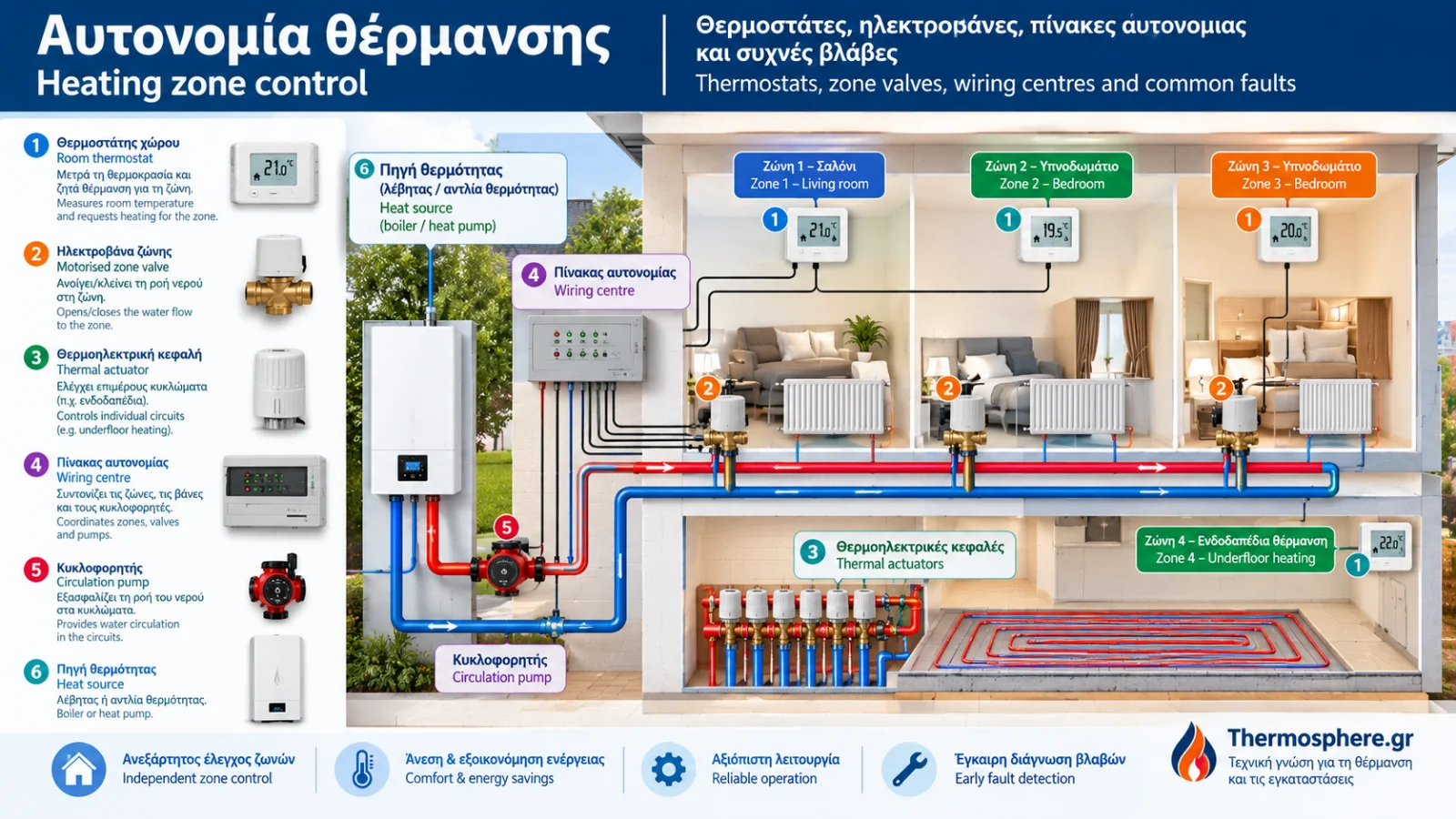
Heating Zone Control: Thermostats, Zone Valves, Wiring Centres and Common Faults
Heating zone control allows different rooms, apartments or areas of a building to request heat independently.
Instead of controlling an entire heating installation through a single thermostat, each zone can respond to its own temperature requirements.
This is achieved through the coordinated operation of room thermostats, motorised valves, circulation pumps, wiring centres and the central heat source.
However, installing multiple thermostats does not automatically guarantee effective heating zoning. Correct hydraulic design, electrical control and equipment compatibility are essential.
This Thermosphere.gr technical guide explains how heating zone control works, identifies the main components and describes common operating faults and troubleshooting principles.
1. What Is Heating Zone Control?
Heating zone control is the ability to regulate heating demand independently in different parts of a building.
A heating zone may represent:
An individual apartment.
A floor of a house.
A group of rooms.
A single room.
An underfloor heating circuit.
When a zone's temperature falls below its target value, its thermostat requests heating.
The zone controller or wiring centre coordinates the appropriate valves, pumps and heat source according to the installation design.
Important distinction: Independent zone control is not the same as independent heat generation. Several apartments may have separate heating controls while sharing a common boiler or heat pump.
2. Main Components of a Zoned Heating System
Typical components include:
Room thermostats: Measure indoor temperature and generate heating-demand signals.
Zone controller or wiring centre: Coordinates signals from different thermostats and controls the appropriate outputs.
Motorised zone valves: Open or close water flow to selected heating circuits.
Thermal actuators: Commonly installed on underfloor heating manifolds to control individual circuits.
Circulation pumps: Provide water circulation through the heating distribution system.
Heat source: A boiler, heat pump or other suitable heating appliance.
Sensors and auxiliary devices: May include temperature sensors, flow switches, differential-pressure devices and other controls.
Not every installation contains all these components. The configuration depends on the hydraulic and electrical design.
3. How Does a Heating Wiring Centre Work?
A heating wiring centre receives demand signals from room thermostats and coordinates the connected devices.
In a typical system with motorised zone valves, the sequence may be:
A room thermostat requests heating.
The controller sends an opening command to the corresponding valve.
The valve actuator moves to the required position.
Where fitted, an auxiliary end switch confirms that the valve has reached its designated position.
The controller enables the relevant boiler or pump demand.
Heated water circulates through the active zone.
When demand ends, the zone is disabled according to the system's control logic.
This is an illustrative sequence.
Other systems may issue heat-source demand simultaneously or use different control strategies.
4. What Is a Motorised Heating Zone Valve?
A motorised zone valve is a valve that regulates water flow through an electrically operated actuator.
Different constructions are available, including motorised ball valves and purpose-designed heating zone valves.
Depending on the model, a valve may have:
Two or more hydraulic ports.
An actuator with a specified supply voltage.
Spring return or powered opening and closing.
An auxiliary position switch.
A manual operating mechanism for designated maintenance procedures.
Valve selection depends on required flow, differential pressure, water temperature and control-system requirements.
5. Two-Wire and Three-Wire Zone Valves
Not all zone valves use the same wiring arrangement.
Some actuators use two conductors, while others require additional connections for supply, opening commands, closing commands or auxiliary functions.
The number of wires alone does not fully identify how a valve operates.
For example, a valve may use:
Electrical power to open and spring return to close.
Separate powered opening and closing commands.
An auxiliary switch to enable the heat source.
Important: There is no universal wiring diagram for all motorised valves.
The correct supply voltage, conductor functions and auxiliary contacts must be verified using the specific manufacturer's installation documentation.
6. What Is a Zone Valve End Switch?
Some motorised valves incorporate an auxiliary contact called an end switch.
This contact changes state when the valve mechanism reaches a defined position.
In appropriately designed installations, it can be used to enable the boiler or circulation pump after the valve has opened sufficiently.
This may help prevent operation without the intended water-flow path.
However, not every valve has an end switch, and not every heating controller uses the same operating sequence.
The end switch must only be used within its specified electrical ratings and approved wiring arrangement.
7. Zone Valves vs Thermal Actuators
Motorised zone valves and thermal actuators both control water flow, but they differ in design and typical application.
Feature | Motorised zone valve | Thermal actuator |
|---|---|---|
Typical application | Heating branches, apartments, zones | Underfloor heating manifolds |
Operating mechanism | Motorised or other suitable actuator | Thermally driven movement |
Operating time | Model-dependent | Often several minutes |
Auxiliary end switch | Available on selected models | Not always provided |
Supply voltage | Depends on actuator | Often 24 V or 230 V, depending on model |
The correct device must be selected according to the valve or manifold specifications, not supply voltage alone.
8. What Do NC and NO Mean on Thermal Actuators?
For thermal actuators, NC and NO generally describe the valve position in the specified unpowered state.
NC — Normally Closed: The valve is normally closed.
NO — Normally Open: The valve is normally open.
Actual operation depends on the actuator and valve design.
The choice between NC and NO must match the control strategy.
These designations should not be confused with the NO and NC contacts of an electrical relay, even though the terminology is similar.
9. Heating Zone Control in Apartment Buildings
In apartment buildings with a shared heat source, zoning allows each apartment to control its own heating demand.
A typical installation may include:
A thermostat in each apartment.
A motorised valve on each apartment's heating branch.
A central zone-control panel.
A shared boiler and circulation pump.
Appropriate heat metering or cost-allocation equipment where required.
Independent control does not automatically provide independent and accurate heat-energy measurement.
Heating-cost allocation is a separate issue governed by the installation design, applicable building arrangements and local requirements.
10. Heating Zones in Detached Houses
In a detached house, zoning may be used to control floors or rooms with different heating requirements.
For example:
Ground-floor zone.
Upper-floor zone.
Bedroom zone.
Underfloor heating zone.
The design must account for changes in total water flow and heating demand when only a small number of zones are active.
These changes can affect circulation-pump performance and heat-source operation.
11. Heating Zones with Heat Pumps
Multi-zone control requires particular attention in heat pump installations.
When several valves or thermal actuators close, the water flow through the system may decrease significantly.
Operating a single small zone can also create a heating demand below the heat pump's minimum available output.
Depending on the equipment, this may lead to:
Frequent starting and stopping.
Unstable operation.
Minimum-flow problems.
Protective shutdowns.
Reduced seasonal efficiency.
The installation must satisfy the manufacturer's minimum water-flow and water-volume requirements.
Some systems may require hydraulic separation, a buffer vessel or another engineered solution.
These components are not universally necessary in every installation.
12. What Happens When All Heating Zones Close?
When all zones stop requesting heat, the controller must manage the heat source and circulation pumps appropriately.
The correct operating sequence depends on the equipment.
Some installations allow pump overrun after heating demand ends.
Others use dedicated flow paths, bypass arrangements or hydraulic separation.
A bypass should not be installed without appropriate hydraulic assessment, as it may affect return temperatures, efficiency and heat-source operation.
13. How Do Thermostats, Zone Valves and Pumps Work Together?
The control strategy depends on the wiring centre or zone controller.
In an appropriately designed system, demand from any zone may open the relevant valve and generate a combined heating request.
The circulation pump must operate under conditions that provide adequate water flow.
In variable-flow systems, an electronically controlled pump may adjust its operation according to its available control modes.
However, an electronic circulation pump does not eliminate the need for correct hydraulic design.
14. Common Heating Zone Control Faults
The Thermostat Requests Heating but the Zone Remains Cold
Possible causes include:
Zone valve not opening.
Thermal actuator not operating.
Controller not recognising demand.
Insufficient water circulation.
Heat source not operating.
Air or hydraulic restrictions in the circuit.
A Zone Heats Up When Its Thermostat Is Off
Possible causes include:
Valve stuck open.
Mechanical valve failure.
Actuator malfunction.
Unwanted water flow through another path.
Incorrect control signal.
The Zone Valve Makes Noise
Possible causes include:
Mechanical wear.
Incorrect differential pressure.
Installation problems.
Actuator vibration.
Actuator and valve incompatibility.
The Boiler Starts but the Radiators Stay Cold
The valve positions, pump operation, water circulation and flow temperature should be investigated.
Heating Works in Some Apartments but Not Others
Possible causes include individual valve faults, wiring problems, thermostat settings or hydraulic balancing issues.
15. Professional Troubleshooting Procedure
A structured diagnostic approach helps identify the actual cause.
Step 1 — Identify the affected zone: Record which zone is affected and under what conditions.
Step 2 — Check the thermostat: Confirm heating demand using the thermostat's operating indications.
Step 3 — Check the controller: Determine whether the wiring centre recognises the demand and indicates the correct output state.
Step 4 — Check the valve: A qualified technician verifies the control signal and actual actuator operation.
Step 5 — Check the heat source: Determine whether the boiler or heat pump receives and responds to the heating request.
Step 6 — Check the hydraulic circuit: Assess water flow, temperatures and possible circulation restrictions.
Electrical measurements and interventions must only be performed by appropriately qualified personnel following suitable safety procedures.
16. Heating Zone Control Maintenance
Periodic maintenance may include:
Checking thermostat operation.
Inspecting actuator condition.
Checking for water leaks.
Confirming valve operation.
Reviewing controller indications.
Assessing circulation and hydraulic balancing.
Inspecting electrical connections by a qualified technician.
Inspection frequency and procedures should follow the equipment manufacturer's requirements and the installation's operating conditions.
17. Frequently Asked Questions
What Is a Heating Wiring Centre?
It is a controller that receives thermostat signals and coordinates valves, pumps and heat-source demand.
Why Is My Zone Valve Not Opening?
Possible causes include supply problems, actuator failure, mechanical valve faults or missing control signals.
What Does NC Mean on a Thermal Actuator?
It generally indicates that the valve is normally closed when the actuator is unpowered, according to the model's specifications.
Can I Install Heating Zones in Every Room?
This is technically possible in many installations, but hydraulic operation and heat-source compatibility must be assessed.
Can a Heat Pump Operate with Multiple Heating Zones?
Yes, provided the installation maintains the required flow, water volume and acceptable operating conditions.
Does Heating Zoning Mean Each Apartment Pays Exactly for the Heat It Uses?
Not necessarily. Independent control and heat-energy measurement or cost allocation are separate functions.
Conclusion
Heating zone control provides independent temperature management for different areas of a building, but effective operation depends on coordinated electrical and hydraulic components.
Thermostats, motorised valves, thermal actuators, wiring centres and circulation pumps must operate as one integrated system.
Effective zoning is not simply about adding more thermostats. It requires correct management of heating demand, water circulation and heat-source operation.
Technical References and Further Reading
EN 60730-1: Automatic electrical controls — General requirements.
EN ISO 52120-1: Energy performance of buildings — Contribution of building automation, controls and building management.
EN 1264 series: Water based surface embedded heating and cooling systems.
Official valve and heating-control documentation: Resideo, Danfoss, Siemens, Caleffi and other manufacturers.
Boiler and heat pump installation manuals: Minimum flow, water-volume requirements and supported control strategies.
Safety note: This article provides general technical information and does not replace equipment-specific hydraulic design or electrical wiring diagrams. Electrical work and heating-control modifications must be performed by appropriately qualified personnel.
Thermosphere.gr — Technical knowledge for heating and building systems.