
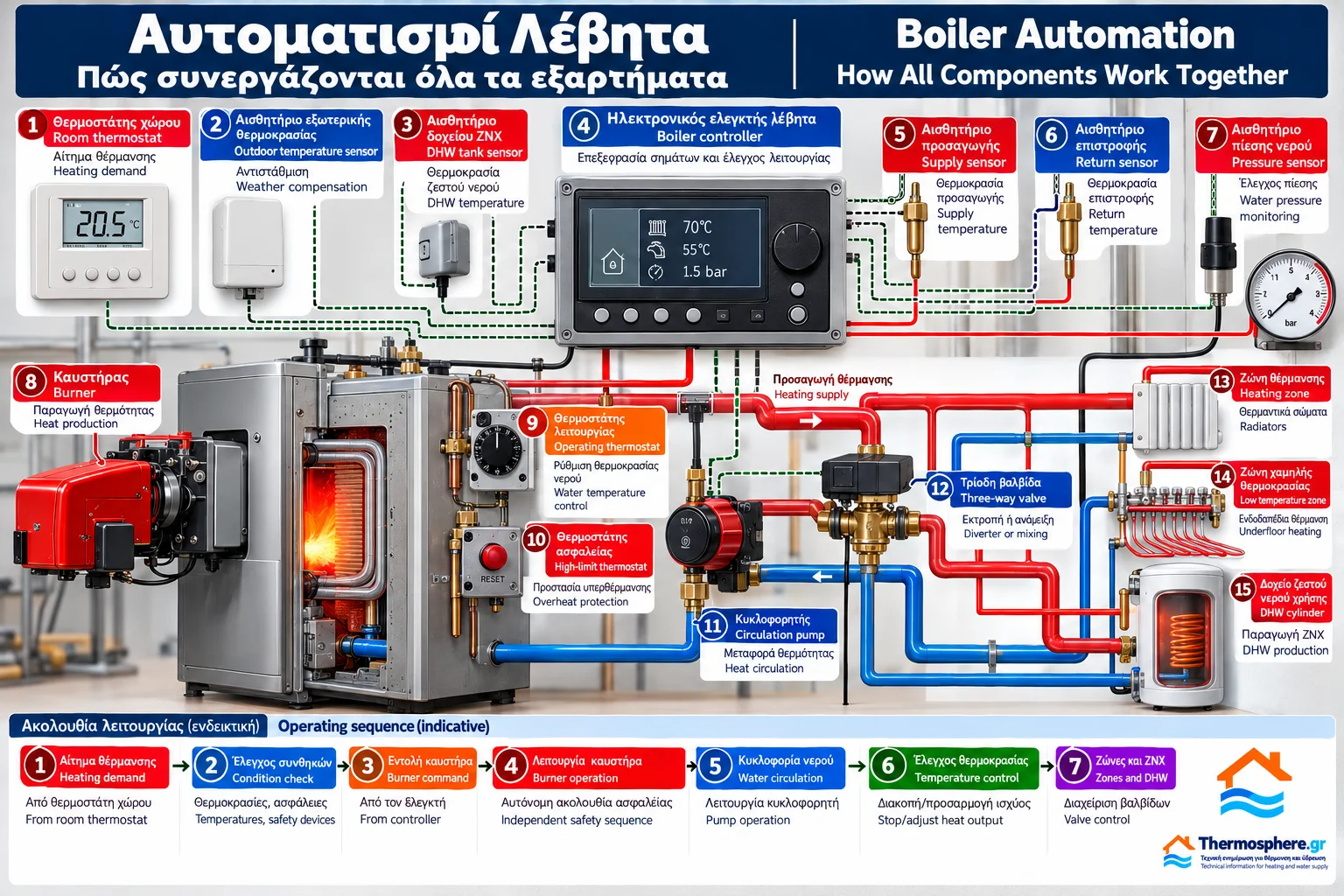
Heating Boiler Automation: How All Components Work Together
Heating boiler automation coordinates heat generation, water circulation and temperature regulation. It is not limited to starting and stopping the burner. Depending on the installation, it may also control circulation pumps, valves, heating zones, domestic hot water production and protective functions.
In a simple conventional boiler, control may rely on mechanical thermostats and electromechanical relays. Modern boilers generally use electronic controllers that process sensor information and execute programmed control functions.
The exact automation architecture depends on the boiler, burner, hydraulic arrangement and heating requirements.
1. What Is Boiler Automation?
Boiler automation refers to the devices and control functions that manage the heating installation according to defined operating conditions.
An automation system generally includes three elements:
Inputs: Sensors, thermostats, switches and signals from external equipment.
Controller: An electronic device or electromechanical arrangement that processes the inputs.
Outputs: Commands to burners, circulation pumps, valves, relays and other devices.
The fundamental principle is to receive information, evaluate operating conditions and initiate appropriate actions.
2. Main Boiler Automation Components
Depending on the system design, boiler automation may involve:
Electronic boiler controller.
Operating thermostat.
High-limit safety thermostat.
Room thermostat.
Supply temperature sensor.
Return temperature sensor.
Outdoor temperature sensor.
Domestic hot water cylinder sensor.
Burner and independent burner controller.
Heating circulation pump.
Cylinder charging pump.
Three-way diverting or mixing valve.
Heating zone valves.
Relays and contactors.
Additional protective devices.
Not every boiler includes all these components.
3. Electronic Boiler Controller
The electronic controller is the central management device in many modern heating systems.
It receives sensor information and compares actual operating conditions with the required values.
Depending on its capabilities, it may:
Enable or interrupt heat production.
Regulate supply water temperature.
Control circulation pumps.
Manage heating zones.
Operate valves.
Prioritise domestic hot water production.
Apply weather-compensated control.
Record operating conditions and faults.
The controller may be integrated into the boiler or installed separately.
4. How Does Heating Start?
The operating sequence begins when the system detects a demand for heat.
For example, a room thermostat may request heating when the room temperature falls below the selected setpoint.
The controller receives this demand and evaluates the required operating conditions.
When the necessary conditions are satisfied, it may activate the circulation pump and permit burner operation.
The exact startup sequence varies between boiler designs.
5. Room Thermostat and Boiler Interaction
A room thermostat does not necessarily measure boiler water temperature.
It measures or evaluates room temperature and indicates the need for space heating.
In a basic ON/OFF arrangement, the thermostat provides a heating demand signal.
In more advanced systems, a compatible digital controller may transmit additional information, such as a target supply temperature or required heating output.
Digital communication requires compatible equipment and protocols.
6. Boiler Water Temperature Control
The controller monitors boiler water temperature using a suitable sensor or thermostat.
In a simple arrangement, heat production may stop when the upper temperature limit is reached and restart when the temperature falls below another threshold.
The difference between these thresholds is known as hysteresis.
Boilers with modulation capability may adjust heating output rather than relying exclusively on repeated starts and stops.
This requires compatible boiler, burner and control equipment.
7. Interaction With the Burner Controller
The boiler controller and burner controller are not necessarily the same device.
The boiler controller manages heating demand and target water temperature.
The burner controller manages its assigned combustion safety functions.
Depending on the burner design, these may include:
Startup sequencing.
Preparation or pre-purge.
Ignition.
Flame supervision.
Fuel valve management.
Safety shutdown.
Burner lockout.
A heating demand signal does not bypass the burner's independent safety sequence.
The exact functions depend on the equipment.
8. Circulation Pump Automation
The circulation pump transfers heat from the boiler to the heating network.
Its operation may depend on:
Heating demand.
Boiler water temperature.
Burner status.
Heating zone requirements.
Frost protection.
Pump overrun strategy.
Correct circulation is essential for transferring heat away from the boiler.
9. What Is Pump Overrun?
Pump overrun is the continued operation of a circulation pump after combustion stops.
It may continue for a specified period or until a temperature condition is satisfied.
Its purpose is to remove residual heat from the boiler body or heat exchanger.
Pump overrun can:
Reduce local temperature rise.
Recover some residual heat.
Limit thermal stress.
The duration and operating conditions depend on the manufacturer and hydraulic installation.
10. Weather-Compensated Heating Control
Weather compensation adjusts the required heating supply temperature according to outdoor conditions.
The system generally uses an outdoor temperature sensor and a heating curve.
When outdoor temperature decreases, the controller may increase the required supply temperature.
When outdoor temperature rises, it may reduce the supply temperature.
Correct heating curve settings depend on:
Building heat losses.
Type of heat emitters.
Hydraulic system design.
Required indoor comfort conditions.
Weather compensation can improve heating efficiency when correctly configured.
11. Three-Way Valve Automation
Three-way valves can perform different functions.
Three-Way Diverting Valve
A diverting valve directs water flow toward different circuits.
For example, it may switch between space heating and domestic hot water cylinder charging.
Three-Way Mixing Valve
A mixing valve combines water streams at different temperatures to achieve a suitable supply temperature.
It may be used in lower-temperature heating circuits, including underfloor heating.
These two applications should not be confused.
12. Heating Zone Automation
In multi-zone heating installations, each zone may have its own room thermostat.
The thermostats communicate heating demand to a central controller or zone control panel.
The automation may operate:
Zone valves.
Zone circulation pumps.
Central heat generation demand.
Operating priorities.
For example, when a zone requests heating, the controller may open its valve and activate the required pump.
Heat generation is then enabled according to the approved operating sequence and necessary permissive conditions.
13. Domestic Hot Water Priority
Heating installations with a separate domestic hot water cylinder may provide priority to cylinder charging.
When cylinder temperature falls below the required threshold, the controller may:
Detect the cylinder heating demand.
Activate the charging pump or diverting valve.
Adjust the operating temperature where supported.
Stop charging when the required temperature is reached.
Resume space heating operation.
The exact sequence depends on system design.
Cylinder temperature settings must account for water hygiene and scalding protection.
14. Overtemperature Protection
Overtemperature protection is a critical safety function.
Many boilers incorporate a separate high-limit temperature protective device.
If temperature exceeds the permitted limit, the device may interrupt heat production and require a reset.
Where independent protection is required by the approved design, it must not rely solely on an ordinary software operating command.
Protective devices must never be bypassed.
15. Insufficient Water Circulation Protection
Insufficient water circulation can cause rapid temperature increases within the boiler.
Depending on the design, the controller may use:
Temperature sensors.
Flow switches.
Pressure switches.
Temperature differential monitoring.
Other approved protective arrangements.
Temperature measurement alone does not necessarily provide direct water flow measurement.
16. Boiler Return Temperature Protection
In many conventional non-condensing boilers, excessively low return water temperature can cause undesirable flue gas condensation.
Possible protective measures include:
Suitable hydraulic arrangements.
Mixing valves.
Recirculation pumps.
Return temperature control.
Requirements depend on the boiler design.
In condensing boilers, lower return water temperatures generally support improved latent heat recovery within the approved operating range.
17. Frost Protection
Some electronic boiler controllers provide frost protection functions.
When a monitored temperature falls below a specified threshold, the controller may activate circulation or heat production.
These functions generally require available electrical power and suitable operating conditions.
They do not guarantee protection of every pipe or external part of the installation.
18. Building Management System Integration
Larger installations may connect the boiler to a Building Management System (BMS).
Depending on the equipment, integration may support:
Temperature monitoring.
Operating status display.
Fault recording.
Scheduling.
Energy data monitoring.
Permitted remote commands.
Available communication protocols and functions vary.
Remote commands must not override local safety protections.
19. Example of an Integrated Operating Sequence
Consider a hypothetical installation with a boiler, two heating zones and a separate domestic hot water cylinder.
Step 1: Heating Demand
The first heating zone thermostat requests heat.
Step 2: Zone Control
The controller activates the relevant zone valve or circulation pump.
Step 3: Operating Condition Verification
The controller evaluates the required conditions according to the system design.
Step 4: Heat Generation Request
The controller requests burner operation when necessary.
Step 5: Burner Safety Sequence
The independent burner controller executes its approved startup and safety sequence.
Step 6: Water Heating
The boiler increases the heating water temperature.
Step 7: Temperature Regulation
The controller maintains the required water temperature according to its control strategy.
Step 8: Zone Demand Satisfied
When the room thermostat no longer requests heating, the corresponding demand is removed.
Step 9: Pump Overrun
The circulation pump may continue operating according to the programmed conditions.
Step 10: Domestic Hot Water Demand
If the cylinder requires heating, the controller may activate the cylinder charging circuit and apply the appropriate priority.
This example describes functional logic, not a specific electrical wiring arrangement.
20. Common Boiler Automation Problems
Boiler Does Not Start
Possible causes include:
No heating demand.
Required water temperature already reached.
Active protective shutdown.
Sensor fault.
Controller or burner fault.
Circulation Pump Runs Continuously
This may be normal under certain control strategies or result from an incorrect command, setting or fault.
Heating Zones Do Not Warm Correctly
Possible causes include thermostat, zone valve, pump or hydraulic balancing problems.
Boiler Starts Too Frequently
Frequent cycling may be associated with oversizing, low active system water volume, unsuitable hysteresis or control strategy.
Sensor Faults Are Displayed
The relevant sensors, wiring and controller inputs must be inspected.
Accurate diagnosis requires appropriate measurements and manufacturer documentation.
21. Optimising Boiler Automation
Correct configuration can improve comfort, reliability and energy performance.
Important considerations include:
Suitable supply water temperature.
Correct weather compensation curve.
Appropriate hysteresis or modulation strategy.
Coordination of pumps and heating zones.
Effective operating schedules.
Avoidance of unnecessary burner cycling.
Appropriate domestic hot water management.
Maintenance of sensors and electrical contacts.
Adjustments must remain within manufacturer-approved limits and must not compromise safety functions.
22. Conventional vs Modern Boiler Automation
Feature | Conventional Automation | Modern Electronic Automation |
|---|---|---|
Temperature control | Mechanical thermostat | Electronic sensors and controller |
Operating logic | Electromechanical contacts | Programmed functions |
Heating output | Often ON/OFF | Modulation where supported |
Weather compensation | Additional controller | Often integrated or optional |
Diagnostics | Limited indications | Fault codes and operating data |
Zone management | External control panel | Integrated or external |
Protection | Separate protective devices | Separate and/or certified electronic safety functions |
Conclusion
Boiler automation coordinates sensor and thermostat information with commands to the burner, circulation pumps and valves.
Correct interaction between these components ensures that heat is produced when required, distributed effectively and regulated according to the installation's operating needs.
Effective boiler automation means more than starting and stopping the burner. It means coordinating all system components while maintaining appropriate control and independent safety protection where required.
This article is intended for technical information. Electrical connections, safety parameter adjustments and control system modifications must be performed by qualified personnel according to manufacturer instructions.
Thermosphere.gr — Technical information for heating and water supply.