
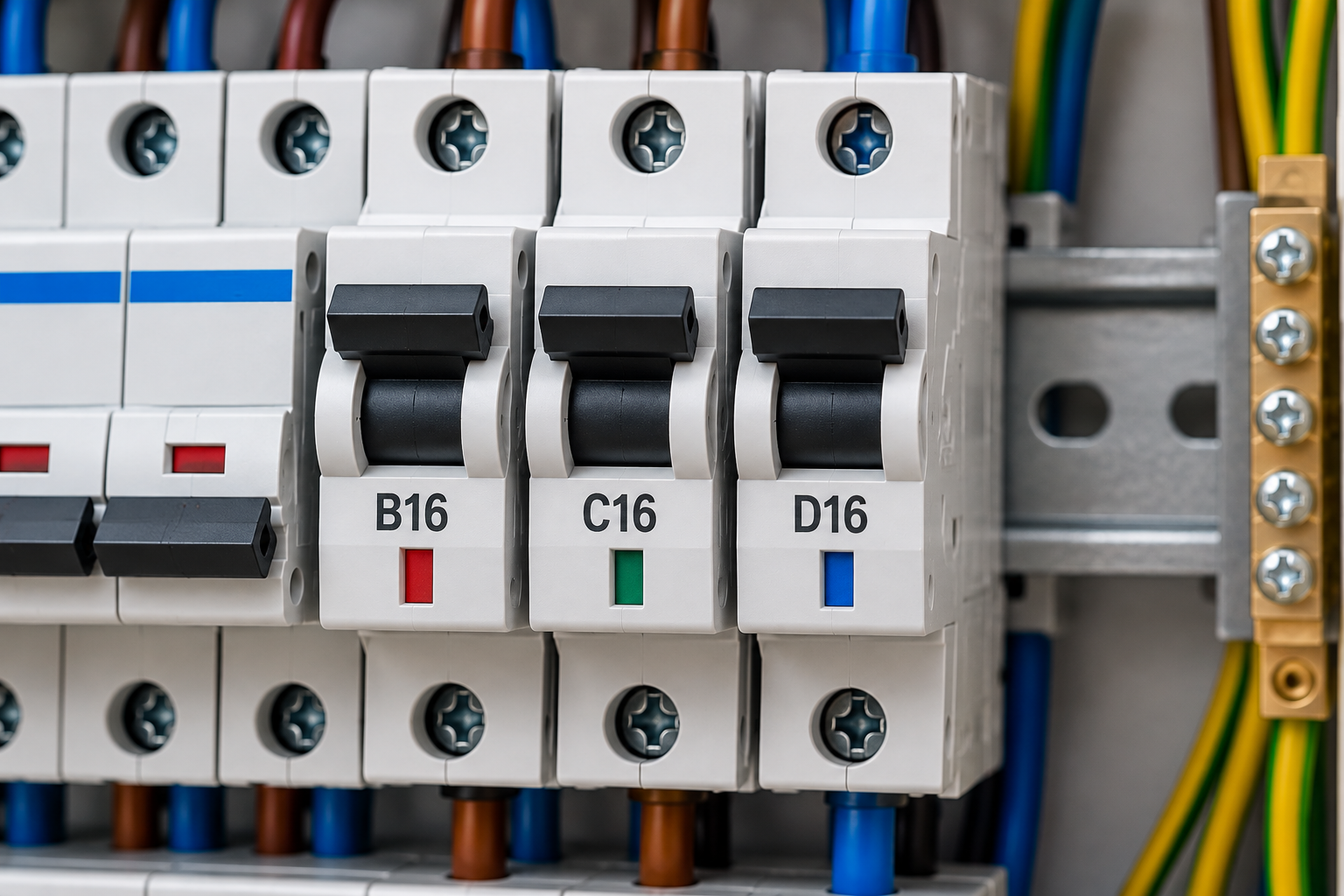
Miniature Circuit Breakers: B, C, D Curves and 10A–25A Ratings Explained
Miniature circuit breakers are essential protective devices in residential and commercial electrical installations. Inside an electrical distribution board, you may find breakers marked B10, B16, C16, C20 or D16.
But what do these letters and numbers actually mean? What is the difference between a 10A and a 16A circuit breaker? And why should you never replace a B16 with a C16, or a 16A breaker with a 25A breaker, without proper electrical assessment?
This guide explains miniature circuit breaker ratings, tripping curves, common applications and the technical factors involved in selecting the correct protective device.
What Is a Miniature Circuit Breaker (MCB)?
A miniature circuit breaker, commonly called an MCB, is a protective device designed to interrupt an electrical circuit when excessive current occurs.
It primarily protects against two conditions:
Overload: Current exceeds the permitted level for a sufficient period.
Short circuit: A fault produces a potentially very high current.
Conventional thermal-magnetic MCBs use two operating mechanisms.
The thermal mechanism responds to sustained overcurrent, while the magnetic mechanism provides rapid tripping at sufficiently high currents.
The B, C and D classifications mainly describe the instantaneous magnetic tripping characteristics.
What Do B10, B16, C16 and D16 Mean?
An MCB marking normally includes a letter followed by a number.
The letter B, C or D identifies the instantaneous tripping curve.
The number 10, 16, 20 or 25 indicates the rated current in amperes (A).
For example:
B10: Type B curve, rated current 10A.
B16: Type B curve, rated current 16A.
C16: Type C curve, rated current 16A.
D16: Type D curve, rated current 16A.
A B16 and a C16 have the same rated current but different instantaneous magnetic tripping characteristics.
A C16 does not automatically allow a higher continuous load than a B16.
Type B Circuit Breaker: How Does It Work?
Type B MCBs have a standard instantaneous magnetic tripping range of approximately 3 to 5 times their rated current under IEC 60898-1.
For a B16 circuit breaker:
3 × 16A = 48A.
5 × 16A = 80A.
These values describe the standardized instantaneous tripping band rather than a single exact operating threshold.
Type B breakers may be suitable for appropriately designed circuits with relatively low starting currents.
However, their suitability must always be verified against the electrical installation’s characteristics.
Type C Circuit Breaker: What Is the Difference?
Type C MCBs have an instantaneous magnetic tripping range of approximately 5 to 10 times their rated current.
For a C16 circuit breaker:
5 × 16A = 80A.
10 × 16A = 160A.
Type C breakers may be suitable for circuits where equipment produces higher temporary starting currents.
Examples can include certain electric motors, transformers and electronic power supplies.
However, a Type C breaker is not automatically better than a Type B breaker.
The installation must provide adequate fault current and meet the applicable automatic disconnection requirements.
Type D Circuit Breaker: When Is It Used?
Type D MCBs have an instantaneous magnetic tripping range of approximately 10 to 20 times their rated current.
For a D16 circuit breaker:
10 × 16A = 160A.
20 × 16A = 320A.
Type D breakers may be used in suitable installations with particularly high inrush currents.
Examples include certain motors, transformers and specialized industrial equipment.
Because Type D breakers require higher current for instantaneous magnetic operation, their application requires careful verification of fault conditions.
They should not be installed arbitrarily in residential circuits.
Type B vs Type C vs Type D: Comparison Table
Tripping Curve | Instantaneous Tripping Range | Example: 16A Breaker |
B | 3–5 × In | 48–80A |
C | 5–10 × In | 80–160A |
D | 10–20 × In | 160–320A |
In represents the rated current of the circuit breaker.
These ranges concern instantaneous magnetic operation, not the entire overload protection characteristic.
What Is the Difference Between 10A, 16A, 20A and 25A Breakers?
The ampere rating indicates the circuit breaker’s nominal current.
However, the correct rating cannot be determined from the connected appliance’s power alone.
The selection must consider:
Conductor cross-sectional area and material.
Cable installation method.
Ambient temperature.
Grouping of cables and circuits.
Load characteristics.
Overload and short-circuit protection requirements.
Fault current and automatic disconnection conditions.
10A Circuit Breaker
A 10A MCB may be used in circuits designed for this rated current, provided the relevant protection requirements are satisfied.
16A Circuit Breaker
A 16A MCB is commonly encountered in residential installations, but its suitability depends on the wiring system and circuit design.
20A Circuit Breaker
A 20A breaker may be used for circuits with different load and wiring requirements.
It must be selected according to the installation’s verified characteristics.
25A Circuit Breaker
A 25A breaker is appropriate only where the circuit design and protective requirements permit its use.
A higher ampere rating does not automatically provide better protection.
How Many Watts Can 10A, 16A, 20A and 25A Handle?
For a simplified single-phase calculation at 230V and a power factor of 1:
P = V × I
Where:
P = Active power in watts.
V = Voltage in volts.
I = Current in amperes.
The theoretical results are:
Rated Current | Calculated Power at 230V |
10A | 2,300W |
16A | 3,680W |
20A | 4,600W |
25A | 5,750W |
These are mathematical reference values, not automatically permitted continuous circuit loads.
For equipment with a power factor below 1, the active power is calculated differently.
The actual permissible load depends on the wiring design, protective device and installation conditions.
This table must not be used on its own to select a circuit breaker.
Which Circuit Breaker Is Suitable for Electrical Sockets?
There is no universal MCB rating suitable for every socket circuit.
The correct protective arrangement depends on:
Circuit wiring.
Socket ratings.
Installation method.
Expected electrical load.
Applicable electrical standards.
A socket rated at 16A does not mean that the circuit can safely be protected by an arbitrarily larger breaker.
The complete circuit must be assessed.
Which Circuit Breaker Is Suitable for Lighting?
Lighting circuits can have different requirements depending on the installation.
Modern LED lighting often consumes relatively little power during normal operation.
However, some LED drivers and electronic power supplies can generate substantial short-duration inrush currents.
These characteristics may affect protective device selection.
A Type C or Type D breaker should not be selected simply because LED lighting is installed.
Which Circuit Breaker Is Suitable for an Electric Water Heater?
Electric water heaters should be connected through appropriately designed and protected electrical circuits.
The required circuit breaker depends on the heater’s rated power, conductor characteristics, installation conditions and manufacturer’s instructions.
Selecting a breaker solely by dividing the appliance’s wattage by the supply voltage is insufficient to verify electrical safety.
Which Circuit Breaker Is Suitable for a Heat Pump?
Modern heat pumps may contain compressors, inverters, circulation pumps, electronic controllers and auxiliary electric heating elements.
Their electrical protection requirements vary between models.
The correct MCB must be selected using the manufacturer’s electrical specifications and the installation design.
Not every heat pump requires a Type C or Type D breaker.
The appropriate curve and rated current must be determined for the specific equipment and circuit.
Why Should You Not Replace a B16 With a C16 Without Testing?
A B16 and a C16 both have a rated current of 16A.
However, the C16 has a higher instantaneous magnetic tripping range.
Changing the tripping curve may affect the circuit’s ability to disconnect within the required time during a fault.
A qualified electrician may need to assess:
Earth fault loop impedance.
Available fault current.
Automatic disconnection requirements.
Earthing arrangements.
Coordination with other protective devices.
If a circuit breaker repeatedly trips, the underlying cause should be investigated before changing the protective device.
Can You Replace a 16A Breaker With a 20A or 25A Breaker?
Not without an appropriate technical assessment.
Increasing the rated current can leave the circuit conductors inadequately protected against overload.
For example, replacing a 16A breaker with a 25A breaker does not increase the cable’s safe current-carrying capacity.
That capacity depends on conductor properties and installation conditions.
A higher-rated breaker may permit excessive current to flow for too long before disconnecting.
Any change must be supported by a proper electrical assessment.
What Do 4.5kA, 6kA and 10kA Mean on a Circuit Breaker?
In addition to the rated current and tripping curve, an MCB has a rated short-circuit breaking capacity.
Common markings include:
4.5kA.
6kA.
10kA.
These values relate to the circuit breaker’s ability to interrupt short-circuit currents under specified test conditions.
The required breaking capacity depends on the prospective short-circuit current at the installation point and the applicable product standard.
A 6kA breaker is not automatically suitable for every distribution board.
Does an MCB Replace an RCD?
No.
An MCB protects against overcurrent, including overloads and short circuits.
An RCD (Residual Current Device) detects residual current and disconnects the circuit under specified conditions.
These devices provide different forms of protection.
Some combined devices, called RCBOs, integrate residual-current protection and overcurrent protection.
The correct arrangement depends on the installation’s protective requirements.
When Should You Contact a Qualified Electrician?
Professional inspection is recommended when:
A circuit breaker trips repeatedly.
You want to change from Type B to Type C or D.
You are considering increasing a breaker’s ampere rating.
A new high-power appliance is being installed.
There are signs of overheating in the electrical panel.
The installation is old or has been modified.
The suitability of existing protective devices is uncertain.
Never open an electrical distribution board or handle internal wiring without the necessary professional qualifications and safety procedures.
Frequently Asked Questions
Is a C16 better than a B16?
Not necessarily. Both are rated at 16A, but they have different instantaneous tripping characteristics. The correct choice depends on the circuit.
What does B16 mean?
It indicates a Type B instantaneous tripping curve and a rated current of 16A.
What does C20 mean?
It indicates a Type C instantaneous tripping curve and a rated current of 20A.
Can a D16 breaker be used in a house?
Only when the particular application and protection conditions justify its use. It is not a general-purpose replacement for residential circuit breakers.
Does a 25A breaker provide better protection than a 16A breaker?
No. If a circuit requires 16A protection, installing a 25A breaker may compromise overload protection.
Is an MCB Type B the same as an RCD Type B?
No. Type B on an MCB refers to its instantaneous overcurrent tripping curve.
Type B on an RCD refers to the residual-current waveforms that the device is designed to detect.
These classifications describe different electrical characteristics.
Conclusion
Selecting a miniature circuit breaker involves much more than choosing an ampere rating.
Type B, C and D breakers have different instantaneous magnetic tripping characteristics, while ratings such as 10A, 16A, 20A and 25A indicate nominal current.
Correct selection requires consideration of conductor characteristics, connected loads, fault conditions, breaking capacity and applicable electrical standards.
Changing a circuit breaker’s rating or tripping curve without proper assessment can introduce serious electrical safety risks.
thermosphere.gr — Practical technical knowledge for safer electrical installations.
Disclaimer: This article provides general technical information and does not replace professional electrical design, inspection or installation.
Technical References
IEC 60898-1 — Circuit-breakers for overcurrent protection for household and similar installations.
IEC 60364-4-43 — Protection against overcurrent.
IEC 60364-4-41 — Protection against electric shock.
IEC 60364-5-52 — Selection and erection of wiring systems.
ELOT 60364 — Requirements for electrical installations in Greece.