
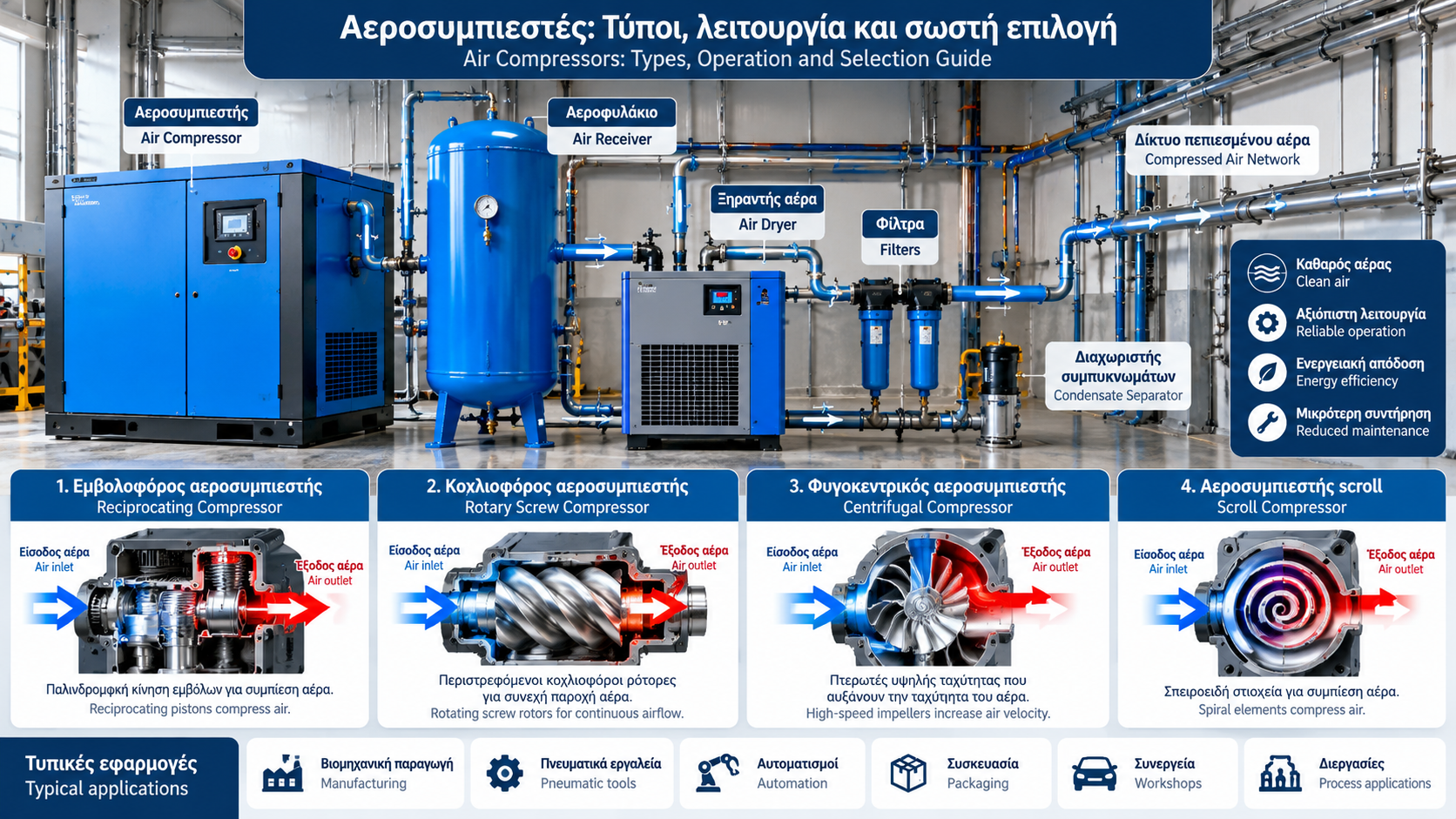
Air Compressors: Types, Working Principles and Selection Guide
Compressed air is an essential utility in industrial production, powering pneumatic tools, automated machinery, packaging equipment and manufacturing processes.
Selecting an air compressor requires more than comparing motor ratings. Engineers must evaluate actual air demand, operating pressure, load profiles, air quality requirements and total lifecycle costs.
How Air Compressors Work
An air compressor draws in atmospheric air and increases its pressure through mechanical compression. The process requires energy and generates heat.
Two fundamental compression principles are used: positive displacement and dynamic compression.
Positive displacement compressors reduce the volume of trapped air. Dynamic compressors accelerate flowing air and convert velocity energy into static pressure.
Main Types of Industrial Air Compressors
Reciprocating Compressors
Reciprocating compressors use pistons moving inside cylinders to draw in and compress air.
They are commonly used for intermittent applications, workshops and specialized high-pressure installations. Their suitability depends on the machine design and required duty cycle.
Rotary Screw Compressors
Rotary screw compressors use intermeshing rotors to reduce the volume of trapped air as it moves through the compression element.
These compressors are widely used in industrial facilities with sustained air demand. Available configurations include oil-injected and oil-free designs, with fixed-speed or variable-speed control.
Centrifugal Compressors
Centrifugal compressors accelerate air using high-speed impellers. Diffusers convert a portion of the kinetic energy into static pressure.
They are commonly selected for large industrial airflow requirements.
Scroll Compressors
Scroll compressors use two interleaving spiral elements, typically one fixed and one orbiting, to compress air.
They are suitable for selected applications requiring compact equipment and relatively quiet operation.
Key Technical Specifications
Operating Pressure
Operating pressure is generally specified in bar(g). The selected compressor must provide sufficient pressure at the point of use, accounting for losses through dryers, filters, piping and fittings.
Airflow Capacity
Airflow is expressed in m³/min, m³/h or l/s. Free Air Delivery (FAD) should be compared under equivalent reference conditions and discharge pressures.
Motor Power and Specific Energy
Motor power alone does not establish compressor efficiency. Actual electrical input power and delivered airflow should be evaluated at the intended operating point.
Duty Cycle
Operating hours, start frequency and variations in demand influence compressor technology, control strategy and receiver sizing.
Selecting the Right Air Compressor
The selection process begins with an assessment of compressed air consumption.
Engineers should determine simultaneous equipment demand, peak requirements and minimum acceptable pressure at critical users.
The distribution network must be assessed for pressure losses, while the compressor control strategy should match the expected load profile.
Variable Speed Drive (VSD) compressors may reduce energy consumption where air demand fluctuates. However, savings depend on operating conditions and should be verified through technical performance data.
Compressed Air Quality
Atmospheric air contains water vapour and particles. Compression and subsequent cooling can produce liquid condensate.
Depending on the application, the compressed air system may require moisture separators, filtration and dedicated air dryers.
Air quality requirements should be specified according to the process and the applicable ISO 8573-1 purity classes.
Energy Efficiency and Operating Costs
Electricity consumption is a major component of compressed air system lifecycle costs.
Leaks, excessive system pressure, inappropriate compressor control and unnecessary operating hours can substantially increase energy demand.
A reliable energy assessment should include measurements of airflow, operating pressure, electrical power and operating hours.
Maintenance and Reliability
Preventive maintenance should address intake filters, lubrication systems where applicable, operating temperatures, oil separators, coolers and electronic controls.
Maintenance intervals must follow manufacturer instructions and actual operating conditions.
Before maintenance, equipment must be electrically isolated and safely depressurized according to the applicable procedures.
Conclusion
Selecting an industrial air compressor is both an engineering and economic decision.
Correct sizing, appropriate compression technology, effective control and suitable air treatment contribute to reliable operation, reduced energy waste and improved lifecycle performance.