
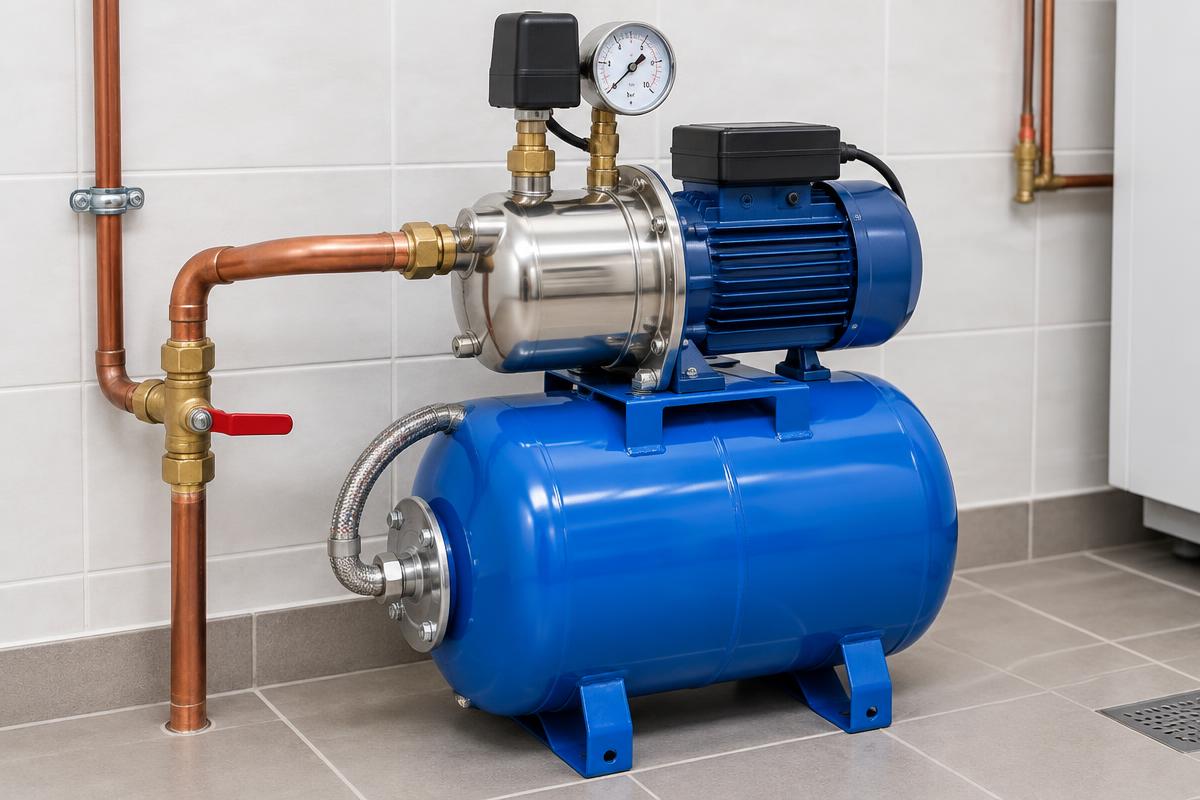
What are start pressure and stop pressure?
In a home booster system with a mechanical pressure switch and a diaphragm tank, the pump does not run continuously. When a tap is opened, the tank initially supplies water, and the pressure drops. Once it reaches the lower set limit, the pressure switch activates the pump. This is the start pressure. When consumption is restricted or stopped, the pump increases the pressure until it reaches the upper limit and stops. This is the stop pressure.
The difference between the two limits is called the pressure differential. For example, a start at 2 bar and a stop at 3.5 bar mean a differential of 1.5 bar. These values are purely for operational illustration, not a general recommendation for every residence. The correct selection depends on the pump, the tank, the height of the building, and the network's requirements.
An excessively small differential can cause frequent starts, especially with a small tank. A very large differential causes greater fluctuations at the taps. The goal is sufficient pressure with an acceptable variation and without continuous switching on and off of the motor.
Before adjustment: system check and safety
First, identify the control type. The process with two springs applies to certain mechanical pressure switches. An electronic flow controller, often known as a press control, may start at the defined pressure but stop when flow reaches zero, without an independent stop pressure setting. An inverter booster pump is usually adjusted via desired pressure and manufacturer parameters.
Inside the mechanical pressure switch, there may be exposed electrical contacts. Do not open the cover or touch the regulators while the power is on. Isolation and confirmation of the absence of voltage, as well as internal adjustments, must be performed by a qualified technician. Operational tests are performed only with the cover replaced. Before dismantling any hydraulic component, pressure must be released.
Before changing the limits, check:
- The accuracy and smooth indication of the pressure gauge.
- The permissible pressure limits of the pump, tank, piping, and appliances.
- The cleanliness of filters, the adequacy of water supply, and any leaks.
- The tightness of the check valve and the condition of the tank membrane.
- The factory instructions for the specific pressure switch and protection against dry running.
If the booster pump was working properly and suddenly changed behavior, first look for a fault. Increasing the pressure does not fix a clogged filter, lack of water, or a worn-out pump.
How to select the appropriate pressure limits
The start pressure must ensure acceptable flow at the most unfavorable consumption point, usually the highest or most distant tap. The elevation difference requires approximately 0.1 bar per meter of rise. Therefore, a tap 10 meters higher than the gauge has about 1 bar less static pressure, before accounting for losses in pipes, filters, and fittings.
The pressure required by the specific appliance or faucet to function correctly is added to the calculation. Losses increase with flow, so evaluation should be done while water is being consumed, not just with all taps closed. A reading on the booster pump does not by itself describe the pressure in the shower when multiple outlets are operating simultaneously.
The stop pressure must be achievable for the pump and lower than the permitted limits of all components. It should not be set at the pump's maximum theoretical pressure, as this might not be reached under actual conditions. In a booster pump with an already pressurized inlet, the inlet pressure must also be taken into account. The final choice is based on the operating curve and the manufacturer's instructions.
Adjusting the pressure switch and tank pre-charge
Proper adjustment is done gradually, by recording actual readings. There is no reliable general rule that one turn corresponds to a specific number of bars.
- Recording initial limits: with the cover closed and normal operation, open a tap and note the pressure at which the pump starts. Then stop consumption and record the stop pressure.
- Isolating power supply: before any access to the pressure switch, turn off the electrical supply and confirm safe isolation by the responsible technician.
- Identifying regulators: in many pressure switches, the large spring moves both limits together, while the small one changes the differential. This is not necessarily true for all models. Operation and direction of rotation are confirmed by the manufacturer's diagram.
- Small change and re-test: make a limited change to one regulator at a time, replace the cover, and test the start and stop again. Repeat a few cycles for confirmation.
At the same time, check the tank air pre-charge. With the pump electrically isolated, open a suitable discharge point until the pressure on the water side is zeroed and the tank is drained of water. The point remains open during the check. Only then measure the air pressure at the tank valve with a suitable gauge.
In many conventional systems, pre-charge is set approximately 0.2 bar lower than the start pressure, but the manufacturer's instruction always takes precedence. For a 2 bar start, 1.8 bar is therefore an indicative example, not a universal rule. In inverter systems, a different relationship may be required.
If water comes out of the air valve, it is a strong indication of membrane failure. Do not simply continue by adding air: check and potentially replace the membrane or tank.
Checking after adjustment and common problems
After adjustment, check the booster pump with low consumption, with more open outlets, and with all taps closed. The pump should start and stop steadily, provide sufficient water, and not lose pressure without consumption. The allowable number of starts is determined by the manufacturer of the motor or the assembly.
- Continuous starts: check pre-charge, membrane, tank capacity, differential, and potential leaks.
- Pump does not stop: possibly an excessively high stop limit, insufficient supply, leak, or reduced pump performance. Discontinue operation if it does not build pressure normally.
- Pressure drop with closed taps: look for a network leak or water backflow from a faulty check valve.
- Delayed or unstable start: requires checking the pressure switch, pressure sensing connection, and gauge.
Adjustment is not a substitute for maintenance or proper sizing. If corrections are constantly required, system diagnosis is needed, not just another pressure increase.
Frequently Asked Questions
How many bar should the home booster pump have?
There is no single correct value for all homes. Limits are chosen based on height, network losses, consumption requirements, and the equipment's permissible characteristics.
Can I increase only the stop pressure?
In some mechanical pressure switches, this is done via the differential, but confirmation from the manual is required. After every change, both limits should be checked because settings may interact.
Do I measure the tank air while the pump is running?
No. Pre-charge is checked with the power isolated, the tank drained, and zero pressure on the water side. Otherwise, the measurement does not represent the actual pre-charge.
Why does the booster pump start without me opening a tap?
Usually, there is a pressure loss due to a micro-leak, a running toilet, or a check valve that does not seal. First, locate the cause; changing the limits does not resolve the problem.