
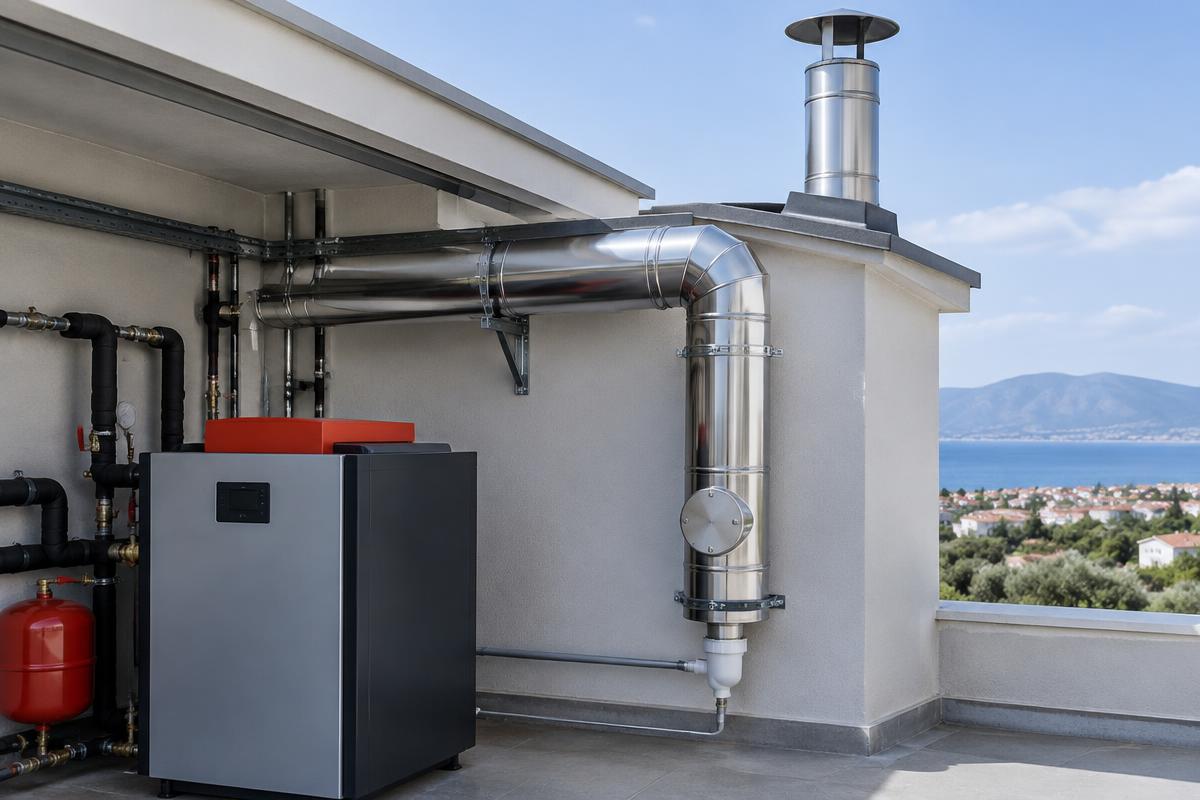
How chimney draft works
When we say a chimney has a "draw," we are describing its ability to remove flue gases from the combustion appliance and guide them to the outdoor environment. In natural draft systems, movement occurs primarily because hot flue gases have a lower density than the outside air. This difference, along with the effective height of the chimney, creates the available negative pressure.
For a steady flow to exist, the negative pressure must overcome the resistance of pipes, elbows, and the termination. At the same time, sufficient combustion air must be admitted. A chimney does not operate independently of the building: airtight frames, range hoods, and mechanical ventilation can decisively change pressure conditions.
These principles apply primarily to fireplaces, wood stoves, and other natural draft appliances. For condensing boilers, closed-chamber appliances, and installations with a flue gas fan, extraction is based on the manufacturer's specified system. Arbitrary solutions for a conventional chimney do not apply there.
The most common causes for poor chimney draw
Smoke backflow does not necessarily mean a taller chimney is needed. Often, problems with cross-section, air supply, and maintenance coexist. The main causes are:
- Deposits or blockages: soot, creosote, nests, dislodged materials, and clogged terminals restrict the effective cross-section and increase resistance.
- Improper cross-section: a too-small cross-section hinders the passage of flue gases. An excessively large cross-section can favor cooling and make it difficult to start the flow.
- Incorrect routing: many elbows, long nearly horizontal sections, and sudden changes in diameter create additional pressure losses.
- Cold or insufficiently insulated chimney: flue gases cool down quickly, especially in outdoor routes, reducing natural draft and favoring condensation.
- Insufficient combustion air: modern airtight frames may restrict the air that previously entered through gaps.
- Negative pressure in the room: range hoods and exhaust fans can compete with the chimney and cause reverse flow.
- Problematic termination: nearby buildings, roof geometry, or obstacles create wind pressure and turbulence around the outlet.
In wood stoves and fireplaces, wet wood also aggravates the situation: part of the heat is consumed in evaporating the water, combustion is degraded, and deposits increase. However, even properly dry firewood will not fix a clogged or poorly designed chimney.
Diagnosis: what the user observes and what the technician measures
The first step is safety. If smoke or flue gases are entering the room, do not continue use to "warm up the chimney." Stop operation if it can be done safely and do not restart the appliance before it is checked. For solid fuel fires, do not add fuel or improvise with extinguishment.
If a carbon monoxide detector is activated or if headache, dizziness, or nausea occur, move immediately to fresh air and seek emergency help. Carbon monoxide is odorless: the absence of smoke smell does not prove safe operation. Ventilation should not delay evacuation.
Without intentionally recreating the problem, the user can record when it occurred: at ignition, during strong wind, when opening the hearth door, or when the range hood was running. Useful information also includes recent frame changes, device replacement, or roof work.
The responsible technician checks the cleanliness, continuity, and tightness of the flue, the connections, the routing, and the termination. Where necessary, they use an inspection camera. They measure the draft and, depending on the device, analyze the flue gases and check for potential leakage into the room. Values are compared with the manufacturer's requirements, not with a general limit considered suitable for all installations.
How to properly correct flue gas flow
Intervention is chosen after diagnosis. A new cowl or a larger pipe is not an automatic solution and may shift the problem to another point.
- Cleaning and restoration: blockages and deposits are removed, inspection doors are checked, and worn connections are repaired with materials suitable for the specific system.
- Sizing and routing: diameter, effective height, lengths, and curves are checked based on the device and thermodynamic calculation where required. The flue gas outlet is not reduced arbitrarily.
- Proper insulation or lining: for a problematic existing flue, a certified internal duct or insulated system, compatible with temperature, fuel, pressure, and condensate, may be needed.
- Ensuring combustion air: appropriate supply is provided according to the device's instructions and installation requirements. A permanently half-open window is not a substitute for proper design.
- Correction of the termination: position and height are re-evaluated in relation to the roof, nearby obstacles, and current requirements. The terminal is chosen for the specific application.
If the problem is due to a range hood or mechanical ventilation, organized air makeup or appropriate operation interlocks may be required. A mechanical draft booster is used only when permitted and with specified safety provisions. For gas appliances, we do not change cowls, diameters, or paths outside approved configurations.
After every significant intervention, operation must be re-checked. The goal is not the maximum possible draft, but the correct one: excessive negative pressure can increase heat losses or affect combustion.
Maintenance and prevention before smoke appears
Inspection before the heating season helps identify blockages, corrosion, and wear. Cleaning frequency depends on fuel, operating hours, deposits, manufacturer's instructions, and applicable requirements. With intensive solid fuel use, more frequent interventions may be required.
Use only the prescribed fuel and do not burn waste, painted, or treated wood. Keep ventilation openings clear and install a suitable carbon monoxide detector according to its instructions. The detector is an additional protection, not a substitute for maintenance. Roof cleaning, tightness testing, and flue modifications are entrusted to appropriate professionals.
Frequently asked questions
Why does the chimney smoke only at the beginning?
At ignition, the duct may be cold and the natural draft weak. Possible causes are also room negative pressure and insufficient air supply. Repeated smoke entry needs checking, not improvised preheating with torches.
Will an anti-wind cowl solve the problem?
Only if a wind pressure problem has been identified and the terminal is suitable for the installation. It does not fix obstruction, incorrect cross-section, or lack of air. An unsuitable cowl can increase resistance.
If I open a window and the flow improves, what does it mean?
It is an indication of a possible air supply or negative pressure problem, not a definitive diagnosis. Report the observation to the technician without repeating tests with flue gas leakage. A permanent, properly designed solution is needed.
Can two devices be connected to the same chimney?
Not arbitrarily. A common flue is permitted only when provided for the specific devices and designed according to relevant requirements. Otherwise, there is a risk of interaction and flue gas backflow from one connection to another.