
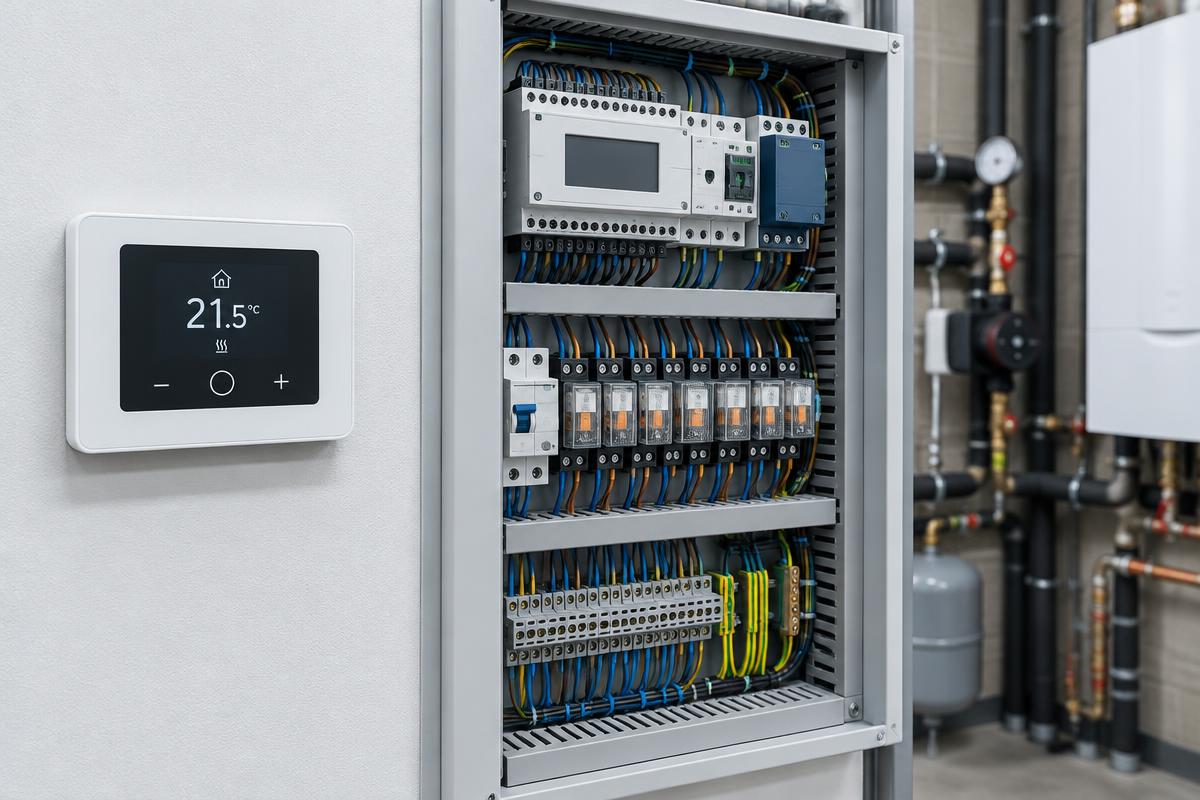
Why thermostat placement affects heating
A room thermostat measures the temperature at its specific location and, depending on settings and control type, sends a signal or adjusts heating demand. It does not automatically know what is happening in every room. If it is located in an unusually warm or cold spot, the system may operate based on a reading that does not represent the living area.
For example, a thermostat next to a radiator may shut off the heating before the rest of the house is warm. Conversely, one near a drafty exterior door might call for more heating than necessary. The result is reduced comfort, potential overheating of certain rooms, and wasteful system operation.
The goal, therefore, is not just an accurate reading, but a representative one. Even a high-quality digital or smart thermostat can control heating incorrectly when subjected to local thermal influences. Proper placement takes precedence over detailed settings and calibration.
The right room, wall, and installation height
In a system with a single central thermostat, choose a room that is used regularly and reflects the home's basic comfort needs. The living room is often suitable, provided it is not strongly affected by sunlight, a fireplace, or other heat sources. A hallway is not automatically the right choice: if it stays colder than the rooms or is subject to air drafts, it can create a false reading.
Prefer an interior wall where air circulates naturally. The device should not be covered by curtains, furniture, or decorations. An exterior wall with insufficient insulation can affect the sensor through its lower surface temperature, especially where thermal bridges exist.
As a practical starting point, many thermostats are placed approximately 1.2–1.5 meters above the finished floor. The exact height and required distances are specified by the manufacturer's instructions. If placed too low, the sensor may be affected by cooler air layers; if placed too high, by warmer air accumulating near the ceiling.
- Choose a spot that is easily accessible for operation and monitoring.
- Leave clear space around the device's ventilation slots.
- Check if there are hot pipes or chimneys running behind the wall.
- Do not choose a position simply because that is where the existing wiring ends.
Positions that distort temperature readings
The thermostat must avoid both direct heating and local cooling. It is not enough to check the room at one moment of the day: a spot that is shaded in the morning might receive intense solar radiation in the afternoon, especially in winter when the sun is lower.
- Next to or above radiators: hot air and radiant heat can locally increase the reading.
- Opposite a fireplace or stove: the additional heat can reduce demand while other rooms remain cold.
- Near windows and exterior doors: air infiltration and frequent opening cause fluctuations that do not represent the entire room.
- Directly in the flow of an air conditioner or fan coil: the sensor primarily measures supply air rather than room conditions.
- Near an oven, lighting, or electronic devices: emitted heat can affect the reading.
- Behind doors, curtains, or inside alcoves: restricted air circulation creates a different microclimate.
There is no single safety distance that covers every device and room. Follow installation instructions and evaluate the actual impact of heat sources or air drafts. In an open-plan living room and kitchen, for example, look for a spot away from the cooking area without isolating the thermostat in a closed corner.
What changes depending on the system and zones
In a home with a single heating zone, the thermostat room serves as the reference area. If it heats up much faster than the rest, moving the device might help, but it doesn't always address the root cause. It is necessary to examine hydraulic balancing, the adequacy of the radiators, and the heat losses of each space.
When thermostatic radiator valves (TRVs) are present, coordination with the central thermostat is required. In a typical installation, the radiator in the reference room should not be prematurely limited by an independent valve, leaving the thermostat calling for heat constantly. The appropriate setting depends on the system design and the equipment's minimum flow requirements.
With underfloor heating, high thermal inertia means changes appear slowly. Avoid constant setting adjustments and evaluate the position under representative operating conditions. A floor sensor, where provided, serves a different purpose than the air sensor and is installed according to system instructions.
In a heat pump with weather compensation, the room sensor can act as a supplement, influencing the heating curve or demand. It is not always correct to treat it as a simple on/off switch. In a multi-zone installation, each sensor must be located in the room it controls, not in a common hallway with different thermal behavior.
Practical check before and after installation
A wireless thermostat makes it easier to test different positions, but it needs a stable usage point. Do not move it from room to room, and do not leave it on a TV, sunny shelf, or table next to a radiator. Also, check communication with the receiver, as metal obstacles and structural elements can reduce range.
Before permanent mounting, where possible, test the position for a few days under different sunlight and usage conditions. Compare the reading with a reliable thermometer, placed nearby and at the same height, allowing time for both to stabilize. A comparison immediately after moving is not a reliable conclusion.
If the deviation remains constant, check if a display offset correction is provided by the manufacturer. Do not use this feature to cover effects that change throughout the day, such as sun or drafts. In a wired installation, relocation and connection must be performed by a qualified professional: there are different voltages and types of contacts or communication buses. Also, check for air leakage from cable conduits without blocking the device's ventilation slots.
Frequently Asked Questions
Should I put the thermostat in the coldest room?
Not necessarily. This may cause other rooms to overheat. Prefer a representative room and investigate why one area remains cold. It may require balancing or an independent zone.
Can the thermostat be placed near a door?
Only if it is not affected by drafts, frequent air movement, or the door itself when it opens. The area next to an entry door is usually not suitable.
Why does the room thermometer show a different temperature?
Possible causes include different height, position, accuracy, and sensor response time. Compare devices near each other after they have stabilized before assuming there is a fault.
Does a smart thermostat fix a bad position?
Not on its own. Automations do not neutralize sun or air drafts. If a remote sensor is supported, it can help, provided it is placed correctly and selected as the measurement source.