
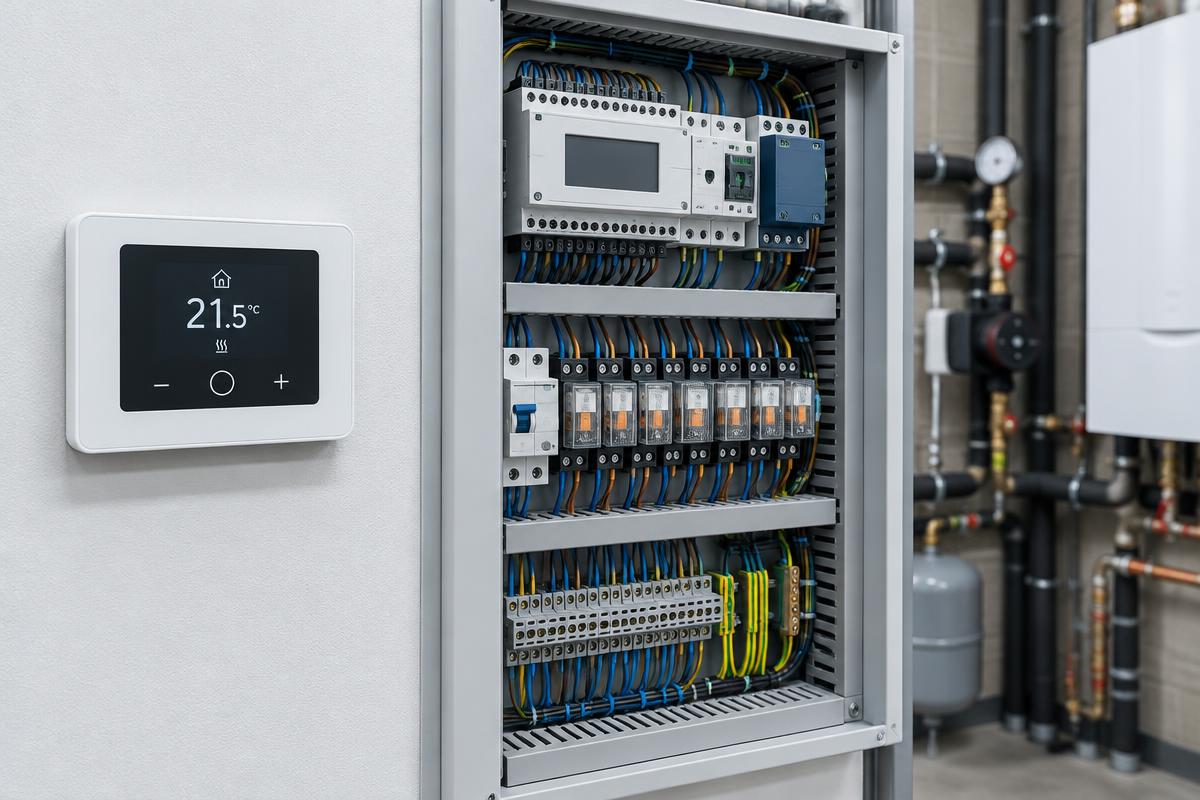
Heat pump thermostat: Settings and proper application
The correct setting of the "Heat pump thermostat" aims to manage the heating demand toward the heat pump in a way that avoids unnecessary start-stop cycles, overheating, or large temperature deviations.
Signals and parameters
Before changing any parameter, the supply setpoint, minimum run time, room temperature, and compensation curve are recorded. We change one setting at a time so it is clear which change affected the result.
Field operation check
After the adjustment, cycles per hour, compressor demand, supply temperature, and modulation are monitored. Evaluation must be performed after the system has had time to stabilize.
Indications requiring investigation
Errors such as an excessively small hysteresis, incorrect curve, wrong thermostat position, or frequent cycling often look like an incorrect setpoint but require a different approach.
Points worth recording
- Supply setpoint.
- Cycles per hour.
- Compressor demand.
- Excessively small hysteresis.
Practical observation
In a heat pump, steady operation with a lower water temperature is usually preferred over frequent on/off cycles. Comparing with previous measurements helps distinguish between a real technical problem and a normal variation due to weather or demand.
Safety
Changes to the controller, BMS, PID, or weather compensation settings must be documented before application so that a safe reset can be performed.
Conclusion
For the "Heat pump thermostat," correct operation results from reliable measurement, appropriate settings, correct command, and verification of the actual outcome. Diagnosis must pinpoint the stage where this chain is interrupted.