
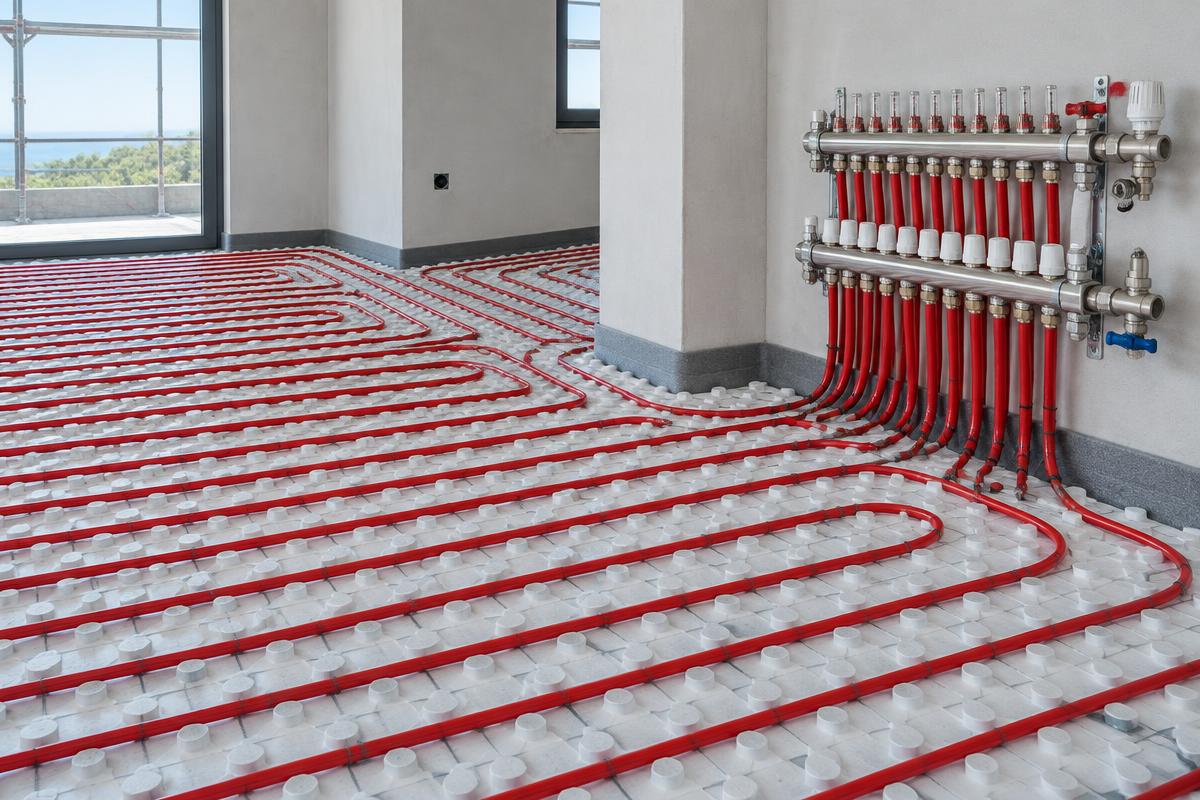
Underfloor heating: collaboration with a heat pump
Low-temperature operation requires proper balancing even more so than high water temperatures. This topic concerns the integration of underfloor heating with a heat pump at low water temperatures.
This article emphasizes the points of collaboration, pump, and heat, so that the inspection is linked to the actual subject of the title.
What to check first
- Minimum heat pump flow rate.
- Compensation curve (weather compensation).
- Flow rate.
- ΔT.
Sudden changes in flow meters are often linked to air, dirt, or differential pressure fluctuations.
Possible causes or mistakes
- Excessively high setpoint.
- Low flow rate.
- Frequent cycling.
- Too many closed zones.
Useful measurements
For this specific subject, supply °C, return °C, l/min, and COP/SCOP (where available) are helpful. Values are compared per loop and against the thermal load of the specific room.
Practical application
In rooms with wooden flooring, the permissible temperature and the thermal resistance of the material are taken into account. Underfloor heating is particularly well-suited to a heat pump when maintaining low water temperatures and constant flow.
Safety
Before intervening on a manifold, circulator, or piping, safe isolation, temperature verification, and pressure relief are performed as required. Electrical measurements on thermostats, actuators, and controllers must be performed by a qualified technician. Do not bypass safety protections.
Conclusion
Regarding "Underfloor heating: collaboration with a heat pump," the correct technical decision is based on the relationship between collaboration, pump, and heat, rather than a single reading.