
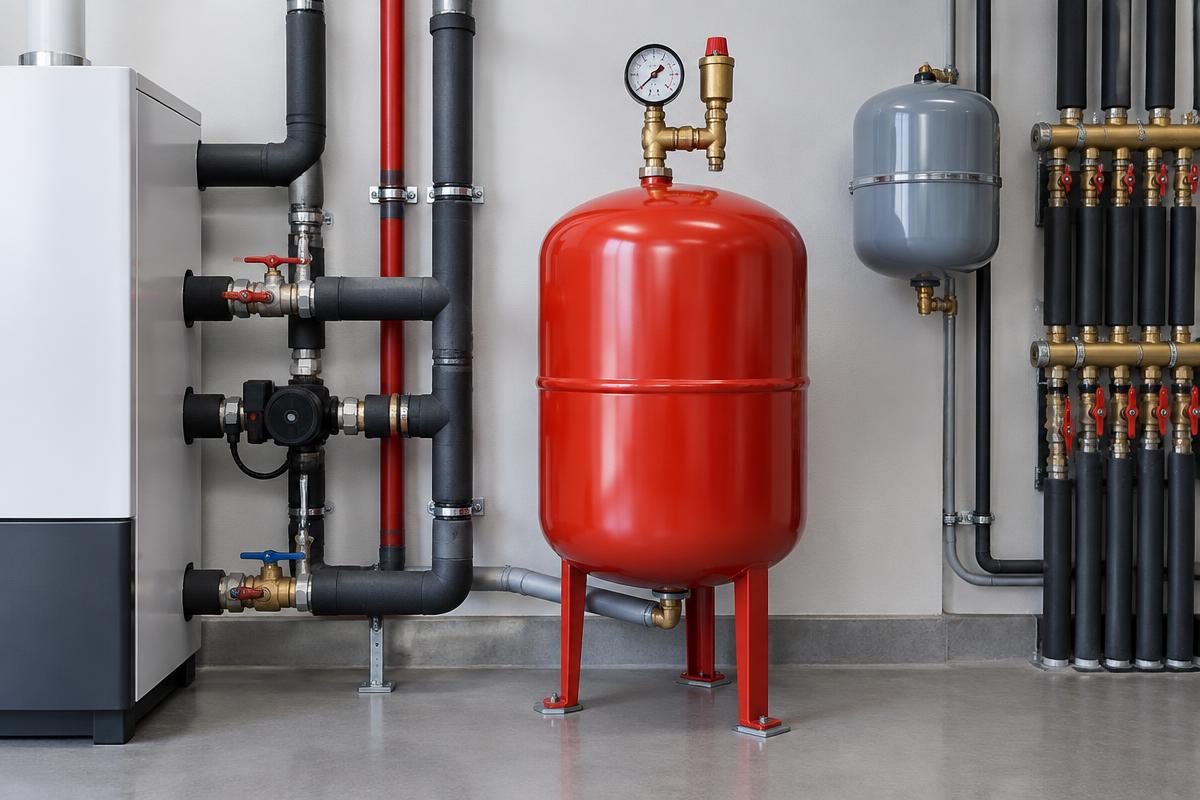
Heat pump expansion vessel: Common faults and diagnosis
In the diagnosis of the "Heat pump expansion vessel," we examine pressure stabilization and expansion absorption in a heat pump circuit. System pressure usually provides the first indication of whether the vessel is functioning correctly.
How to evaluate correctly
We start with operating temperatures and total water volume. Next, we check the buffer (if present) and the static height to determine if the problem is a matter of settings, sizing, or a genuine fault.
Measurements and observations
Cold pressure, pressure in heating mode, ΔP during defrost, and pre-charge are recorded. Comparing the pressure before and after heating is of particular value.
Common mistakes
Common causes include an undersized vessel, incorrect pre-charge, air locks, and frequent pressure variations. In a heat pump, the additional volume of a buffer or hydraulic separator is also taken into account.
Measurement and recording points
- Cold pressure.
- Pressure in heating mode.
- Δp during defrost.
- Pre-charge.
Practical observation
In a heat pump, the additional volume of a buffer or hydraulic separator is also considered. For a correct assessment, we note the system temperature at the time of measurement, as pressure fluctuates along with temperature.
Safety
Before checking or disconnecting an expansion vessel, the hydraulic circuit must be isolated and safely depressurized, confirming that there is no dangerous pressure or temperature. The work should be performed by a suitably qualified technician.
Conclusion
For the "Heat pump expansion vessel," proper operation is verified by correct pre-charge, an appropriate vessel volume, and controlled pressure variation between cold and hot states.