What it means when tap water is rust-colored
When tap water turns yellow, orange, or brown, it usually carries particles or compounds coming from the water supply network. A common cause is iron corrosion products, although the color alone does not prove that your home's pipes are rusted. Similar results can be caused by manganese compounds, accumulated sediments, or work being done on the public utility network.
Rust forms on ferrous metal elements. In old galvanized steel pipes, the protective zinc coating gradually wears off, and the steel can corrode. Corrosion products accumulate on the inner walls and detach when flow or pressure changes. This is how cloudy water appears, often accompanied by brown grains in the faucet filter.
Plastic pipes do not rust, but they can carry rust from upstream metal sections. Similarly, copper pipes do not produce the characteristic iron rust, although they can exhibit other forms of corrosion. Therefore, even a relatively new installation can show brown water due to shared risers, metal fittings, or a supply issue.
How to distinguish a network problem from internal piping issues
The most useful initial observation is where and when the discoloration occurs. Check the cold and hot water separately at more than one faucet. Use a clear, transparent container against a white surface to distinguish the color and any particles. Do not taste the water to evaluate its quality.
- In all faucets, only in the cold water, or in both: the central supply, the communal installation, and the public network should be examined.
- Only in the hot water: suspicion turns to the water heater, the hot water tank, the connections, or the hot water pipes.
- Only in one faucet: a local cause is more likely, such as the supply branch, a flexible hose, or accumulated particles in the aerator filter.
- After many hours of non-use: stagnation can highlight corrosion within the installation, especially if the water initially clears up and the phenomenon repeats daily.
- After an outage or construction work: the resumption of flow may dislodge old sediments from the network.
Ask if the same is observed in neighboring apartments or buildings. If the entire area is affected, contact the water supply authority first. If the problem is limited to your apartment building, you need to check the communal supply, the risers, and any storage tank. These indicators guide the investigation but do not constitute a definitive diagnosis.
When the pipes are at fault and what the plumber checks
The recurring appearance of rust without a corresponding problem in the neighborhood is a strong indication that the internal installation needs to be examined. This suspicion is reinforced when there are old galvanized pipes, small leaks, frequent clogs in faucet filters, or a noticeable reduction in flow. Internal deposits can restrict the available pipe diameter, so the flow weakens even if the supply pressure remains sufficient.
The plumber checks the materials, the condition of accessible pipes, joints, and the supply route. Where technically feasible, they compare the appearance of the water at the building's inlet with that at the final discharge points. Pressure and flow measurements help identify restrictions, but they do not indicate whether the water is safe to drink.
When the discoloration only affects hot water, the storage tank, any internal corrosion, and the condition of its protection (such as the anode where applicable) are also checked. Maintenance should follow the manufacturer's instructions. Opening, draining, or interfering with a water heater is not a safe test for the user due to the risk of burns, electric shock, and high-pressure water discharge.
There is no specific age after which every network mandatorily requires replacement. Factors such as material, water quality, operating conditions, and inspection findings are what matter. Persistent corrosion in multiple places usually requires a comprehensive assessment rather than sequential local patches.
What to do immediately when brown water appears
Until the cause is clarified, do not use noticeably discolored water for drinking, cooking, making ice, or baby formula. Prefer water of known suitability and follow any announcements from the water supply authority. Color is not enough to assess health risks, and boiling does not remove metals or rust.
- Record when the problem started, which faucets are affected, and whether it concerns cold or hot water.
- Check for a recent water outage, construction work, or information from the provider.
- Avoid using washing machines and dishwashers as long as there is visible discoloration, as stains or particle accumulation may occur.
- If there is no instruction to the contrary and it is a transient incident after work, let one cold-water faucet run for a while, monitoring if it clears up.
- If there is no improvement, do not waste water by letting it run unnecessarily. Contact the water utility or a plumber, depending on the scale of the problem.
Once the supply has stabilized, accessible faucet outlet filters can be cleaned according to their instructions. If laboratory testing is needed, request sampling instructions first: flushing before taking a sample can affect the result. Persistent color, unusual odor, or recurring incidents need investigation, even if the water appears clear in between.
Filter, cleaning, or network replacement?
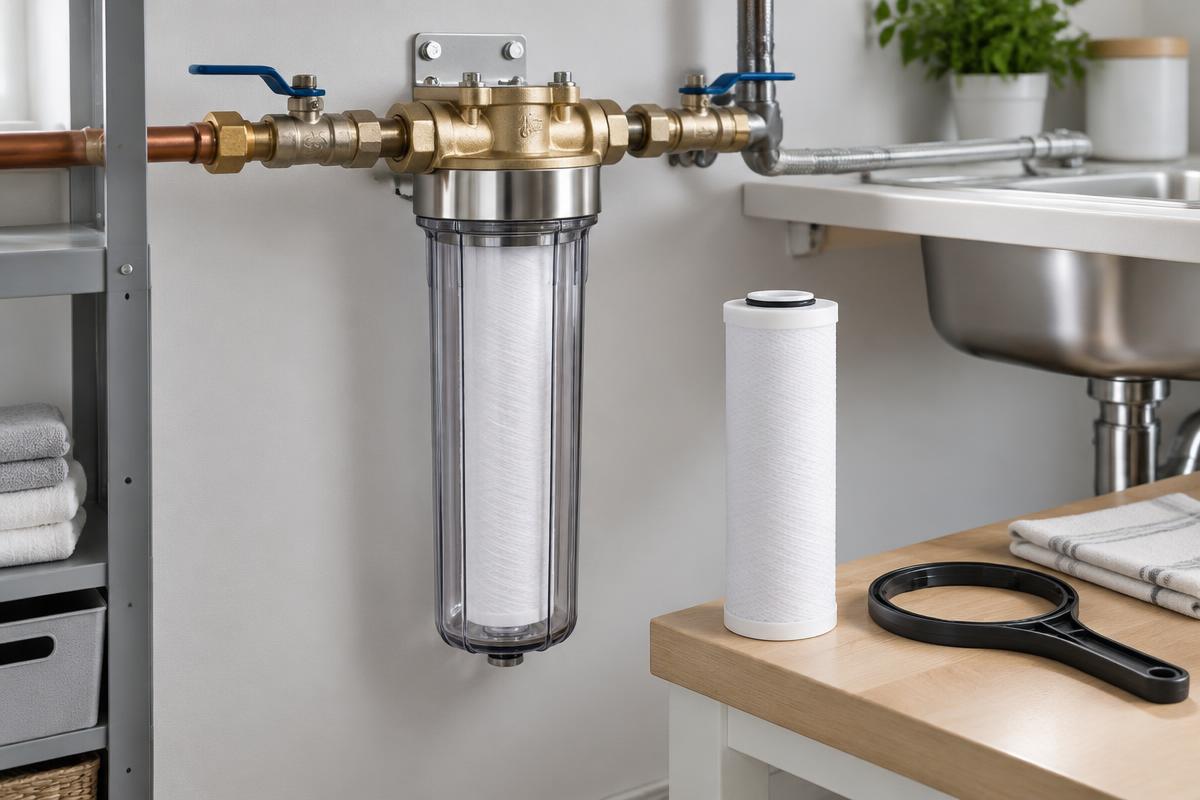
The correct solution depends on the source. A suitably chosen particle filter can retain suspended solids, but it does not repair corroded pipes and does not necessarily remove dissolved iron or other substances. Nor is a simple activated carbon filter a general solution for every case of rust. The choice of treatment must be based on water quality, supply requirements, and the feasibility of regular maintenance.
If the cause is local, replacing a worn fitting or branch may be sufficient. If there is extensive internal corrosion, replacing pipes with materials suitable for drinking water should be considered. Aggressive cleaning of an old network should not be performed without technical assessment, as it may reveal weak points and leaks.
After restoration, the required leak tests, flushing, and, where necessary, disinfection or water analysis are required. The goal is not just to make the color disappear temporarily, but to remove the cause and confirm the correct operation of the installation.
Frequently Asked Questions
If the water clears up after a few seconds, is it safe?
Clarity does not certify suitability. If the phenomenon repeats after stagnation, the installation needs to be checked and, depending on the findings, a laboratory analysis may be required.
Why does rust only come out of the hot water?
Possible sources are the hot water tank, metal connections, or hot water pipes. This does not automatically mean a new water heater is needed; a technical inspection comes first.
Can rust appear in new plastic pipes?
Yes, because the particles may come from the public network, old communal risers, or metal fittings. Plastic pipes themselves do not rust.
When is a water analysis needed?
When discoloration persists, returns without a clear cause, or if there is a suspicion of contamination. The water utility or an accredited laboratory can provide guidance on the appropriate parameters and proper sampling.