What is condensate and why is it valuable?
In industrial facilities, steam transfers heat to exchangers, tank jackets, dryers, and other production equipment. When it gives up its latent heat, it turns back into water: condensate. Although it has completed its primary mission, it still contains significant sensible heat. If discharged, the facility loses both this energy and water that has already undergone treatment.
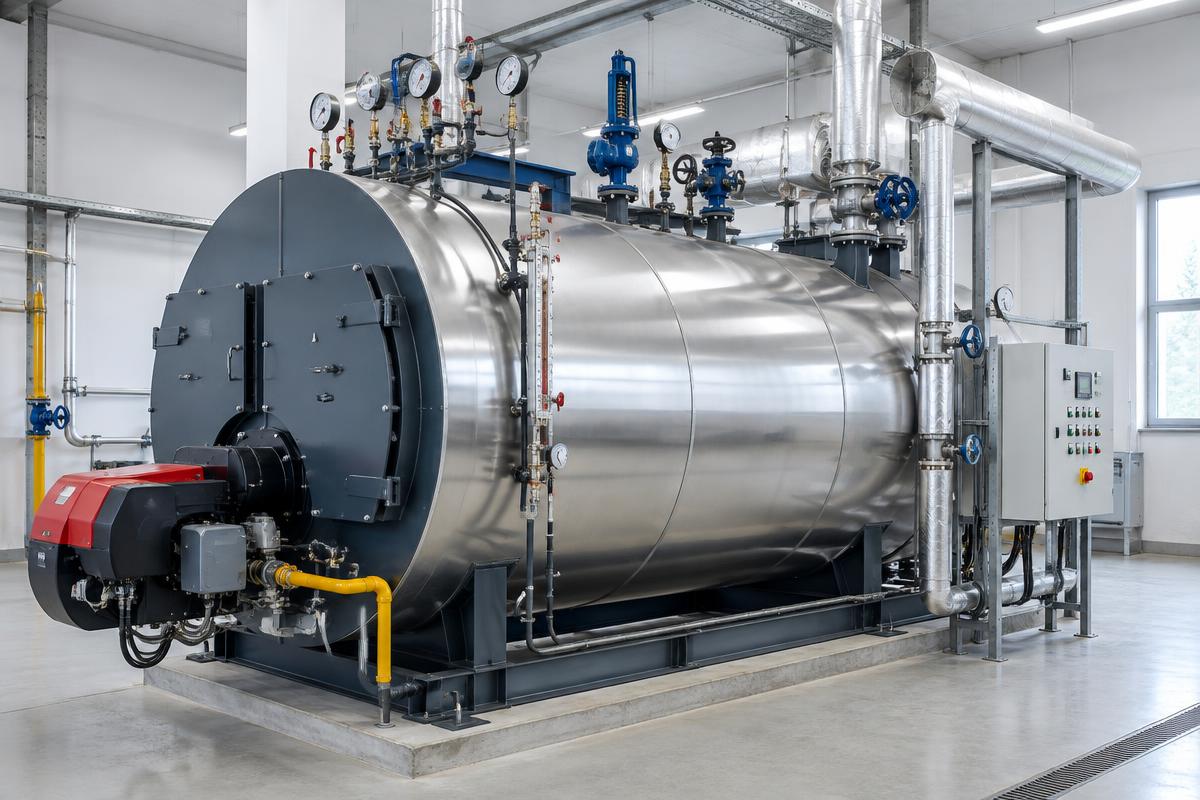
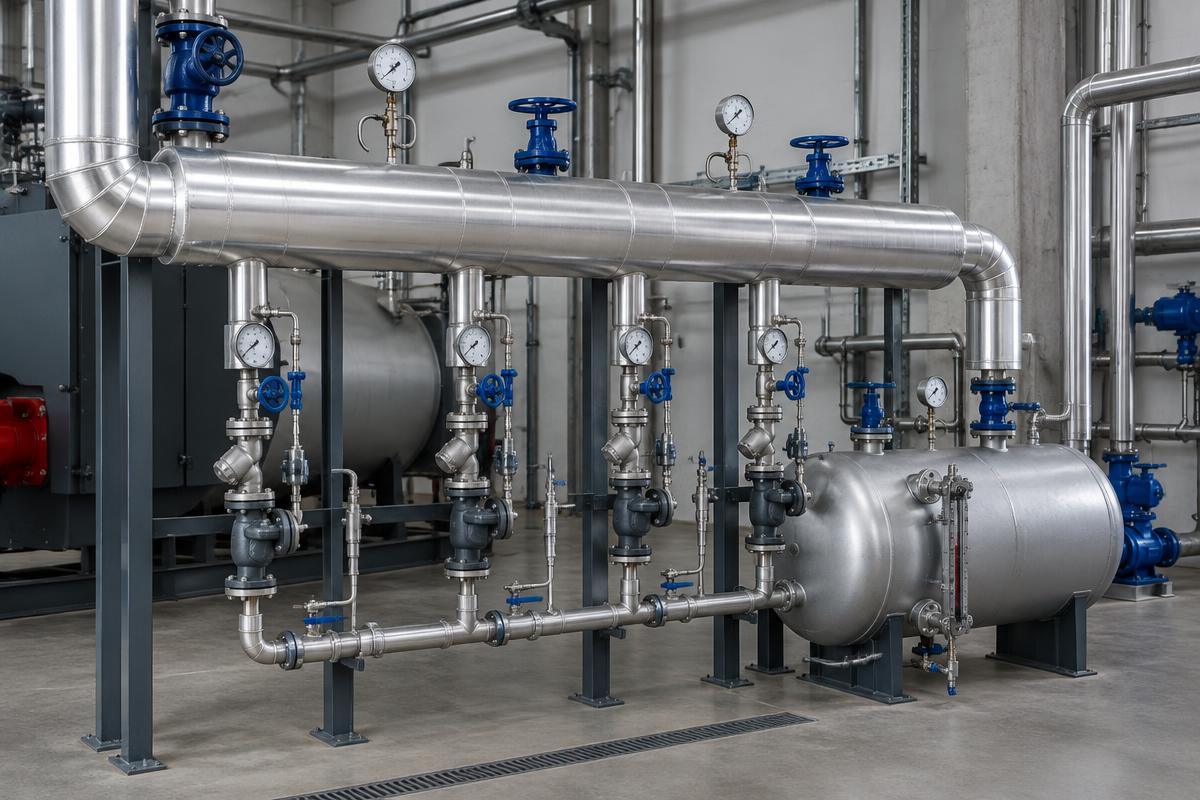
Returning condensate to the boiler does not usually mean a direct connection from the return line to the boiler body. The condensate is led to an appropriate collection tank, feed tank, or deaerator and, through the feed system, is reintroduced into the steam production cycle. The exact configuration depends on pressures, temperatures, elevation differences, and water quality requirements.
The goal is to return as much suitable and clean condensate as possible. This does not include water contaminated by the process, nor steam consumed through direct injection into the product. Recovery requires technical design, not just connecting all drains to a common pipe.
The key benefits for energy, water, and treatment
The first benefit is the reduction in energy required for steam production. Hot condensate replaces part of the cooler makeup water, increasing the feed temperature. Thus, the boiler requires less additional heat for the same steam output. The actual savings depend on the return flow rate, its temperature, network losses, and boiler efficiency.
For instance, one ton of water at 80°C, instead of makeup water at 20°C, carries approximately 70 kWh of additional thermal energy. The calculation is based on the relationship Q = m × c × ΔT and relates only to the difference in sensible heat. It is not guaranteed fuel savings: for that, the facility's efficiency and the actual energy balance are also required.
At the same time, the consumption of makeup water and the load on softening or other treatment processes are reduced. Clean condensate usually has a low content of dissolved solids, so its return can limit the introduction of salts into the boiler and the required blowdown. Blowdown, i.e., the controlled removal of boiler water, is still adjusted based on measurements and operating limits.
Reduced need for makeup water can also limit chemical consumption and the volume of hot discharges. However, condensate return does not eliminate the need for deaeration, chemical treatment, or quality checks. Condensate can pick up oxygen, carbon dioxide, and corrosion products along its path.
How to design a proper condensate return system
Operation starts at the steam traps. These must remove condensate and, depending on their type, non-condensable gases, while limiting live steam leakage. Their selection is based on the condensate load, available differential pressure, start-up conditions, and type of application. A steam trap is not selected correctly based solely on connection diameter.
After the steam trap, the pressure drop can cause partial re-evaporation of the hot condensate. The generated steam is called flash steam. Therefore, the return line often carries two-phase flow and should not be sized like a simple water pipe. Where there is a suitable demand for lower pressure, the flash steam can be separated and utilized.
For reliable collection and transport, the following are required:
- Proper slopes, supports, and provisions for thermal pipe expansion.
- Control of backpressure from the return line, elevation differences, and the receiving tank.
- A suitable collection tank and safe management of venting or pressure, depending on the arrangement.
- Pumps selected for the fluid temperature and available Net Positive Suction Head (NPSH) to avoid cavitation.
- Thermal insulation, sampling points, monitoring instruments, and access for maintenance.
Particular attention is needed for exchangers with steam flow control. At partial load, the internal pressure may drop so much that it is insufficient for drainage to the return. This phenomenon, known as stall, causes condensate accumulation and unstable heating. It may require a condensate pump or a combination of a pump and a steam trap, not just a larger steam trap.
When return becomes dangerous or unprofitable
The most important reason to exclude a return is contamination. A leak in an exchanger can carry oil, chemicals, or product into the condensate. If these reach the boiler, they may cause foaming, deposits, corrosion, or carryover of water with the steam. Suspicious returns require separate evaluation and the ability to safely divert them.
Conductivity is a useful indicator, but it does not detect every pollutant. Depending on the process, checks for pH, hardness, turbidity, organic load, or the presence of oils may be required. Sensors, alarm limits, and the isolation procedure must correspond to the specific risk. The fact that the condensate looks clear does not prove its suitability.
Equally critical is the avoidance of water hammer. Pockets of condensate, poor drainage, and sudden steam condensation can create powerful impacts. Noise, vibrations, and recurring leaks are not considered normal features of the network. They require investigation by a qualified technician and safe isolation before any intervention.
Performance monitoring and a practical maintenance program
The assessment begins with recording steam consumers and a water balance. Measure steam production, the returned quantity, makeup water, and discharges. The return percentage is meaningful only when its basis is clarified: total production or the amount that can actually be recovered. Direct injection processes have different recovery potential than closed exchangers.
A practical program includes checking steam traps with appropriate methods, monitoring temperatures and pressures, inspecting insulation, and checking pumps, filters, and check valves. Temperature alone is not always enough to diagnose a steam trap failure. Measurements must be evaluated together with the load and operating conditions.
Before an upgrade, compare the cost of piping, pumps, and controls with the recovered heat and the reduction in water and treatment consumption. Include maintenance and electrical consumption in the calculations. The best solution is not necessarily the highest return, but the greatest safe and economically justified recovery.
Frequently asked questions
Can all condensate be returned to the boiler?
No. Only what meets the system's quality requirements is returned. Condensate with potential contamination needs checking, separation, and possibly disposal or special treatment.
Why does steam appear in the condensate tank?
It could be flash steam due to a pressure drop. However, it could also be due to live steam leakage from a faulty steam trap. Distinguishing the two requires testing, not just visual observation.
Is a condensate return pump always needed?
No. When available pressure or gravity is sufficient, drainage can occur without a pump. The choice is determined by pressures, elevations, and load fluctuations.
Does condensate return replace water treatment?
No. It reduces the treatment load, but it does not eliminate dissolved gases, corrosion products, or potential impurities. Checks and treatment continue according to boiler requirements.