Why does the heat pump outdoor unit freeze?
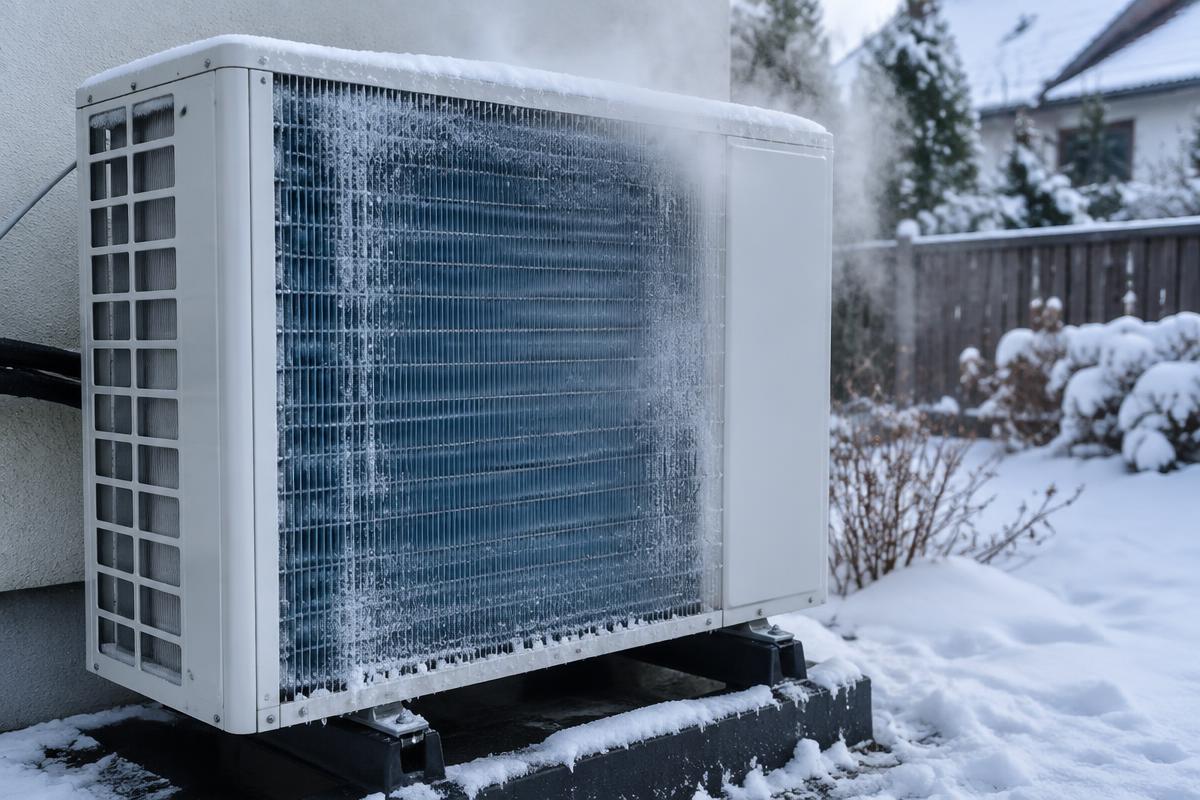
The appearance of frost on the outdoor unit is common during the winter operation of an air-to-water or air-to-air heat pump. It is not an indication of a malfunction by itself. The critical factor is whether the unit automatically removes the ice and smoothly returns to heating mode without the coil remaining clogged.
In heating mode, the outdoor exchanger absorbs heat from the air. For this to happen, its surface temperature must be lower than the ambient temperature. When the surface drops below freezing, atmospheric moisture can form frost on the metal fins.
Therefore, the outdoor unit can freeze even when the thermometer shows a positive temperature. High relative humidity, fog, and cold, damp weather favor this phenomenon. Conversely, in cold but dry environments, less ice may form, even if the outdoor temperature is lower.
Frost gradually restricts airflow and heat transfer. This is why the pump needs an automatic defrost cycle: a controlled process that cleans the exchanger so that operation can continue efficiently.
How does automatic defrosting work?
In most modern heat pumps, defrosting is achieved by temporarily reversing the refrigerant cycle. The outdoor exchanger is heated, and the accumulated ice melts. The automation determines when to start and finish the process, using sensors and criteria that vary by manufacturer and model.
During defrosting, the outdoor fan usually stops. You may hear a change in operating noise, see a white steam-like cloud, and notice water running under the unit. These signs are generally normal as long as heating restarts normally afterward. The white cloud should not be confused with smoke accompanied by a burning smell.
In an air-to-water pump, part of the required energy may be drawn from the system's water. Thus, a temporary drop in supply temperature may be observed. Depending on the design and settings, an auxiliary electric heater may also be involved. In air-to-air systems, the supply of warm air to the space is usually interrupted temporarily.
Defrosting usually lasts a few minutes, but there is no fixed time that applies to all installations. The duration is affected by conditions, the amount of ice, and the control logic. For specific limits, the device manual is the reference point.
When is ice and defrosting normal?
A normal scenario is a layer of frost developing on the exchanger during heating and being removed by defrosting. After the cycle, airflow should be restored, and the unit should continue to meet the building's needs, taking into account external conditions and its available capacity.
There is no universally accepted number of defrost cycles per hour. In damp weather near freezing, cycles may be more frequent than at lower temperatures with dry air. Frequency alone, without information about the weather and the unit's behavior, is not enough to diagnose a fault.
- Temporary fan stoppage may be part of the defrosting process.
- Water at the base is expected as long as it drains correctly.
- A brief change in water temperature does not necessarily indicate a problem.
- Returning to heating without persistent errors is a key indicator of smooth operation.
Defrosting consumes time and energy, therefore affecting average efficiency. However, it is necessary: operating with an exchanger covered in ice would further limit efficiency and thermal output.
Which signs indicate that a technical check is needed?
An inspection is necessary when solid ice remains after successive defrost cycles, when the unit does not return to heating normally, or when recurring error codes appear. Care should also be taken if ice accumulates at the base and approaches the fan, as it may block its rotation or cause mechanical damage.
Possible causes include a dirty exchanger, airflow obstructions, recirculation of cold exhaust air, or inadequate drainage. Water dripping from a roof or gutter onto the unit may also freeze, creating a problem distinct from normal operational frost.
In air-to-water installations, insufficient water flow or a lower available water volume than required by the manufacturer may hinder defrosting. The technician checks, where necessary, filters, the circulator, valves, sensors, and hydraulic configuration. A buffer tank is not mandatory in every installation, but ensuring the required operating conditions is essential.
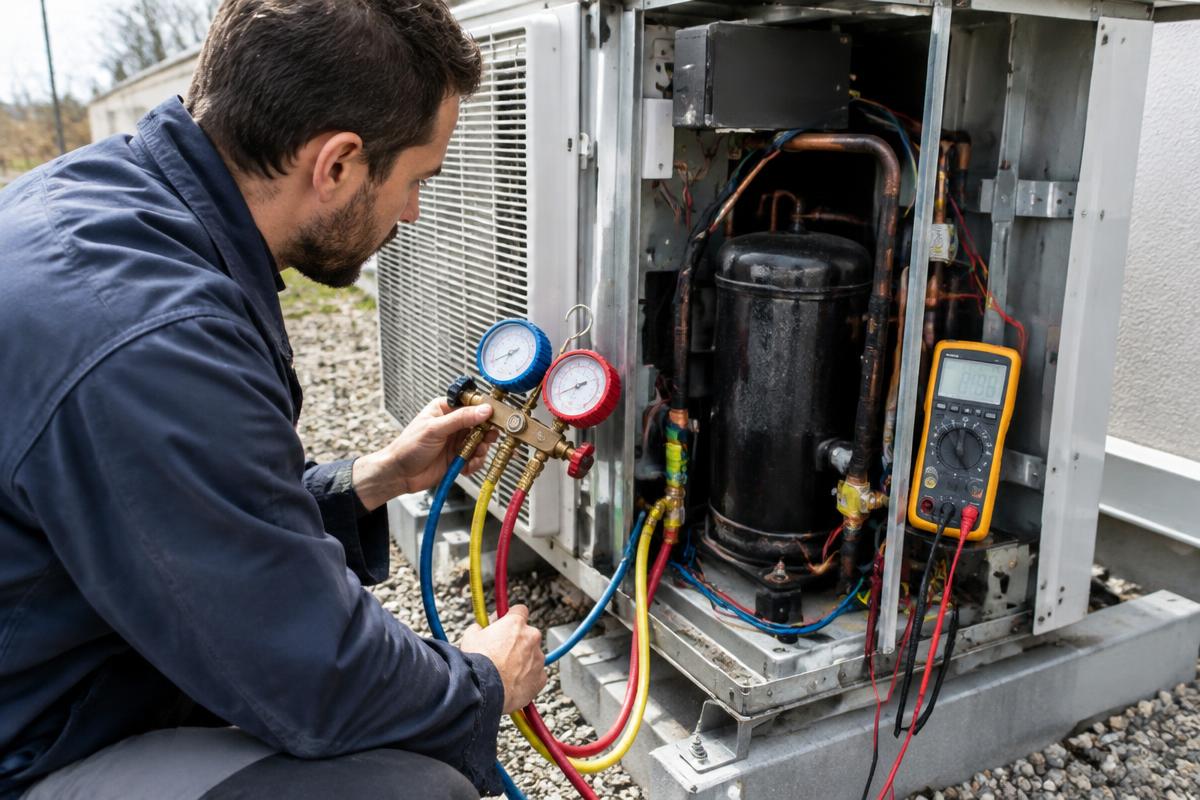
A potential problem in the refrigerant circuit is not confirmed only by the sight of ice. Measurements by a qualified refrigeration technician are required. If the fan hits the ice, there is intense mechanical noise, or there is a burning smell, do not persist with restarts; stop operation according to safety instructions and call a technician.
What can you do for proper defrosting and prevention?
Keep the area around the outdoor unit clear, according to the manufacturer's distances. Remove leaves and objects that block air intake or exhaust without opening covers or touching moving parts. Do not cover the unit to protect it from the cold: obstructing airflow worsens performance.
Visually check that defrost water is draining away and not creating an icy pool under the device or on a pathway. In areas with frequent frost, drainage requires proper design. Any base heater or other anti-freeze solution must be approved for the specific unit and installed by a technician.
Do not remove ice with sharp tools, impacts, hot water, or a flame. There is a risk of injury and damage to the fins, piping, or electrical parts. Also, do not change defrost parameters from the installer menu without technical guidance.
Avoid systematically cutting off electrical power as a way to deal with frost. Particularly in monobloc pumps with water in the outdoor section, anti-freeze protection requires specific measures and may depend on power supply and water circulation. Regular maintenance and recording weather, cycle duration, and error codes significantly help with diagnosis.
Frequently Asked Questions
Can the unit freeze with an outdoor temperature above freezing?
Yes. The surface of the outdoor exchanger can be below freezing even if the air is warmer. With enough humidity, frost forms and is removed via automatic defrosting.
Why does a white cloud come out of the heat pump?
During defrosting, a visible cloud of moisture may appear as the wet exchanger heats up. It is usually normal. However, if there is a burning smell or another indication of an electrical problem, an immediate check is required.
Do I need to manually activate defrosting?
Normally no. The process is controlled automatically. If the ice is not being removed, do not attempt forced defrosting from technical menus; record the indications and contact the maintenance technician.
Does frequent defrosting mean the pump is too small for the house?
Not necessarily. The frequency strongly depends on humidity, temperature, and unit ventilation. Sizing is evaluated based on heat losses and actual available capacity under operating conditions, not just by the defrost cycles.